

Description
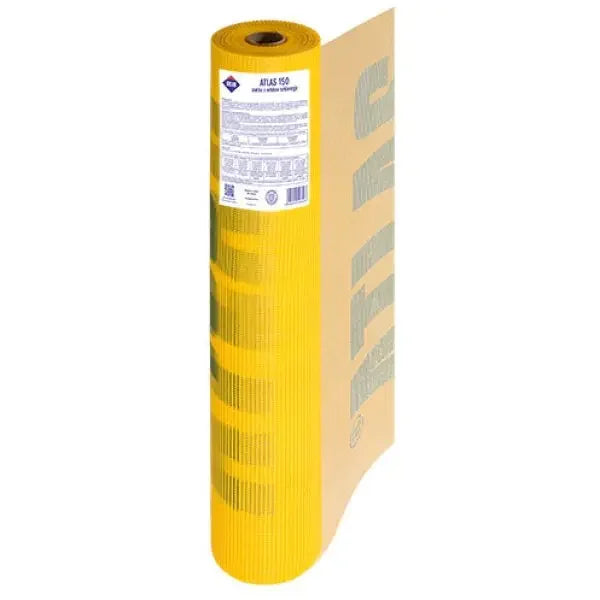
Embedded mid-thickness in the basecoat of an external wall insulation build-up, Atlas Fibreglass Reinforcing Mesh 150 g/m² is the standard-weight reinforcement layer that distributes thermal stress across the facade and stops cracks telegraphing from board joints. Supplied on a 1.0 m × 50 m roll for a 50 m² nominal coverage, it is the reinforcement weight named on most UK EWI system documents, and the roll a contractor opens first on nearly every job.
What Atlas 150 g/m² Mesh Does in a UK EWI System
Atlas 150 g/m² mesh is a woven, alkali-resistant reinforcing fabric embedded in the outer third of the basecoat over EPS, graphite EPS or mineral wool, where it distributes tensile stress and resists crack telegraphing through ETAG 004 EWI build-ups. It ships on a 1.0 m × 50 m roll for 50 m² nominal coverage. Supplied through the Renders World fibreglass mesh range, it is the reinforcement weight most UK and European system documents name by default.
Pressed into the wet basecoat above the insulation board, the mesh absorbs the expansion and contraction that would otherwise crack a rigid render surface. The 150 g/m² weight balances coverage area, embedment ease and tensile strength, which is why it carries the general-facade reinforcement role on the vast majority of standard thin-coat systems. Get the weave bedded flat and the second basecoat pass floats over it clean, so the finish reads as texture rather than pattern.
Why Trade Specifiers Choose Atlas 150 g/m² Mesh
- Specified reinforcement weight for UK EWI work: 150 g/m² is the weight named across most UK and European EWI system documents, suiting EPS, graphite EPS and mineral wool under thin-coat finishes.
- Alkali-resistant acrylic coating: the protective treatment lets the mesh survive prolonged contact with cementitious and polymer-modified basecoats, holding tensile strength through the system service life.
- Crack-distribution performance: the woven warp-and-weft structure spreads thermal and mechanical stress laterally, so cracks are far less likely to telegraph from board joints to the finished face.
- Practical 50 m² roll format: the 1.0 m × 50 m roll gives a manageable handling weight on the scaffold and reduces vertical jointing on full-height reinforcement, so your programme keeps its rhythm across a full elevation.
- ETA-system component: approved within European Technical Approval EWI systems, supporting full system warranties when installed inside the specified build-up.
Technical Specifications — Atlas 150 g/m² Mesh Data Sheet Highlights
| Property | Value |
|---|---|
| Material | Woven fibreglass, alkali-resistant acrylic coating |
| Manufacturer | Atlas (Poland) |
| Mesh weight | 150 g/m² (tolerance −3 / +10%) |
| Roll width | 1.0 m |
| Roll length | 50 m running metres |
| Roll coverage | 50 m² nominal |
| Weave | Open gauze, warp and weft |
| Alkali resistance | Suitable for embedment in cementitious basecoats |
| Certification | ETA-system component, subject to system specification |
How to Embed Atlas 150 g/m² Mesh — Basecoat Pass, Overlap, Corner Patches
Work the basecoat in two passes for the cleanest result. Trowel an initial layer of EPS adhesive or basecoat onto the insulation, press the mesh into the wet bed working top-down, and close immediately with a second pass that fully embeds the weave. The mesh should sit in the outer third of the basecoat thickness, barely visible through the wet finish, rather than against the board.
Overlap successive sheets by 100 mm minimum at vertical joints, and add diagonal stress patches around 200 × 300 mm at 45° at every window and door corner before the field mesh goes on. These patches absorb the concentrated movement where opening cracks otherwise initiate. The full reinforcement-layer method, basecoat thickness windows and overlap geometry sit in the basecoat and mesh reinforcement layer guide and the fibreglass mesh overlap guide for UK projects, which own the step-by-step depth this page summarises.
Installation Notes — Conditions, Sequencing, Detail Reinforcement
The mesh embeds best when the basecoat is wet enough to accept the weave without snagging. Plan each lift so the second pass goes on while the first stays workable, typically within fifteen to twenty minutes depending on substrate suction and ambient temperature. Two operatives keep the tempo: one rolling out and pressing in, the other closing with the second pass across the elevation.
Where field mesh meets a profile, overlap onto the profile's mesh wing by 100 mm to keep reinforcement continuous around the change of plane. On openings, the diagonal patches go on first, then the field mesh is trimmed neatly to the bead. This sequence is the single biggest factor in preventing the diagonal corner cracks that otherwise appear within the first two heating cycles, a pattern set out in the guide to render cracking causes and prevention.
Pro Tips From UK Installers Using Atlas 150 g/m² Mesh
A few habits separate clean mesh work from mesh that telegraphs through the finish. The list below is what experienced UK applicators consistently get right.
- Cut to length before you climb: measure the elevation and pre-cut sheets with a 100 mm overlap allowance, so each operative on the scaffold is bedding, not measuring.
- Close with a clean trowel: a clean blade floats the basecoat over the weave without dragging fibres up, leaving a flat surface that needs minimal sanding before primer.
- Batch the diagonal patches: pre-cut 200 × 300 mm corner patches in fifties at the start of the day, because opening corners are where rhythm breaks down on a busy facade.
- Check embedment with a sideways glance: stand parallel to the wall after each lift; the weave should read as a faint texture, not a defined pattern, before the basecoat skins over.
- Feed rolls standing up: bring rolls onto the scaffold upright so the cut edge stays clean and the roll runs smoothly off the spindle.
How Atlas 150 g/m² Compares to the Ceresit CT325 160 g/m²
Renders World stocks two reinforcement tiers, and the choice comes down to zone rather than a blanket preference for heavier mesh. The table below places this roll against its nearest sibling so you can specify by facade zone.
| Variant | Key Spec | When to Choose |
|---|---|---|
| Atlas Mesh 150 g/m² (50 m²) | 150 g/m² · 1.0 m × 50 m | Standard full-facade reinforcement above impact line |
| Ceresit CT325 160 g/m² (55 m²) | 160 g/m² · 1.1 m × 50 m | Plinths, impact zones, Ceretherm-specified systems |
Is Atlas 150 g/m² Mesh Right for Your Project?
- Default for standard EWI builds: the right specification for full-facade reinforcement over EPS, graphite EPS and mineral wool with standard 4–6 mm basecoat thickness.
- Step up for high-impact zones: for plinths, ground-floor commercial facades and impact-prone areas, the Ceresit CT325 160 g/m² mesh adds tensile reinforcement where it earns its place.
- Board reinforcement continuity: pairs with EPS insulation boards and standard adhesives to form the continuous reinforcement plane across the build-up.
- Coverage planning: the 50 m² roll suits single-elevation refurbishment through to multi-roll new-build EWI, with pallet pricing on bulk orders from Renders World.
FAQ — Atlas 150 g/m² Mesh Coverage, Compatibility, Ordering
How many rolls do I need per square metre of facade?
One 50 m² roll typically reinforces 45–48 m² of finished facade once 100 mm vertical overlaps and corner patches are deducted. As a planning rule, divide measured facade area by 0.92 to estimate roll demand, then round up for offcuts.
Is it compatible with Ceresit and Stopter basecoats?
Yes. The alkali-resistant coating is formulated for embedment in any standard cementitious or polymer-modified EWI basecoat, including Ceresit CT85, CT87 and Stopter K20. Mesh specification is system-neutral provided weight and width meet the basecoat manufacturer's stated requirement.
How does it compare to the Ceresit CT325 160 g/m²?
Atlas 150 g/m² is the specified weight for general facade reinforcement in a 1.0 m × 50 m roll. The Ceresit CT325 is a 160 g/m² mesh in a 1.1 m × 50 m roll (55 m² nominal), suited to impact-prone zones, plinth bands and projects where the system DoP calls for the heavier weight.
Why does the mesh need to sit in the outer third of the basecoat?
Tensile stresses concentrate on the outer face of the basecoat, closest to the decorative finish. Mesh pressed flat against the insulation board gives little crack resistance because the high-stress zone is outboard of where it sits; the two-pass method places it correctly.
Is 150 g/m² enough for impact areas such as plinths?
For general facade height it is the specified weight. For plinths, areas below 2 m on commercial facades, or zones exposed to mechanical impact, system designers commonly double-layer the 150 g mesh or step up to 160 g for additional impact resistance, subject to the system documentation.
What overlap is required at vertical joints and internal corners?
A minimum of 100 mm at each vertical joint, applied during the wet basecoat pass so the overlap embeds into a continuous adhesive bed. Internal corners typically take a wrapped 200 mm fold rather than a butted joint, keeping reinforcement continuous around the change of plane.
Technical Documentation — Atlas 150 g/m² Mesh TDS and Manufacturer Data