

Description
At a harder, sharper arris than either PVC or aluminium can hold, galvanised steel is the corner specification for high-traffic domestic interiors where edge sharpness and mechanical durability govern the choice over corrosion tolerance in damp air.
What the BP28 L250 Steel Corner Lux Does in Traditional Plaster and Skim Work
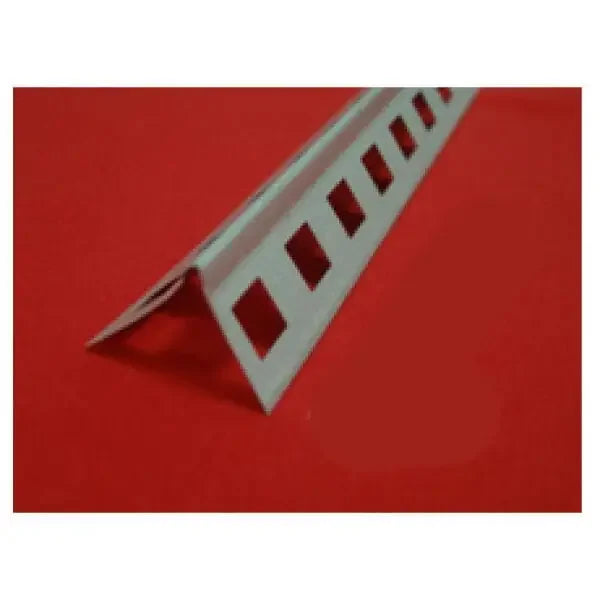
The BP28 L250 is a 2,500 mm galvanised steel external corner profile with perforated wings on both faces of the arris, finished to the "Lux" premium quality grade with consistent edge geometry and uniform perforation along the full length. It is stocked within the render and plaster corner beads range for the hallway, doorway, and reveal corners where the sharpest, most rigid arris is required.
Steel produces a harder, sharper finished arris than PVC or aluminium because the metal resists deformation under trowel pressure during finishing: the trowel runs along the nose without rolling the edge over, and the corner sits crisp and true after the plaster has cured. The "Lux" designation reflects manufacturing finish quality rather than coating specification, meaning clean true edges along the full 2.5 m and perforations sitting consistently along the wings for repeatable embedment. That uniformity is what shows under raking light on a long internal corner, where softer profiles or inconsistent perforation telegraph small variations through the plaster while a premium-finish steel bead presents a single uninterrupted line.
What Makes the BP28 L250 Steel Corner Worth Specifying
- Sharpest available arris finish: steel resists trowel-pressure deformation during the skim pass, producing a crisper, harder edge than PVC or aluminium achieve in the same plaster build-up.
- Long-term mechanical wear resistance: hallway, doorway, and high-traffic domestic corners take repeated contact from furniture, suitcases, and vacuum cleaners, and steel holds its arris where softer profiles round off visibly over three to five years.
- Galvanised zinc coating: protects the base steel against the moisture of fresh plaster and basecoat during the curing window and against the residual humidity of normal internal wall conditions.
- Premium "Lux" manufacturing finish: consistent wing geometry and uniform perforation across the full 2.5 m, which matters on long visible corners where any variation would telegraph through the finished plaster under raking light.
- Mechanical key through perforated wings: plaster or basecoat extrudes through the perforations during bedding, locking the bead into the coat so it becomes a structural part of the plaster rather than sitting on top of it.
Technical Specifications — BP28 L250 Steel Corner Lux Data
| Property | Value |
|---|---|
| Product code | BP28 L250 |
| Profile type | External corner bead, galvanised steel, premium "Lux" finish |
| Material | Galvanised steel, zinc-coated for corrosion protection |
| Length | 2,500 mm |
| Wing dimensions | ~23 × 23 mm, class-typical |
| Steel thickness | ~0.4 mm, class-typical |
| Wing perforation | Yes, for mechanical key into plaster or basecoat |
| Reaction to fire | A1 steel profile classification (assembly subject to system fire strategy) |
| System compatibility | Internal plaster, skim, scratch-coat render, protected external corners |
| Application temperature | +5 °C to +30 °C, air and substrate |
| Mesh continuity (thin-coat use) | Wall mesh lapped ~100 mm onto each wing before basecoat closes up |
| Cutting | Metal snips, fine-tooth metal saw, or angle grinder |
| Pack | Single 2.5 m length; trade pack quantities available |
Wing dimensions and steel thickness are class-typical for premium galvanised steel corner profiles and may vary slightly between consignments. Where project specification calls for exact tolerances, verify the supplied product against drawings before committing to a bedding sequence.
How the BP28 L250 Installs Into Plaster, Skim, and Scratch-Coat Systems
Apply a continuous, generous strip of plaster, scratch coat, or basecoat along the corner, generous enough that the bedding material extrudes through every wing perforation when the bead is pressed in. Press the steel angle into the bed firmly, work along the full 2.5 m in a single pass rather than walking the bead in from one end, and check plumb with a spirit level before the bed skins. Steel does not flex back into line after the bedding sets, so plumb discipline at the bedding stage is the single largest factor in the finished arris quality.
Finish across both wings with the smooth side of the trowel to feather the steel edge into the surrounding surface, leaving the nose proud as the depth gauge for the final skim. On thin-coat render applications, lap the wall's fibreglass reinforcing mesh approximately 100 mm onto each wing during basecoat so crack control runs continuously across the corner. The full step-by-step bedding technique is set out in the corner bead installation guide for UK projects, with detailing context for openings and reveals in the render detailing guide for windows and doors.
Installation Notes — Bedding, Cutting, Plumb Discipline
Work within +5 °C to +30 °C ambient and substrate temperature, and confirm the corner is sound, clean, and free of loose material before applying the bed. Lay the full 2.5 m bed of plaster or basecoat in one continuous pass before placing the bead, since a generous continuous bed gives even pressure across all contact points and keeps the arris straight after the plaster sets. Walking a bead in from one end runs the bedding thin at the far end and leaves a bow that no skim-coat ruling will hide.
Cut to length with metal snips on short trims, a fine-tooth metal saw on longer cuts, or an angle grinder with a thin metal disc on larger jobs. Whichever method is used, deburr the cut end with a quick file or abrasive pass before fitting so end-to-end joints butt cleanly without a standing fibre protruding from the cut. Where two beads meet on a long run, butt the ends tight and patch the joint with a 250 × 250 mm fibreglass mesh square embedded in the bedding coat across the join to keep the joint from telegraphing through the finish.
What UK Plasterers Do Differently With Steel Corner Beads
The single decision that separates a corner still sharp at year five from one visibly rounded is matching the metal to the room rather than the building. Across internal corner specifications supplied through Renders World, the pattern is consistent: steel earns its place in hallways, doorways, and stairwells where furniture and hoover edges hit the arris daily, while aluminium belongs in the kitchen and bathroom on the same job where drying-phase moisture is the real risk. Specifying one bead for a whole house always over-serves the dry rooms or under-protects the damp ones.
- Specify for the corner's lifetime, not the day it goes on: PVC, aluminium, and steel look identical under fresh paint, but three years into a hallway corner the steel is still sharp while a softer profile has rounded where the hoover edge runs.
- Plumb-check before the plaster skins, not after: steel does not flex back into line once the bedding sets, so plumb discipline at bedding is the largest single factor in the finished arris.
- Lay the full bed first, place the bead second: a continuous 2.5 m bed in one pass gives even pressure, where walking the bead in from one end is the most common cause of bowed arrises on long internal runs.
- Use steel for high-traffic rooms, aluminium for damp ones: the two metals solve different problems, so match the bead to the room's actual exposure rather than the building's average.
- Deburr every cut end: a quick file pass after snips or grinder keeps butt joints tight without a standing edge that would show through the skim as a mark in the finish line.
How the BP28 Steel Lux Compares to the Steel Mesh-Wing Corner
Both are galvanised steel corners for the same rigid-arris job, so the decision turns on whether the system needs an integrated mesh wing. Read across to match the profile to your reinforcement detail before ordering.
| Variant | Key Spec | When to Choose |
|---|---|---|
| BP28 L250 steel corner lux | No mesh · premium finish · 2.5 m | Internal plaster and skim, high-traffic |
| BP24 L300 steel mesh corner | Coextruded mesh wings · 3 m · ETICS | Thin-coat render needing integrated mesh |
Is the BP28 L250 Steel Corner Lux Right for Your Project?
- Internal plaster and skim corners on high-traffic domestic walls: the primary use case, covering hallways, doorway returns, reveal angles, and stairwell corners where edge sharpness and long-term mechanical durability are the priorities.
- Traditional scratch-coat render where the build-up fully embeds the bead: a sound application for steel where thick coat coverage protects the profile from direct moisture exposure.
- Damp internal rooms such as kitchens, bathrooms, and basements: use the wet plaster aluminium corner 3 m instead, sized for traditional plaster build-ups but in aluminium for drying-phase moisture tolerance.
- Thin-coat render specifications mandating a steel bead with integrated mesh: the BP24 L300 steel mesh corner combines steel rigidity with coextruded mesh at 3 m, the matched profile for ETICS work requiring an integrated mesh corner.
- Lower-cost internal plastering with no high-traffic exposure: the PVC L250 plastering corner is the value alternative at the same 2.5 m length where mechanical wear is not the governing concern.
The BP28 L250 steel corner lux is UK-stocked for next-working-day trade despatch at Renders World. One 2.5 m bead covers a standard reveal height or an internal corner run between coving and skirting, so count one length per corner and order with a 10% overage for cut-end discards and short jamb returns.
FAQ — BP28 L250 Specification and Installation
Does the galvanised coating stop the steel rusting through plaster?
The zinc galvanising protects the base steel against the moisture of fresh plaster and basecoat during the curing window and against the residual humidity of normal internal wall conditions throughout the bead's service life. In persistently damp rooms where ventilation is limited and moisture lingers for weeks after application, aluminium remains the safer long-term specification, because the drying-phase chemistry can begin to attack the zinc coating before the plaster has fully cured.
Why choose steel over aluminium on internal work?
Steel produces a sharper, more rigid arris that resists trowel-pressure deformation during finishing and mechanical wear from furniture, hoover edges, and door-handle contact over the corner's service life. On internal plaster work in normally heated and ventilated rooms where moisture exposure is low, the long-term durability advantage of steel typically outweighs the corrosion-tolerance advantage of aluminium. The two metals solve different problems, and the room's actual exposure tells you which belongs in it.
Can the BP28 L250 be used on EWI thin-coat render systems?
The bead is compatible with thin-coat render systems where the basecoat and finish coat fully encapsulate the steel and the wall's main mesh is lapped onto the wings during basecoat application. For exposed external corners on driving-rain elevations, aluminium or PVC is generally the more straightforward long-term specification, since they remove the dependency on the render finish remaining intact as the steel's moisture barrier across the facade's service life.
How is the steel bead cut to length cleanly?
Use metal snips for short cuts up to around 500 mm, a fine-tooth metal saw for square cuts on longer trims, or an angle grinder with a thin metal disc on production runs. Whichever method is used, deburr the cut end with a quick file pass before fitting so end-to-end joints butt cleanly without a protruding fibre, since a single sharp edge at a butt joint shows through the finished skim as a visible mark across the corner line.
How many BP28 L250 beads are needed for a typical project?
One 2.5 m bead covers one standard UK reveal height or a single internal corner run between coving and skirting. A typical four-bedroom house re-plaster, including hallway returns, doorway corners, window reveals, and stairwell angles, tends to land in the 20–40 length range depending on openings and partition layout. Order with a 10% overage for cut-end discards and short returns where a main-run offcut is not long enough to reach.
Are mechanical fixings needed in addition to plaster bedding?
On most plaster backgrounds the bedding coat provides sufficient grip, since the plaster extrudes through the wing perforations and locks the bead mechanically once it cures. On hard, low-suction backgrounds where bed adhesion alone is uncertain, supplementary fixings can be added at 600 mm centres during bedding. Use galvanised or zinc-plated fasteners compatible with the steel bead to keep the corrosion-protection envelope consistent across the corner detail.