
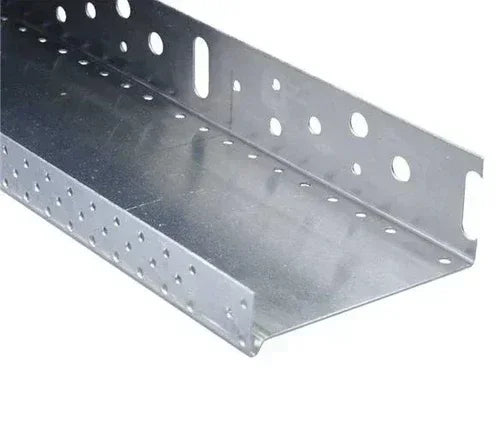
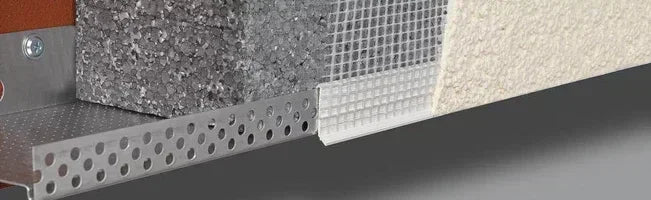
Description
Window reveals. Door reveals. Soffit returns. Lintel junctions. These are the points where a finished EWI system either eliminates the last thermal bridges in the building envelope or quietly carries them into the certified performance figure. The 23 mm base track is the slim aluminium starter profile that anchors thin insulation boards into exactly those details — too narrow for main-wall use, precisely right for the slim-board work that finishes a thermally continuous facade.
What the 23 mm Base Track Does in a UK EWI System
The 23 mm base track is a 2.5-metre aluminium starter profile that anchors the lowest course of slim insulation boards at reveal, soffit, and lintel details in UK external wall insulation systems. With a 23 mm channel width, 0.6 mm aluminium gauge, and clip-on mesh-carrier compatibility on the front edge, it is the thinnest base track in the insulation fixing accessories range and the profile specified wherever 10–20 mm boards close the insulation envelope at openings and horizontal junctions.
The track is mechanically fixed to the substrate at 300 mm centres above the damp-proof course, and the slim insulation board is adhesive-bonded and seated into the channel before the rest of the reveal detail is built up. Its function is structural and thermal at once — providing the rigid horizontal datum that locks the slim board against the wall and closing the metal-free thermal pathway from masonry to render across the reveal width.
What Makes the 23 mm Base Track Worth Specifying
- Sized for 10–20 mm Reveal and Soffit Boards: The 23 mm channel width matches the slim EPS and XPS boards used in window reveals, door reveals, soffit returns, and lintel junctions — a snug fit without board overhang and without point-loading on the aluminium lip that wider tracks suffer when forced to hold thin boards.
- Aluminium Alloy With Inherent Corrosion Resistance: The natural aluminium oxide layer protects the profile against the moisture exposure and alkaline basecoat chemistry concentrated at the wall base, holding structural integrity across the design life of the EWI system.
- Lightweight 0.6 mm Gauge for Fast Site Handling: Each 2.5 m length cuts cleanly with tin snips or an angle grinder, drills easily for fixing, and stacks compactly on site. On reveal-heavy elevations with twenty or thirty openings, the time saving over heavier-gauge alternatives is measurable.
- Continuous Reinforcement via Clip-On Mesh Carrier: The front edge accepts a snap-on mesh profile that ties the track directly into the reinforced basecoat layer, producing a continuous mesh path from the track lip across the board face — the detail that prevents micro-cracking at the reveal corner under thermal cycling.
- Compatible With EPS and XPS at Reveal Thicknesses: Works with any slim board from the EPS insulation boards range at 10–20 mm thickness, including graphite EPS for higher thermal performance on minimum-reveal-depth specifications where every fraction of a watt counts.
- Aligned to a Single Datum Across the Elevation: When the 23 mm reveal track and the wider main-wall track are set to the same datum line, the finished facade reads as a continuous insulation system rather than a patchwork of separate details — a quality signature on rendered openings.
Technical Specifications — 23 mm Base Track Data Highlights
| Parameter | Value |
|---|---|
| Profile Width | 23 mm |
| Length | 2,500 mm (2.5 m) |
| Material | Aluminium alloy |
| Gauge (Thickness) | 0.6 mm |
| Finish | Natural aluminium (mill finish) |
| Pre-installed Mesh | No — clip-on mesh profile required |
| Recommended Fixing Centres | 300 mm |
| Suitable Insulation Thickness | 10–20 mm boards |
| Drip Edge | Integrated front lip |
| Corrosion Resistance | Inherent aluminium oxide layer |
| Recommended Expansion Gap | 2–3 mm between adjacent lengths |
| Recommended Fixing | 6 mm masonry bit · wall plug + screw |
How the 23 mm Base Track Installs in a Render or EWI System
The 23 mm base track enters the EWI build-up at the start of the reveal or soffit detail, before any insulation is bonded. The installer snaps a chalk line at the intended datum height — typically 150 mm above finished ground level for ground-floor work and immediately above the DPC, or aligned to the underside of the lintel or soffit for opening details — and pre-drills the track at 300 mm centres using a 6 mm masonry bit. Wall plugs and screws fix the track through into the substrate, with a 2–3 mm expansion gap left between adjacent track lengths to accommodate thermal movement. A spirit level across the full run confirms true horizontal alignment before any insulation is placed.
Once the track is set, adhesive is applied to the rear face of each 10–20 mm slim insulation board and the board is seated into the channel so it rests on the horizontal shelf without projecting below the track edge. The clip-on mesh profile then snaps onto the front lip, carrying the fibreglass mesh into the basecoat layer above. The step-by-step installation guide for insulation fixings covers each stage of mechanical anchorage and substrate assessment in detail, and the fixing pattern and spacing calculation guide sets out the layout method aligned with ETAG 014 wind-load categories for the main board courses above the track.
Installation Notes — Datum Setting, Expansion Gaps, Reveal Detailing
Datum setting is the single most important variable at the base-track stage. The 23 mm track on a reveal must align precisely with the wider main-wall track that runs across the elevation — any vertical offset becomes a visible step in the finished render and produces a thermal break in the insulation continuity. A laser level set to the design datum line, projected across all openings and the full elevation, is the reliable method on any job with more than four openings.
Expansion gaps are the second discipline. Aluminium expands and contracts measurably across the seasonal temperature range encountered on UK facades, and butted track ends without expansion provision will buckle the profile or crack the surrounding basecoat over the first summer. A 2–3 mm gap between adjacent lengths gives the metal room to move without transferring stress into the render system.
Reveal detailing closes the install. On window and door reveals, the 23 mm track should stop short of the cill or threshold by approximately 5 mm to allow basecoat continuity around the corner, and the cut edge should be deburred with a fine file to prevent any sharp aluminium point from telegraphing through the finished render. On soffit returns, the track is fixed inverted with the channel facing downward, and a small bead of EWI-system-compatible sealant at the wall-to-soffit junction prevents moisture tracking behind the insulation board.
What UK Installers Do Differently With the 23 mm Base Track
- Run a single laser-level datum across every opening on the elevation: Setting each reveal track to a chalk-line transferred from the main-wall datum introduces cumulative error across multiple openings. A single laser projection across the full elevation eliminates the offset that shows as a stepped shadow line under raking light on the finished render.
- Pre-cut all reveal lengths before fixing any of them: On a typical four-bed semi-detached with eight to twelve openings, batch-cutting the 23 mm track to length at the start of the day produces consistent end profiles and removes the temptation to bend a slightly long piece to make it fit. Each cut is fast — the rhythm gain across twelve openings is significant.
- Leave 5 mm short at internal corners: Where the 23 mm reveal track meets the main-wall track at the corner of an opening, holding the reveal track 5 mm clear of the corner gives basecoat and mesh room to wrap the corner properly. Butting them tight forces a hard mesh fold that telegraphs through any subsequent render coat.
- Deburr every cut edge with a file, not just snips: Tin-snip cuts leave micro-burrs along the channel edge that can slice through the rear face of an EPS reveal board during insertion. A few seconds with a flat file across each cut end protects the insulation and produces a cleaner overall finish.
- Fix to the substrate proper, not to the basecoat or render plinth: On retrofit work where existing plaster sits below the new EWI system, the base-track fixings must reach the structural masonry behind the plaster — a screw landing only in old render or plaster will not hold the track under board weight plus wind loading on the elevation above.
Is the 23 mm Base Track Right for Your Project?
- Choose the 23 mm base track if you are anchoring 10–20 mm slim EPS or XPS boards in window reveals, door reveals, soffit returns, or lintel junctions — the reveal and junction detailing where thin boards eliminate the last thermal bridges around openings.
- Stepping up to slightly thicker reveal boards? The 33 mm base track at 2.5 m length accommodates 30 mm boards on deeper reveals where the structural opening allows additional insulation depth without compromising sight lines.
- Need a main-wall track to pair with the reveal detail? Most UK facade specifications use the 53 mm base track at 2.5 m length for 50 mm primary insulation, or wider profiles for thicker boards. Setting the reveal track and main-wall track to the same datum keeps the elevation reading as a single system.
- Specifying deep-renovation or Passive House thicknesses on the main wall? The 163 mm base track at 2.5 m length reaches the maximum board thickness used on UK domestic facades — pair it with the 23 mm reveal track at the same datum line for a continuous thermal envelope from main wall to opening.
FAQ — 23 mm Base Track Compatibility, Cutting, Ordering
What insulation thickness does the 23 mm track actually accept?
The 23 mm channel width accommodates boards from 10 mm to 20 mm thickness, with 20 mm being the practical upper limit before the board begins to project beyond the channel lip. This range covers the slim EPS and XPS boards used in reveal, soffit, and lintel detailing, where the structural opening dimensions and the visual sight lines of the finished window or door determine how much insulation depth is available. Above 20 mm, step up to a wider track in the range.
Can I cut the track to shorter lengths on site?
Yes — the 0.6 mm aluminium gauge cuts cleanly with standard tin snips or an angle grinder fitted with a metal-cutting disc. Deburr every cut edge with a fine file before installation; the micro-burrs left by tin snips can slice the rear face of a slim insulation board during seating and produce visible imperfections at the track edge after the basecoat coat is applied. A few seconds of filing per cut end protects both the insulation and the finished surface.
Does the track ship with mesh already attached?
No — this profile ships as a plain aluminium channel without pre-installed mesh. A separate clip-on mesh-carrier profile snaps onto the front lip of the track to integrate it into the basecoat reinforcement layer. This two-part approach lets installers choose the mesh weight and overlap appropriate to the project specification rather than being locked into a single factory-attached configuration.
How does the 23 mm track differ from wider profiles in the range?
Channel width is the primary difference, and it corresponds directly to the insulation board thickness the track is designed to hold. The 23 mm accepts 10–20 mm boards for reveal and junction detailing; 33 mm accepts 30 mm boards; the 53–103 mm range covers main-wall facade insulation; and 163 mm accommodates the thickest boards used on deep-renovation and Passive House builds. All tracks in the range share the same aluminium alloy construction, 0.6 mm gauge, and 2.5 m length — only the channel width changes.
Which substrates can the 23 mm base track be fixed to?
The track fixes reliably to all standard UK masonry substrates including clay and calcium silicate brick, concrete and concrete block, lightweight aggregate block, and dense stone. Fixings should reach the structural substrate at full embedment depth — on retrofit walls carrying existing plaster, ensure the wall-plug length passes through the plaster and anchors into the masonry behind it. On lightweight aggregate or autoclaved aerated substrates, use rotation-only drilling mode to preserve the block's internal structure and the certified fixing performance.
How much 23 mm base track do I need for a typical project?
For reveal and soffit detailing, calculate the total linear length of all openings around the perimeter — for a four-bed semi-detached with eight openings averaging 1.5 m perimeter each, the requirement is roughly 12 linear metres, or five 2.5 m lengths. Allow one additional length as cutting and waste reserve. Soffit returns, lintel undersides, and any below-roof junctions add to the total, so a full take-off from the elevation drawings produces the most reliable quantity figure.


