
Description
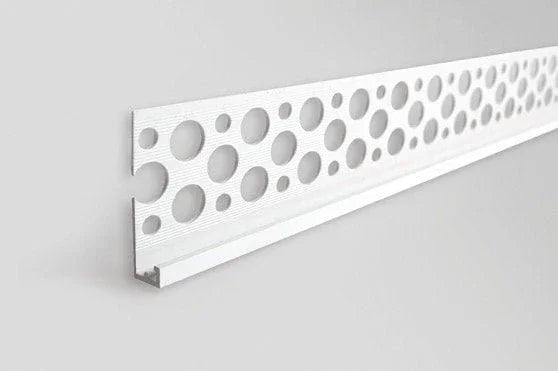
The 15 mm PVC render stop bead without mesh is the deepest termination profile in the render stop beads range — a specialist member of the family designed for heavy external wall insulation systems, traditional sand-cement renders, brick-slip and stone-slip carriers, and heritage refurbishment work where measured finish thickness genuinely exceeds 10 mm. It is a specification answer rather than a default selection, and the projects that need it usually know they need it before the bead box is opened.
What the 15 mm No-Mesh Stop Bead Does on Plinth Bands and Heritage Renders
At 15 mm nose depth, this 2.5 m white rigid PVC profile creates a flush termination edge wherever the total render build-up lands in the 11–14 mm band — covering plinth bands carrying double-mesh reinforced basecoats plus heavy decorative finishes, brick-slip and stone-slip systems where the carrier mortar adds substantial depth, dual-density mineral wool EWI configurations with impact-resistant outer layers, and traditional two-coat sand-cement renders applied at 14–18 mm on heritage and period properties.
This is the no-mesh variant — fixed mechanically through a perforated flange rather than embedded via an integrated wing. The configuration suits the robust junctions where the 15 mm depth is most often specified: plinth steps, brick-slip terminations, heritage matching lines against existing deeper render coats, and step junctions at material changes on ground-floor elevations. None of these scenarios provide the continuous wet basecoat that a mesh wing would need to bond into.
Why Specifiers Choose the 15 mm Stop Bead for Heavy Systems and Brick-Slip Details
- Proportioned for heavy decorative and impact-zone systems: The 15 mm nose accommodates the thick basecoats, brick-slip carriers, and high-build decorative finishes specified at plinth bands and ground-floor zones where impact resistance is prioritised over thin-coat economy.
- Standard depth for traditional sand-cement work: Two-coat sand-cement renders applied at 14–18 mm — the historical UK render specification — terminate cleanly against the 15 mm nose, making this the right profile for period-property refurbishment and heritage matching.
- Sized for dual-density mineral wool EWI: Where the harder outer board layer pairs with a thicker reinforced basecoat for impact resistance, total finish thickness regularly exceeds 10 mm and the 15 mm depth keeps the bead flush rather than buried.
- Brick-slip and stone-slip compatibility: The deeper nose absorbs the additional thickness contributed by carrier mortars and slip-bedding adhesives that thin-coat profiles cannot accommodate.
- Mechanical fixing strategy suited to robust junctions: The perforated flange takes adhesive dabs, render staples, or substrate-appropriate fasteners, which matches the typical role of this depth at plinth steps and over existing renders where embedded mesh would have nothing to bond into.
- Non-corrosive PVC body where it matters most: Plinth bands sit close to splash and ground moisture, and a non-corrosive nose means no rust streaks below the most weather-exposed line on the facade.
- Clean masking edge for high-build textures: The 15 mm nose holds tape true even when the adjacent decorative coat is heavily floated or texture-finished, producing sharp transitions to plinth paint colours or adjacent material boundaries.
Technical Specifications — 15 mm Stop Bead Data Sheet
| Property | Value |
|---|---|
| Profile type | Render stop bead, no mesh wing |
| Body material | Rigid PVC, white, UV-stabilised |
| Render depth (nose) | 15 mm |
| Length | 2.5 m per piece |
| Target render build-up | 11–14 mm (plinth bands, brick-slip, dual-density MW EWI, traditional sand-cement at 14–18 mm) |
| Fixing method | Mechanical — adhesive dabs, render staples, or substrate-appropriate fasteners |
| Recommended fixing centres | 150–200 mm on heavy build-ups · 200–250 mm on standard |
| System mesh lap onto flange | 100 mm minimum (both layers on double-mesh specifications) |
| Frame gap (sealant joint) | 2–3 mm |
| Application temperature | +5 °C to +25 °C (governed by render system or fixing adhesive) |
| On-site cutting | Tin snips or fine-tooth hacksaw |
| Compliance reference | Typically meets BS EN 13658-2 design principles for plastering accessories — confirm with project documentation |
How to Install the 15 mm Stop Bead — Datum Setting, Tightened Fixing Centres, Layered Build-Up
Dry-fit the bead against the termination line and check the nose for line and level with a long straight edge — the deeper projection makes any deviation more visible on the finished elevation than on lighter profiles, and a 2 mm misalignment that vanishes under a thin-coat finish will read clearly under a heavy decorative or brick-slip coat. Tighten fixing centres to 150–200 mm on the heavier build-ups this bead is sized for, rather than the 200–250 mm appropriate to lighter profiles, because the additional pull of thicker wet material as it is feathered onto the flange demands closer mechanical hold.
Allow each layer of the build-up to gain its grab time before applying the next. Rushing the build with this profile risks the wet material slumping behind the deep nose, leaving a hollow that no amount of finishing recovers. For the complete step-by-step process — substrate testing, fixing-centre adjustment for plinth conditions, mitre cuts at step junctions, and sealant sequencing at frames — the full stop bead installation guide for UK projects sets out each stage in order. For coordinating the 15 mm bead with bellcasts at DPC level, corner beads at plinth-band angles, and oversills above heavy bands, the render detailing guide for windows and doors covers the full profile sequencing process across the elevation.
Installation Notes — Conditions, Sealant Joints, Plinth and Heritage Junctions
Where the bead terminates against a window or door frame, leave a 2–3 mm gap between the nose and the frame face. After the render has fully cured, this gap takes a low-modulus UV-stable sealant that forms the primary waterproof joint and accommodates the larger differential thermal movement between heavy render coats and lightweight frame materials. The movement at this build-up depth is genuinely greater than on thin-coat work, and closing the gap with render rather than sealant fails noticeably earlier here than on lighter systems.
Lap the system reinforcement mesh from the wider facade onto the perforated flange by a minimum of 100 mm; on double-mesh plinth specifications carry both layers across the flange to maintain continuous reinforcement at the impact zone. At plinth corners and step junctions, mitre the bead at 45° rather than overlapping ends — stacked PVC noses at this depth read as a hard step through any topcoat, and no amount of finishing recovers the visible junction. On heritage matching work the 15 mm bead often sets the new datum line itself: adjacent profiles such as bellcasts at DPC level and corner beads at external angles are installed afterwards to align with this controlling edge, rather than the other way around.
Pro Tips From UK Installers Using the 15 mm Stop Bead
For best result, treat the 15 mm bead as a specification answer rather than a default selection. Reaching for the deepest profile when finished thickness is unclear, on the logic that bigger is safer, regularly produces a hard proud step that the topcoat cannot mask — and a visible PVC line at the termination draws the eye on every elevation. Confirm the actual measured build-up first on a finished test patch, then size the bead to match. A 6 mm or 10 mm bead correctly chosen consistently looks better than a 15 mm bead defaulted to.
On new-build plinth-band detailing the standard profile sequence still applies — bellcast first to fix the lower datum, then this stop bead to terminate the field render against the band, then corner beads at the band's external angles. On heritage matching work the sequence inverts: the 15 mm bead sets the controlling line because it is following an existing render datum, and downstream profiles align with it. Recognising which scenario applies before fixing the first bead is the single most useful site judgement on heavy-system work, because once a controlling datum is anchored in the wrong order the only recovery is to lift profiles and start over.
Is the 15 mm No-Mesh Stop Bead Right for Your Project?
- Best fit: plinth bands with heavy decorative or brick-slip finishes, dual-density mineral wool EWI, traditional two-coat sand-cement renders at 14–18 mm, and heritage refurbishment matching deeper original render lines.
- Step down for standard mineral wool EWI: for 7–9 mm total finish thickness on conventional mineral wool systems, the 10 mm PVC stop bead is the proportionate selection.
- Standard thin-coat EWI default: for 5–7 mm total finish on EPS or graphite EPS, the 6 mm PVC stop bead with mesh is the right specification and reinforces the termination through its embedded wing.
- Same-depth alternative at 6 mm dry junction: where measured thickness is 5–7 mm and the bead lands against an existing finish, the 6 mm no-mesh stop bead handles the boundary cleanly.
- Need datum-setting advice for heritage work? Heritage matching often involves working to existing render lines that pre-date modern thin-coat conventions; our technical desk can confirm bead depth and fixing sequence against site photographs and elevation drawings on request.
FAQ — 15 mm Stop Bead Application, Fixing, Ordering
When does a project genuinely need a 15 mm stop bead?
When a measured finish-thickness test patch confirms the build-up exceeds 10 mm — typically on plinth detailing carrying double-mesh reinforced basecoats, brick-slip or stone-slip systems with carrier mortars, dual-density mineral wool EWI with impact-resistant outer layers, traditional sand-cement renders at 14–18 mm, or heritage matching work against existing deeper render lines. Anything thinner is better served by the 10 mm or 6 mm profiles, which produce a flusher finish at lighter build-ups.
Why is this profile supplied without an integrated mesh wing?
The 15 mm bead is most often specified at robust junctions — plinth steps, brick-slip terminations, heritage matching lines, and step boundaries against existing renders — where mechanical fixing through the perforated flange combined with lapped system mesh is the more appropriate reinforcement strategy than an embedded wing. Many of these scenarios also lack the continuous wet basecoat that a mesh wing would need to bond into.
Will a 15 mm bead create a visible proud edge?
Only if the bead is oversized for the build-up. Correctly matched to a render system measuring 11–14 mm finish thickness, the 15 mm nose sits flush with the topcoat and reads as a deliberate detail edge. Mismatched to a thinner system, the nose stands proud and the topcoat cannot recover the visible step — which is why bead sizing on this depth is driven strictly by measured thickness rather than specified thickness.
How should the bead be fixed on a plinth band?
Mechanical fixing through the perforated flange — typically render staples or substrate-appropriate fasteners at 150–200 mm centres on heavier build-ups, with adhesive dabs as a secondary support. The closer 150–200 mm spacing resists the pull of the heavier wet material as it is feathered onto the flange, where the lighter 200–250 mm spacing appropriate to thin-coat work would allow the bead to lift slightly under the basecoat's weight.
Will the white nose remain visible under a heavy decorative finish?
On heavily textured or float-finished decorative coats — the typical companion finish for a 15 mm bead — the topcoat surface itself absorbs more visual attention than the nose line, so a correctly proportioned bead reads as a deliberate detail edge rather than an interruption. Where the texture is unusually fine or the topcoat partially translucent, masking and over-painting the exposed edge with a matching silicone masonry paint after full render cure produces a uniform appearance.
How much 15 mm stop bead does a typical plinth-band detail need?
Plinth bands run continuously around an elevation rather than terminating at openings, so quantities are driven by elevation perimeter rather than opening count. A typical three-bedroom semi-detached property with a 600 mm plinth band around the full ground-floor perimeter requires approximately 30–40 linear metres of 15 mm stop bead across the top and bottom edges of the band, plus 10–15% for cuts and waste. Heritage matching projects with full-elevation deeper render coats need substantially more — our technical desk can confirm exact lengths against site drawings.

