
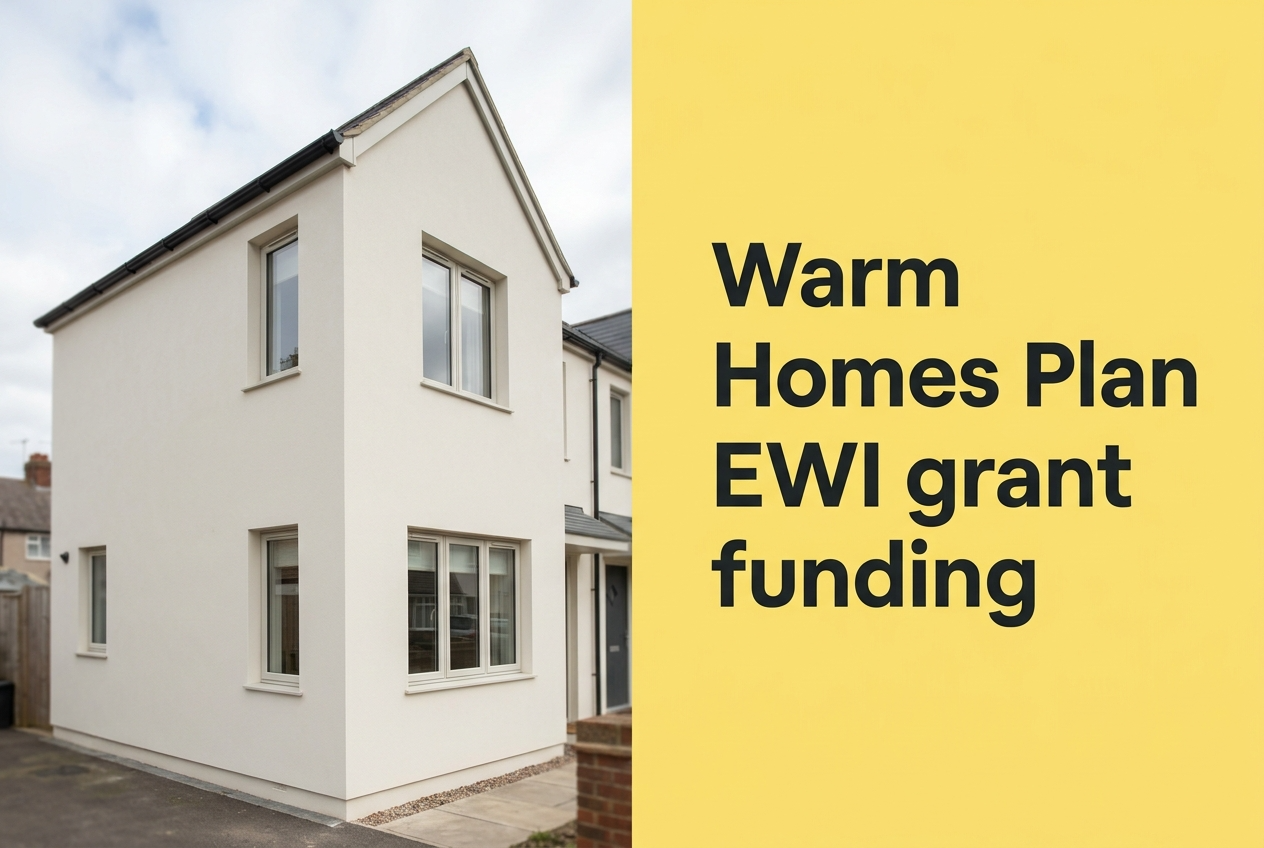
The Warm Homes Plan is the UK Government's £13.2 billion programme to upgrade up to five million homes by 2030, and it replaces the supplier-obligation model that has funded most external wall insulation projects for the past decade. For homeowners, landlords, and trade specifiers planning EWI work in 2026, the shift matters: GBIS closed on 31 March 2026, ECO4 winds down on 31 December 2026, and the Warm Homes: Local Grant becomes the primary route to publicly funded solid-wall insulation in England.
This guide explains exactly how the Plan changes EWI funding, which schemes remain open, what the eligibility thresholds look like, and how the regulated installation pathway connects grant approval to a finished, rendered facade. For the wider picture across all UK funding routes, including devolved nation schemes, see the complete EWI grant funding guide — this article focuses specifically on the Warm Homes Plan and the schemes operating under it through 2026.
Regulatory Context — What the Warm Homes Plan Sets Out
Published by the Department for Energy Security and Net Zero, the Warm Homes Plan commits £13.2 billion of public investment over the current Spending Review period and consolidates previously fragmented grant routes into a clearer, council-led delivery model. The Plan's published scope is set out in full on gov.uk, and the most relevant change for EWI specifiers is the explicit replacement of supplier-driven referrals with a local-authority-administered model that local councils run from the household-facing end.
External wall insulation sits within the Plan's eligible measure list because it delivers measurable fabric-first improvements: a typical solid-wall retrofit lifts a property by one to three EPC bands, improves U-values to meet Approved Document L thresholds, and reduces annual heating demand for the lifetime of the building. The Plan therefore funds EWI not as a stand-alone product but as part of a regulated retrofit sequence governed by PAS 2035 — meaning grant approval and installation quality are managed together rather than separately. Renders World tracks scheme updates because nearly every installer-customer ordering EPS, mineral wool, or render finish in 2026 is doing so against one of these funded pathways.
Three Headline Changes From 2026
- GBIS closed 31 March 2026: the Great British Insulation Scheme, which funded middle-income households in council tax bands A–D, has ended and is not accepting new applications.
- ECO4 extended to 31 December 2026: following a government consultation, the energy-company-funded scheme received a nine-month extension to complete existing obligations, but no successor supplier obligation will follow.
- Warm Homes: Local Grant becomes primary route: council-administered, government-funded, with expanded budget from 2027/28 onwards.
Compliance Requirements for Grant-Funded EWI Projects
Every EWI installation funded under the Warm Homes Plan — whether delivered via ECO4, the Local Grant, or the Social Housing Fund — must comply with the PAS 2035 retrofit framework. A qualified Retrofit Coordinator conducts the dwelling assessment, specifies insulation type and thickness against the property's U-value target, and oversees the project to handover. The installer must hold PAS 2030 certification, work under TrustMark registration, and complete the installation with an Insurance Backed Guarantee.
From the materials side, this means EWI components specified for grant-funded projects need clear CE/UKCA marking, declared thermal conductivity values, and traceable documentation. Renders World stocks graphite-enhanced EPS boards with λ values around 0.031 W/mK and Rockwool dual-density slabs suitable for fire-strategy-driven specifications — both routes commonly used on Warm Homes Local Grant installations. The PAS 2035 homeowner and retrofit coordinator guide explains the full assessment-to-sign-off sequence for households entering the scheme.
Quality Assurance After ECO4 Concerns
Following installation-quality concerns reported during ECO4 delivery, the Government strengthened the audit regime that now applies across all Warm Homes Plan schemes. Retrofit Coordinators carry out mandatory site visits, supplier audits run with greater frequency, and TrustMark enforcement powers have been expanded. The ECO4 and GBIS quality check guide walks through the warning signs homeowners should look for if they suspect an earlier installation fell short of standard.
Grant Schemes Open for EWI in 2026
Three publicly funded routes currently deliver external wall insulation, each with distinct eligibility criteria and operational timelines. Choosing the right one depends on household income, property tenure, and EPC band — the Retrofit Coordinator assesses this during the initial survey.
ECO4 — Extended to 31 December 2026
ECO4 remains the most established route to fully funded EWI for low-income households. Eligibility is determined primarily through receipt of means-tested benefits such as Universal Credit, Pension Credit, or Income Support, and the property should typically hold an EPC rating of E, F, or G. Under ECO4 Flex, local authorities can also refer households earning below £31,000 annually. The solid-wall minimum requirement continues through the extension, meaning energy suppliers must keep delivering EWI alongside other measures until the December deadline.
Warm Homes: Local Grant — Ongoing
The Local Grant, administered by participating English councils, offers fully funded energy-efficiency improvements including external wall insulation. The property must be privately owned, located in England, and hold an EPC rating of D, E, F, or G. Household income must normally sit at £36,000 per year or less, though higher-income households can still qualify when a household member receives qualifying benefits or the property falls within a designated postcode area. Councils arrange the survey, recommend measures, and organise the installation at no cost to the eligible householder. Applications open at gov.uk/apply-warm-homes-local-grant.
Warm Homes: Social Housing Fund
Social housing providers access EWI funding through the Warm Homes: Social Housing Fund (WH:SHF), which targets the upgrade of social housing stock currently rated below EPC Band C. Local authorities, combined authorities, and registered providers of social housing apply for programme funding to deliver whole-estate retrofit schemes. The Government has indicated the Local Grant and Social Housing Fund will eventually consolidate into a single integrated low-income scheme, simplifying delivery for large-volume EWI procurement.
| Scheme | Status (Mid-2026) | End Date | EWI Funded | Key Eligibility |
|---|---|---|---|---|
| ECO4 | Open (extended) | 31 December 2026 | Yes | Means-tested benefits or Flex referral |
| GBIS | Closed | 31 March 2026 | N/A | No longer accepting applications |
| Warm Homes: Local Grant | Open | Ongoing | Yes | Income ≤ £36,000 + EPC D–G |
| WH: Social Housing Fund | Open | Rolling waves | Yes | Registered social housing provider |
Compliance Pathway — From Application to Installation
Checking eligibility takes a matter of minutes, but the regulated installation pathway runs over weeks. For the Warm Homes: Local Grant, the application starts on the GOV.UK portal where a short questionnaire confirms income, benefit, and property criteria. The local council typically responds within ten working days to book a home survey. For ECO4, households usually enter via their energy supplier, an approved installer network, or a local authority Flex referral.
Once eligibility is confirmed, the regulated sequence follows the same pattern regardless of scheme. A PAS 2035 Retrofit Coordinator conducts a dwelling assessment, recommends the insulation type, thickness, and render system, and produces a Medium-Term Improvement Plan covering the whole property fabric. A PAS 2030 certified installer then carries out the work, and on completion the property receives an updated EPC, TrustMark registration, and an Insurance Backed Guarantee. Households earning above the grant threshold can access the new zero- and low-interest consumer loan facility being delivered alongside the Plan — backed by an initial £2 billion of Government support — which gives Renders World trade customers a useful secondary route when advising clients who don't qualify for direct grants.
Key Deadlines for the Remainder of 2026
- 31 March 2026 — GBIS closed: the Great British Insulation Scheme ended on this date. Any projects not fully delivered by the deadline fall outside the scheme's scope.
- 31 December 2026 — ECO4 closes: the extended deadline gives suppliers and installers until the end of the year to complete existing obligations. Households should apply early because scheme capacity is constrained by both funding allocations and installer availability.
- From 2027/28 — Expanded Warm Homes investment: additional low-income capital funding enters the delivery pipeline, and the Government intends to consolidate low-income schemes into a single programme administered through the new Warm Homes delivery body.
Key Takeaway: The Warm Homes Plan secures £13.2 billion for domestic energy upgrades, with external wall insulation funded as a core measure. ECO4 runs until December 2026, the Warm Homes: Local Grant continues for low-income households at £36,000 income or below, and a council-led delivery model replaces the supplier-obligation approach — making early application the surest route to fully funded EWI.
What This Means for Your Material Specification
For trade installers, the transition from supplier obligations to council-administered programmes changes the referral and procurement model but not the demand signal. The Plan's five-million-home target and the retention of solid-wall minimum requirements under ECO4 mean EWI installation volumes are expected to remain strong through 2026 and into 2027. Aligning the business with PAS 2035-compliant delivery networks and maintaining TrustMark registration positions installers to access the expanding pipeline of publicly funded work. Specifying certified components from recognised manufacturers — including Atlas, Ceresit, and Rockwool product ranges held across the Renders World stock — ensures every installation meets the audit standards now enforced across all government-backed schemes.
For procurement teams managing larger projects or social housing programmes, a coordinated material order matters more under the new model because the Retrofit Coordinator signs off the specification before installation begins. Buying components individually risks compatibility issues at audit. The Renders World full EWI system bundle — covering insulation board, adhesive, mesh, basecoat, and silicone render finish in compatible per-m² quantities — provides a single-line specification that streamlines both the Retrofit Coordinator sign-off and the installer's site delivery schedule. The EWI build-up layers explained guide walks through how each component contributes to the certified system performance.
Material Specification Checklist for Grant-Funded Work
- Insulation thermal performance: declared λ value matching the U-value target set by the Retrofit Coordinator. Graphite-enhanced EPS at λ 0.031 W/mK is the most common choice; mineral wool at λ 0.034–0.036 W/mK applies where fire strategy requires Euroclass A1.
- System compatibility: adhesive, basecoat, mesh, primer, and render finish from a tested system family, not mixed across manufacturers without a documented compatibility check.
- Documentation: CE/UKCA marking, Declaration of Performance (DoP), and Technical Data Sheet retained for every component for the Retrofit Coordinator file.
- Render finish: vapour-permeable thin-coat silicone render is the standard finish for grant-funded EWI in the UK because it pairs hydrophobic performance with breathability across the solid-wall build-up.
Written by Mariusz Saja. Technically reviewed by Rafał Wyrzykowski. Last reviewed June 2026.
FAQ — Warm Homes Plan and EWI Funding
How much can a household receive toward external wall insulation under the Warm Homes Plan?
Under the Warm Homes: Local Grant, eligible households receive fully funded external wall insulation at no personal cost — the council arranges and pays for the entire installation. ECO4 similarly covers the full cost for qualifying low-income households. The exact value depends on property size, insulation specification, and local council funding allocation, but grants typically cover installations valued between £10,000 and £15,000 per property, subject to the project assessment carried out during the home survey.
Does the Warm Homes Plan fund EWI for landlords as well as homeowners?
Private landlords with eligible tenants can access EWI funding through ECO4 and the Warm Homes: Local Grant, though the landlord may be required to contribute toward some of the improvement costs depending on the route. Social housing providers apply directly through the Warm Homes: Social Housing Fund. The Plan also signals new minimum energy-efficiency standards for privately rented properties, creating both regulatory motivation and financial support for landlords planning fabric upgrades over the next few years.
What happens to EWI grant funding after ECO4 closes in December 2026?
The Government has confirmed there will be no successor supplier obligation after ECO4. However, the Warm Homes Plan commits £13.2 billion over the current Spending Review period, with additional low-income capital funding entering delivery from 2027/28. The Warm Homes: Local Grant is expected to remain active and expand its budget, and a consolidated low-income scheme will follow — meaning grant-funded EWI continues beyond the ECO4 closure, just through council-led rather than supplier-led delivery.
Is PAS 2035 certification required for grant-funded EWI installations?
All retrofit work delivered under ECO4, the Warm Homes: Local Grant, and the Social Housing Fund must comply with the PAS 2035 framework. This means a qualified Retrofit Coordinator oversees the project from design to completion, and the installer holds PAS 2030 certification. Strengthened requirements introduced after ECO4 concerns now mandate site visits by Retrofit Coordinators and enhanced audit processes, providing stronger protection for households and ensuring every funded EWI installation meets consistent quality standards.
Does the grant cover the render finish as well as the insulation?
Yes. Grant-funded EWI is treated as a complete system rather than a stand-alone insulation measure, so the funding package covers the full build-up — adhesive, insulation board, mechanical fixings, basecoat with embedded mesh, primer, and the final render finish. The Retrofit Coordinator specifies a system family that has been tested together, which is why specifying components from a coordinated range matters at both the procurement and the audit stage.