
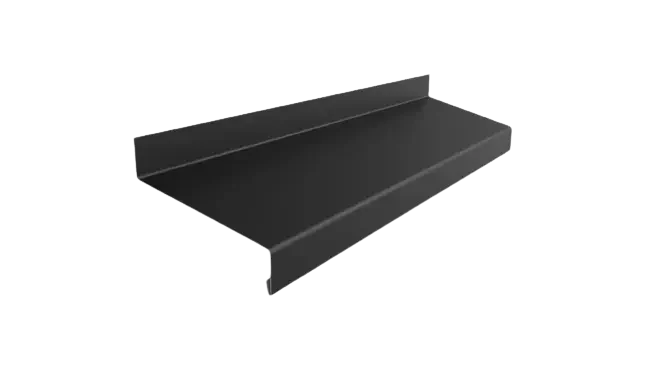
VERGE TRIM- UPSTAND ANTHRACIT 2.5m 140mm


Price:
Sale price£29.50

Shipping calculated at checkout

Stock:
Sold out

Pickup currently unavailable at Renders World Southampton

Description

Where a rendered facade meets a flat-roof upstand or runs out behind a fascia board at the gable verge, the termination detail must close the EWI system against weather penetration without dependence on silicone or expanding foam tape that age out long before the render does — and the Anthracite Upstand Verge Trim 2.5 m × 140 mm is the dedicated profile engineered for that job. Supplied through our window sill extensions and oversills collection, this 140 mm-width profile houses insulation builds between 70 mm and 120 mm — the depth band that covers most UK EWI work above ground-floor level. Stocked for trade self-collection from our Southampton counter.

What the Anthracite Verge Trim Upstand Does in a UK Render or EWI System

The Anthracite Verge Trim Upstand is a 2.5-metre powder-coated aluminium profile that closes the top edge of an EWI elevation against weather penetration at flat-roof upstands, parapets and pitched-roof gables, using mechanical upstand geometry rather than dependence on silicone or foam tape. The vertical leg slides up behind the roof membrane upstand or the fascia board, and the horizontal section integrates into the EWI build-up below — the waterproof seal is created by the slide-behind fit, not by a sealant bead. The 140 mm profile width accommodates 70–120 mm insulation depths, covering the graphite EPS and mineral wool builds specified across most UK refurbishment and new-build EWI work.

The anthracite finish corresponds to the RAL 7016 family that defines current UK contemporary specification, pairing the verge line with anthracite fascia, rainwater goods and oversills on the same elevation. Unlike an oversill — which projects past the finished render face to shed water at window heads — the verge trim's job is at the top edge of the wall, where the rendered surface terminates against another building element. The two profiles share the collection but address different junctions, and confusing them at order stage is the most common SKU error on contemporary facade specification.

Why Trade Specifiers Choose the Anthracite Verge Trim Upstand

  • Sealant-free waterproof termination: the upstand geometry creates the watertight seal mechanically, removing dependence on silicone or foam tape that degrades long before the surrounding EWI system reaches end of life.
  • Sized for standard EWI builds: the 140 mm profile width houses 70–120 mm insulation depths — the band that covers most graphite EPS and mineral wool specifications across UK projects.
  • Top-fix design: engineered for fixing from above, allowing installation behind fascia boards or against flat-roof upstands without disturbing finished surfaces below.
  • Powder-coat anthracite finish: factory-applied industrial coating delivers consistent colour density coordinated with anthracite oversills, fascia and rainwater goods on contemporary facades.
  • 2.5 m unit length: efficient cutting yield across typical gable widths, with a single profile typically serving short-to-mid gable runs without intermediate joints.
  • Self-collection logistics: packed for damage-free transit from our Southampton warehouse, avoiding the courier-handling marks that anthracite shows more readily than white finishes.

Technical Specifications — Anthracite Verge Trim Upstand Data Sheet

Property Value
Profile type Upstand verge trim — top-edge termination for render and EWI
Material Powder-coated aluminium extrusion, exterior grade
Colour Anthracite (RAL 7016 family)
Length 2.5 m
Profile width 140 mm
Insulation depth accommodated 70–120 mm
Fixing method Screws at 300 mm centres along upstand vertical leg
Sealing principle Mechanical slide-behind upstand seal — no silicone or foam tape required for primary seal
Application Flat-roof upstand connection, parapet, pitched-roof gable verge
Compatible end caps Anthracite end-cap pair (sold separately)
Delivery Self-collection from Southampton — courier transit excluded
Storage Flat, dry, prior to install

How to Fit the Anthracite Verge Trim — Top-Edge Sequencing, Upstand Fixing, Membrane Dressing

The verge trim works in two application zones. At a flat-roof connection, the vertical upstand slides up behind the roof membrane upstand or parapet flashing, with the horizontal leg integrating into the EWI build-up below. At a pitched-roof gable, the vertical leg slides up behind the fascia board, with the horizontal section terminating the rendered face along the verge line. Both applications rely on the same fixing pattern: screws at 300 mm centres along the upstand vertical leg, locking the profile to the substrate before the EWI build is closed up around it.

Install the verge trim before the insulation reaches the top of the wall — the trim sets the termination line that the insulation cuts to, reversing the post-EWI fitting sequence used for oversills. Where the trim meets the roof membrane on a flat-roof upstand, the membrane must dress over the top of the vertical leg, not under it, so any wind-driven rain is shed onto the trim rather than diverted behind it. Pair the trim with the matching anthracite end-cap pair at each gable end to close the open profile section. For the full installation sequence — including the order of work between verge trim, oversills, end caps and render termination — the window sill extensions installation guide for UK projects walks through the trade method with worked examples.

Installation Notes — Multi-Trade Coordination, Substrate Fixings, Joint Detailing

Verge trim installation is one of the few EWI details that requires explicit coordination with the roofing trade. The trim sets the height that the roofer's membrane upstand or fascia must dress over, and that height needs to be agreed before either trade starts work at the top of the elevation. A 15-minute conversation between EWI installer and roofer at the start of the programme prevents the rework that comes from one trade fixing to a line the other did not expect.

Screw length depends on substrate type behind any sheathing or breather membrane: for masonry behind a breather membrane, 60–80 mm exterior-grade A2 or A4 stainless screws penetrate adequately; for timber sheathing alone, 40–50 mm typically suffices. Where elevations exceed the 2.5 m profile length, butt-joint cut ends at intermediate positions and seal the joint with a manufacturer-recommended PVC-compatible jointing tape if exposure conditions demand it — though the primary seal at the trim's two ends remains mechanical. Verge-trim detailing sits within the broader render termination strategy that includes corner beads at external arrises and stop beads at jamb terminations; the render detailing around windows and doors pillar guide covers the full junction-by-junction coordination across the facade.

Pro Tips From UK Installers Using the Anthracite Verge Trim Upstand

Verge trim is the least-installed of the trim family because most installers see one or two top-edge terminations per project compared to multiple oversills, and rhythm comes slower as a result. The list below is what experienced UK applicators consistently get right on contemporary anthracite facade work.

  • Don't substitute sealant for the upstand fit: the mechanical slide-behind seal is what holds the waterproofing for the 25–30 year EWI life; relying on a sealant bead to take up a gap means the seal degrades on the sealant's UV ageing curve, not the trim's.
  • Coordinate with the roofer before either trade starts the top course: the trim height sets the line the roofer's membrane must dress over; a programme conversation up front prevents the rework that mismatched lines create at the most exposed point on the elevation.
  • Membrane dresses OVER the upstand, never under: water-shedding geometry depends on this orientation; a membrane tucked behind the trim leg routes any wind-driven rain straight onto the EWI behind the wall, the exact failure the trim exists to prevent.
  • Match screw length to actual substrate, not generic spec: 60–80 mm for masonry behind breather membrane, 40–50 mm for timber sheathing alone; over-long screws hit voids and lose grip, under-length screws leave the trim floating on the membrane.
  • Cap the verge ends before the scaffold goes down: end caps at gable ends are easier to fit during the final scaffold-up day than from a ladder afterwards; the anthracite end-cap pair lands in the same self-collection visit as the trim itself.
  • Don't confuse the verge trim with the oversill at order stage: verge trim closes top-edge terminations, oversill projects past the render face at window heads — the most common SKU confusion on contemporary anthracite specifications where both products share colour family.

Is the Anthracite Verge Trim Upstand Right for Your Project?

  • Flat-roof EWI connections: the correct termination at the upstand interface where rendered facade meets flat-roof membrane, with insulation builds in the 70–120 mm range.
  • Pitched-roof gable verges: the appropriate trim where rendered EWI runs up to the underside of a fascia board, with the upstand sliding behind the fascia for hidden fixing.
  • Contemporary facade with coordinated trim family: the anthracite verge trim pairs visually with the 140 mm anthracite oversill for shallow contemporary builds and the 170 mm anthracite oversill for standard EWI on the same elevation, maintaining a single dark trim line across windows and verges.
  • White facade schemes: the matched white upstand verge trim 140 mm is the correct specification where the facade calls for white trim throughout — geometry is identical, only the powder-coat colour differs.
  • Deeper insulation builds (above 120 mm): for high-performance Passivhaus-adjacent specifications running deeper insulation depths, contact our trade team for project-specific verge profile sizing — the 140 mm width may not provide adequate cover.

FAQ — Anthracite Verge Trim Upstand Installation and Compatibility

What insulation depths does this 140 mm trim accommodate?
The 140 mm profile width houses insulation builds between 70 mm and 120 mm — the depth band that covers most graphite EPS, standard EPS and mineral wool EWI specifications on UK projects. For shallower or deeper builds the profile width may not suit; verify the spec against your insulation thickness before ordering, and contact our trade team for specifications outside that range.

What is the difference between this verge trim and an oversill?
The two profiles share the collection and the colour family but address different junctions. A verge trim closes the top edge of the rendered elevation where it meets a flat-roof upstand, parapet or pitched-roof fascia, with an upstand return that slides behind the adjacent element. An oversill projects past the finished render face at the head of a window opening to shed rainwater clear of the wall below. Both can appear on the same contemporary facade, and ordering the right SKU for each junction is straightforward provided the verge-vs-oversill distinction is clear at specification stage.

Is silicone or sealant tape required at the upstand?
Not for the primary waterproof function. The upstand geometry creates the seal mechanically through the slide-behind fit against the fascia or roof membrane upstand. Sealant remains optional at intermediate butt joints between trim lengths in high-exposure conditions, but the main termination relies on the metal-to-substrate fit rather than on a sealant bead that would age out before the surrounding EWI system does.

What screws should be used at the 300 mm fixing centres?
Exterior-grade A2 or A4 stainless screws of length sufficient to engage the substrate behind any sheathing or membrane. For masonry behind a breather membrane allow 60–80 mm; for timber sheathing alone 40–50 mm typically suffices. Match the screw head colour to the trim where the head will remain visible after fixing.

Why is courier delivery excluded?
Powder-coated aluminium extrusions of this length sustain corner damage during courier transit at a rate that makes shipping uneconomic for a visible facade product, and anthracite shows transit marks more readily than white. Self-collection from our Southampton counter ensures the profile arrives with the powder-coat edge intact and ready for install. Trade buyers collecting larger orders regularly can arrange scheduled pickup in advance.

How does the anthracite finish age on UK coastal and exposed facades?
Powder-coated aluminium is the standard specification for UK coastal and exposed-elevation work because it does not corrode like steel and resists the UV and salt-spray loading that degrades softer finishes. The factory coating provides the long-term colour and surface stability these conditions demand, with routine facade washing supporting long-term appearance across all elevation orientations.

You may also like

Recently viewed