
Description
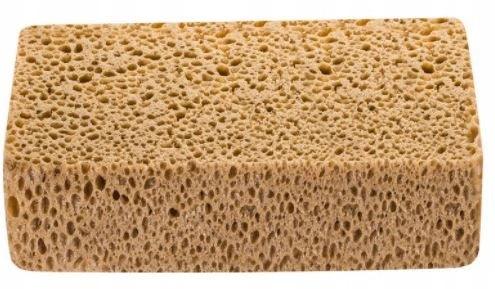
For floor grouting, large-format tile, and bulk render clean-down where ground-coverage speed sets the project pace, the KAEM 20 × 14 × 7 cm sponge delivers a 280 cm² footprint and 70 mm water-holding depth — the largest standard tiling sponge format and the workhorse choice for area-led jobs.
Where the Large KAEM Sponge Earns Its Place
The KAEM 20 × 14 × 7 cm tiling sponge is the bulk-coverage hand sponge in the Renders World power floats and sponges range, built for floor grouting cleanup, large-format wall tile work, and continuous render clean-down across UK trade projects, with a 280 cm² footprint and 70 mm depth that holds enough water to keep a continuous wipe consistent before the next rinse. The format earns its place specifically where wipe count is what limits the working pace — kneeling-position floor work, large-module porcelain wall tile, and elevation-scale render hand-finishing after machine pads.
The size advantage compounds across the working day. A 280 cm² contact area is roughly 50% larger than a mid-format sponge and almost double a compact pad. On a forty-square-metre floor that means real minutes saved through the grouting phase, and minutes saved before grout starts to re-haze in the corners of the area being worked.
Why Trade Installers Choose This Large Format
- 280 cm² footprint covers ground fast — measurable productivity gain on floors, large-format wall tile, and continuous render elevations.
- 70 mm depth holds working water — fewer trips back to the bucket across each grouting or clean-down cycle.
- Large-pore open-cell foam — releases water cleanly and lifts grout haze without smearing the joint line on the return stroke.
- Two-handed control on floors — the size suits kneeling-position grouting where leverage and pressure distribution matter more than fingertip precision.
- KAEM build consistency — dimensional stability and edge integrity hold up across many working cycles with proper rinse care.
Technical Specifications — KAEM 20 × 14 × 7 cm Sponge Data
| Property | Value |
|---|---|
| Dimensions | 200 × 140 × 70 mm |
| Footprint area | 280 cm² |
| Working depth | 70 mm |
| Pore structure | Large open-cell foam |
| Brand | KAEM |
| Primary use | Floor grouting, large-format wall tile, bulk render clean-down |
| Working faces | Four (rotation between rinses) |
| Recommended water | Clean potable water at ambient temperature |
The 70 mm depth matters as much as the surface area. A shallow sponge of the same footprint would saturate quickly and start redepositing pulled grout across the next wipe — depth gives the foam volume to absorb residue throughout a working stroke rather than just at the leading edge.
How to Use the Large KAEM Effectively on Floors and Large-Format Tile
Soak the sponge fully before first use to open the cell structure — fresh foam can briefly repel water until wetted through. Wring to a damp working state, not dripping, so the sponge lifts residue without flooding the joint and softening the bedded grout. On floors, set up two buckets in parallel: one for the dirty rinse, one with clean water for the final wipe across each tile. Cross-contaminating the rinse water with grout slurry is the single most common reason a clean job finishes hazy on inspection.
For the cleanest result on large-format tile, wipe in long diagonal strokes across the joint line rather than along it. Diagonal strokes draw grout out evenly without dragging bedded material from any single joint, which is what creates re-cut joints that have to be topped up before the work signs off. Rotate the sponge to a fresh face every few wipes — the larger format gives four working faces before a rinse cycle is needed, which is part of how the productivity case adds up.
The power floats for render finishing guide from Renders World covers where hand sponges fit alongside machine pads in the surface sequence — useful context for renderers running the KAEM alongside the DED7767 pad ecosystem on continuous elevation work.
How the Large KAEM Compares to Function-Overlap Siblings
The KAEM range progresses by geometry across three formats, each tuned to a different working pattern. The comparison below sits this sponge between its two range neighbours — the same step a tiler makes when assembling a working kit from a single brand line.
| Variant | Key Spec | When to Choose |
|---|---|---|
| KAEM 15 × 10 × 5 cm sponge | 150 cm² · 50 mm depth · compact | Mosaic, small-format tile, corners and detail |
| KAEM 20 × 14 × 7 cm (this) | 280 cm² · 70 mm depth · large square | Floors, large-format tile, bulk render |
| KAEM 23 × 11.5 × 7 cm sponge | 265 cm² · 70 mm depth · elongated | Linear-set tile, reach work, long-shift comfort |
Outside the KAEM line, the mid-format 170 × 110 × 60 mm beige sponge covers the day-to-day general-purpose role between the compact and bulk formats, the dual-density double tile sponge condenses a two-pass workflow into a single tool for mobile work, and the cellulose sponge outperforms foam on the final residue lift on visible tile faces. Most professional kits pair the large KAEM with at least one of the smaller formats rather than running it as the sole sponge.
How Pros Get the Best Result From This Format
Match the sponge size to the working phase rather than to the whole job. The large KAEM earns its productivity on the first and second wipes, where bulk water capacity and ground coverage compress the grouting phase into fewer rinse cycles. For the final residue pass — the wipe that determines whether the tile face reads as cleanly finished or slightly hazy under raked light — a compact sponge or a cellulose pad delivers better control across visible surfaces. Switching format mid-job is not a sign of poor tool selection; it is the productivity logic of the KAEM range.
Renderers using the large KAEM after machine work on continuous elevations benefit from the same water-capacity advantage that suits floor grouting. After the DED7767 power-float sequence has worked the surface texture, the hand sponge pass evens out any localised tool marks and removes residue before the next coat or finish stage. Working top-down on elevations keeps rinse drips falling onto unfinished surface rather than back onto cleaned faces — a small workflow detail that affects how the final pass reads on a finished facade.
For ongoing trade use, store the sponge damp on the same job and allow it to dry fully between projects. Replace when the cell structure breaks down at the edges; foam fragments embedded in a grout joint create rework that costs more time than a fresh sponge does. Renders World ships the KAEM range alongside cleaning products and the wider sponge family in consolidated UK trade orders, so kit refresh and chemical re-stock can move through the same delivery.
Is This Sponge Right for Your Project?
- Floor grouting and large-format wall tile (600 × 600 mm and above): ideal — the format is built for area-led work.
- Bulk render clean-down across continuous elevations: well suited — water capacity matches the scale of the wipe.
- Mosaic, small-format tile, and detail work: consider the KAEM 15 × 10 × 5 cm compact sponge — fingertip control suits small joint grids.
- Linear-set tile, long subway runs, and reach work: the elongated KAEM 23 × 11.5 × 7 cm tracks joint direction with better wrist economy.
- Final residue pass on visible tile: pair with a cellulose sponge — foam moves water, cellulose lifts the last haze.
FAQ — KAEM Large Sponge Use, Compatibility, Care
Is this the right sponge for floor grouting?
Yes — the 280 cm² footprint and 70 mm depth are specifically suited to floor work, where kneeling-position leverage and water capacity matter more than the fingertip precision of a smaller sponge. The size suits two-handed wipes across continuous floor area without the rinse-cycle interruptions a mid-format sponge would impose.
Can it be used on small-format and mosaic tile?
It can, but the size advantage is largely lost on tiles below around 200 × 200 mm. For mosaic and small-format work a compact sponge gives better control over individual joints and tracks the joint grid more accurately. Most professional kits keep both formats on hand and switch between them as the working area changes.
How many working cycles does one sponge last?
The KAEM construction holds together for many working cycles when rinsed properly between uses and stored damp on the same job, then allowed to dry between projects. Replace once the cell edges break down at the corners or the sponge no longer recovers its shape fully after wringing. Bulk-coverage use on floor work tends to wear the format slightly faster than wall use, because the kneeling-position pressure is higher.
Can the large format be used for render finishing?
Yes — the same water-capacity advantage that suits floor grouting works on bulk render clean-down across continuous elevations. The hand sponge typically follows the machine pad sequence on the surface, evening out tool marks and removing residue before the next coat. The render finishing guide covers where hand sponges sit in the full surface sequence.
Does it need to be paired with a smaller sponge?
For most jobs over a few square metres, yes. The large format delivers ground coverage on the first and second wipes, but the final residue pass on visible faces calls for finer control than 280 cm² of contact area allows. A complete tile-cleaning kit usually pairs this sponge with the compact KAEM or a cellulose pad for the last wipe, which is the productivity logic the KAEM range is designed around.

