

Description
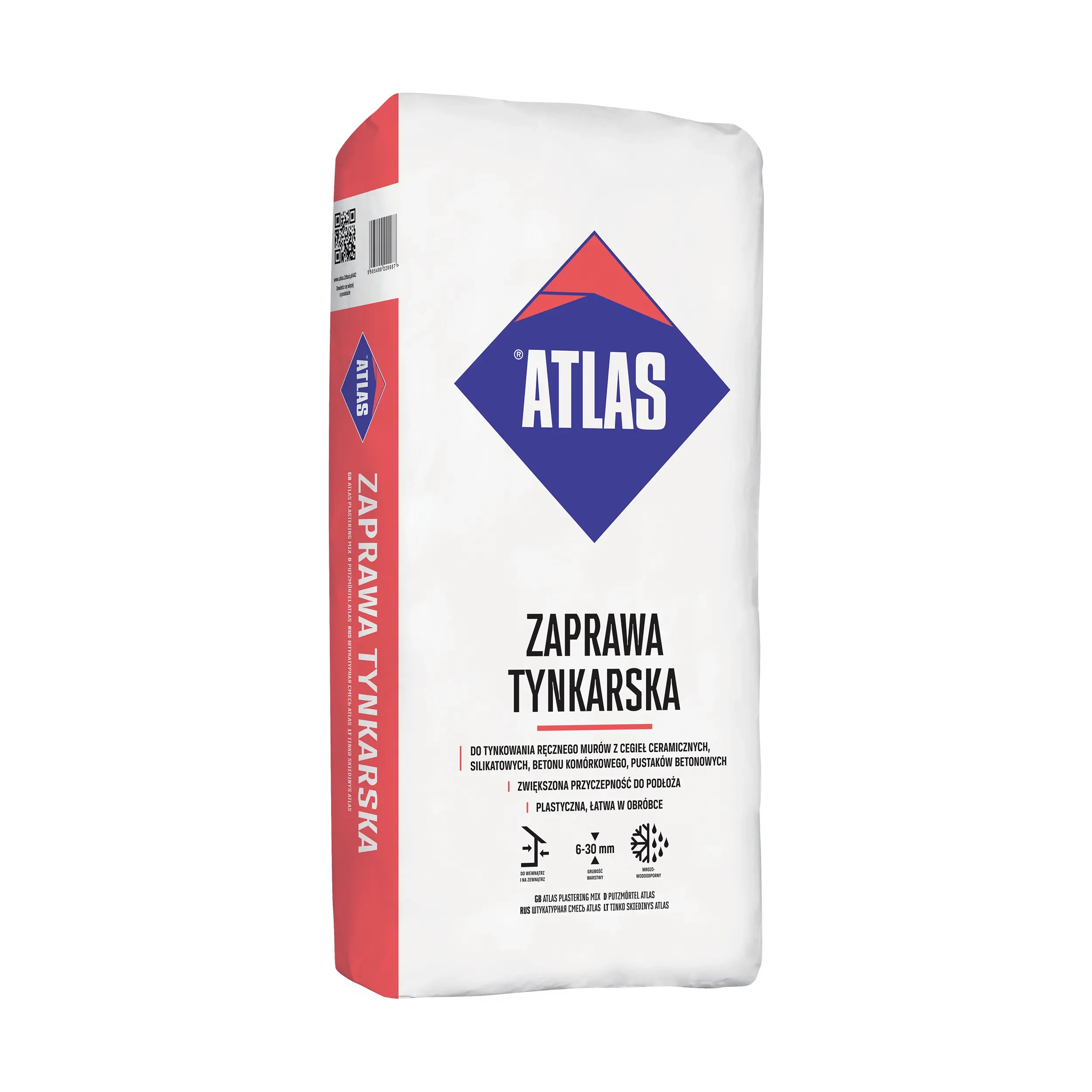
Sold at Renders World as One Coat Dash Cover, this bag is Atlas Plastering Mix M: a cement plaster made for plastering machines and built up as a rough coat followed by a top coat. It belongs with our board adhesives and basecoats, and everything below is what Atlas declares for it.
Atlas Plastering Mix M: What Is in the Bag
Atlas Plastering Mix M is a dry mix of cement binder, quartz fillers and refining additives, with cement and filler in a ratio of 1:4. It is a general-purpose plaster mortar to EN 998-1, for interior and exterior use on walls, ceilings, columns and partitions, and it sets to compressive strength category CS II (1.5–5.0 N/mm²). Atlas lists high ductility and increased adhesion to the substrate as its working properties.
The listing name says one coat; the manufacturer's sheet does not. Atlas specifies a two-layer plaster — a preliminary rough coat, then a top coat — applied with a plastering machine, and both the 2022 English sheet and the 2025 Polish edition say so in the same words. Plan labour, drying time and scaffold days for two passes, not one.
| Property | Declared value |
|---|---|
| Composition | Cement, quartz fillers, additives; 1:4 |
| Application | Plastering machine; rough coat, then top coat |
| Plaster thickness | 6 mm minimum, 30 mm maximum |
| Mixing water | 0.13–0.16 l per kg (3.9–4.8 l per 30 kg bag) |
| Maturation after mixing | Approx. 5 minutes |
| Working time | Approx. 4 hours |
| Substrate and air temperature | +5 °C to +30 °C |
| Bulk density, dry mix | Approx. 1.6 kg/dm³ |
| Compressive strength | CS II (1.5–5.0 N/mm²) |
| Adhesion | 0.3 N/mm², fracture pattern FP:B |
| Water absorption | Class W c 1 to EN 998-1 |
| Water vapour permeability | μ ≤ 30, declared value |
| Reaction to fire | Class A1, as declared |
| Standard | EN 998-1:2016, general-purpose (GP) plaster mortar |
| UK Declaration of Conformity | No. 006-2/2-UK/CPR, UKCA, System 4 |
| Coverage | Approx. 1.6–1.7 m² per 30 kg bag at 10 mm |
| Pack and shelf life | 30 kg paper bag; 12 months |
The English sheet prints the water absorption class as "IN 1C"; the Polish sheet and the UK Declaration of Conformity print it as W c 1, which is the class under EN 998-1 and the one to quote in a specification.
Why Specify It on a Machine Job
- One mortar for both coats. The same bag makes the rough coat and the top coat, so the machine runs one material through the whole build-up.
- A wide thickness window. From 6 mm to 30 mm in total, in the same two-coat build-up.
- Inside and out. Declared for external walls, ceilings and columns as well as internal walls and partitions.
- A UK declaration behind the figures. Reaction to fire A1, water absorption W c 1, vapour permeability μ ≤ 30 and adhesion 0.3 N/mm² are declared under UK Declaration of Conformity 006-2/2-UK/CPR.
- Time to work. About four hours of working time from mixing, after a maturation of about five minutes.
Which Walls It Goes On — and Where a Dashed Wall Stands
Atlas Plastering Mix M is declared for these substrates:
- concrete and ceramic ceilings;
- walls of brick, block, hollow block and similar ceramic or silicate units;
- concrete and aerated concrete;
- cement-bonded particle board;
- existing cement or cement-lime plaster.
Whatever the material, the surface has to be dry, stable, even and load-bearing, and clean of dust, dirt, lime, oil, grease, wax, release-agent residue and paint. Poorly bonded areas are chipped off and loose, crumbling material is taken back with a steel brush.
Atlas does not mention pebbledash by name. A dashed wall is therefore judged against the same test as any other substrate: an existing cement render that is firmly bonded, clean and brought to the even, load-bearing surface the sheet asks for, with every hollow or loose patch removed first. Where the survey leaves doubt, our guide to preparing walls for rendering sets out the order of work.
Where the substrate is too absorbent, Atlas recommends one of three priming emulsions — Grunt NKP used undiluted, Uni-Grunt, or Uni-Grunt Ultra. All three are in our primers range. Joints between cement-bonded particle boards are reinforced with strips of Rabitz-type stainless steel mesh before plastering, and corners and the edges of window and door openings are protected by embedding galvanised steel profiles.
Applying It with a Plastering Machine, Rough Coat to Top Coat
Atlas describes machine application only for this bag: the mortar is prepared in a plastering unit and both coats are applied with it, and no hand method is given.
- Set the guides. Plaster guide strips, fixed mechanically or bedded in the mortar as mesh laths, are what give the finished wall an even plane.
- Mix in the machine. The mortar is prepared in the plastering unit with 0.13–0.16 l of water per kg, adjusted within that range to the consistency, the substrate and the weather. Water outside the range lowers the strength of the plaster.
- Throw the rough coat. The preliminary rough coat goes on first, from the machine.
- Follow with the top coat. Apply it once the rough coat has set but before it has hardened. The 2025 Polish sheet says only "after it has set"; the 2022 English sheet adds the closing limit, and it is the tighter instruction to work to.
- Rule it off. Level the fresh plaster with a long straightedge running on the guide strips.
- Trowel to the finish needed. Trowelling usually follows a further thin layer matching the aggregate size, timed so the surface has not dried out. A base for ceramic tiles is left untrowelled or rough; a base for a gypsum skim is trowelled with a polystyrene float.
Protect the new plaster from drying too quickly — misting it with water is the method Atlas gives — and keep rooms ventilated while internal work dries. Rendered walls crack for several reasons, set out in our guide to cracked render; for this plaster, keep the water dose inside the declared range and protect the fresh coats from fast drying. For how machine work compares with trowel work across a whole elevation, see machine versus hand-applied render.
How Many Bags an Area Takes
Atlas gives approx. 1.6–1.7 m² of plaster 10 mm thick from one 30 kg bag of Atlas Plastering Mix M.
Order on the lower figure:
- Coverage to plan on: 1.6 m² per bag at 10 mm.
- Worked example: a 100 m² wall plastered to 10 mm takes 100 ÷ 1.6 = 62.5, so 63 bags.
- Other thicknesses: the figure is stated for 10 mm, so scale a thicker build-up from it rather than from the 10 mm bag count.
The manufacturer's Polish product page gives the same consumption as about 18.5 kg per m² "for a plaster 10 cm thick". At 10 mm that agrees with the sheet — 30 kg over 1.6–1.7 m² — so the "10 cm" is a misprint on that page, and the sheet figure is the one to order from.
Finishing, Painting and Cleaning Up
- Painting. Facade paint can go on two to six weeks after plastering, depending on the type and colour of the paint. Any facade paint is permitted, and Atlas gives its own Salta paints as the example; the Atlas Salta range is stocked in white and grey bases.
- Walls left unpainted. Use bags from one production batch, each mixed with an identical amount of water, because the colour of Atlas Plastering Mix M is not a declared property and can differ between batches.
- Cleaning. Clean tools in clean water straight after use. Set mortar that will not wash off comes away with Atlas Cement Away, the cleaner the sheet names.
Storage, Weather and Safety
- Working window. +5 °C to +30 °C for the mortar, the substrate and the air throughout the work.
- Below +5 °C. Anti-freeze admixtures may be added, and the temperature range, mixing water, working method and setting conditions then follow the admixture maker's instructions — Atlas takes no responsibility for the admixture.
- Storage. Closed original bags, in a dry, cool, ventilated place, preferably on pallets and out of direct sun, and protected from frost. Moisture hardens the mix irreversibly.
- Shelf life. 12 months from the production date printed on the bag.
- Safety. The mix contains Portland cement, classified as causing serious eye damage, skin irritation and possible allergic skin reaction and as irritating to the airways, so the work calls for eye protection, gloves and dust control.
Ordering, Delivery and Returns
- Dispatch. Orders are processed the same day when the stock is there.
- Delivery. The cost is quoted by the Renders World team after the order is placed, and every delivery is kerbside.
- Collection. Bags can be collected in person from the Renders World counter at Unit 9A, Central Trading Estate, Southampton SO14 5JP, Monday to Friday 7am–5pm and Saturday 7am–12pm.
- Returns. Goods in paper bags stand outside the 14-day change-of-mind return, and this plaster comes in a paper bag — order to the quantity worked out above.
FAQ
Can it be applied as a single coat?
No. Atlas Plastering Mix M is specified as a two-layer plaster: a rough coat, then a top coat once the rough coat has set but before it hardens, both from the machine.
How do I work out the number of bags?
Divide the wall area by 1.6 m² per 30 kg bag, the lower of the two coverage figures Atlas gives for a 10 mm plaster, and round up: 63 bags for 100 m².
Will it go over an existing render?
Existing cement and cement-lime plaster are on the declared list of substrates, provided the surface is sound, even, load-bearing and clean, with poorly bonded areas chipped off first.
What is the lowest working temperature?
Atlas Plastering Mix M is worked from +5 °C to +30 °C, for the mortar, the substrate and the air alike. Below that, work only with an anti-freeze admixture used to its own maker's instructions.
When can the wall be painted?
Facade paint follows two to six weeks after plastering, depending on the paint's type and colour.
How long does an unopened bag keep?
Twelve months from the production date on the bag, kept closed, dry and cool, preferably on pallets. Moisture hardens the mix irreversibly.
Technical Documentation