


Description
Atlas M-System 3G 50mm is the shortest length of Atlas's adjustable disc anchors for fixing plasterboard, fibre cement or wood-based boards to walls, ceilings and attic slopes indoors. Each anchor screws into the wall, carries a round plate on an adjustable joint, and the board is screwed to the plate, so the lining can sit from 14 mm off the wall without battens, frames or levelling first. The 50mm pin is the one to choose when the new face should stay close to the old one. Renders World stocks it with the rest of its drylining range, next to the other three lengths.
Atlas M-System 3G 50mm at a Glance
Why the short pin suits a tight lining:
- Least room lost. The board can sit 14 mm from the wall, so a small room keeps almost all of its floor area.
- No battens, no frame. Each fixing point is an anchor and a plate, so there is no timber or metal grid to set out and cut.
- Old plaster stays. Cracked or uneven plaster does not need hacking off, levelling or priming before you start.
- One fitter is enough. Atlas designs the system for one person: drill and set the anchors, then screw the board to the plates.
- Cables keep their route. Wiring and small pipes already on the wall stay where they are under the lining.
| Property | Atlas M-System 3G 50mm |
|---|---|
| Fixing pin | 3GL M8/ø6.5, length 50 mm |
| Mounting plate | polypropylene, 120 mm across, M8 thread on a ball joint |
| Board to timber base | 14–40 mm |
| Board to concrete or masonry | 14–32 mm, with the UNO-08 sleeve |
| Tilt of the lining | up to ±27° |
| Pin pull-out from C20/25 concrete | at least 1 kN (about 100 kg) |
| Board pull-off at one plate, 12.5 mm plasterboard | at least 0.5 kN (about 50 kg) |
| Plasterboard | 12.5–25 mm |
| Fibre cement board | 8–25 mm |
| Wood-based board | 12–25 mm |
| Use | indoors: walls, ceilings, utility attics |
Which Length Do You Need?
The four lengths do the same job; the pin length sets how far the board can stand off the wall. Measure the deepest hollow on the wall plus anything you want to hide behind the board, then pick the row that covers it on your base:
| Length | Board to timber base | Board to concrete or masonry |
|---|---|---|
| 50 mm | 14–40 mm | 14–32 mm |
| 100 mm | 14–90 mm | 14–50 mm |
| 150 mm | 90–140 mm | 50–100 mm |
| 200 mm | 140–190 mm | 100–150 mm |
On masonry the pin loses part of its length inside the wall, which is why every length reaches less there than on timber. If the Atlas M-System 3G 50mm falls short on a brick wall, the 100mm covers the same starting gap with more room to spare.
What Is in a Pack
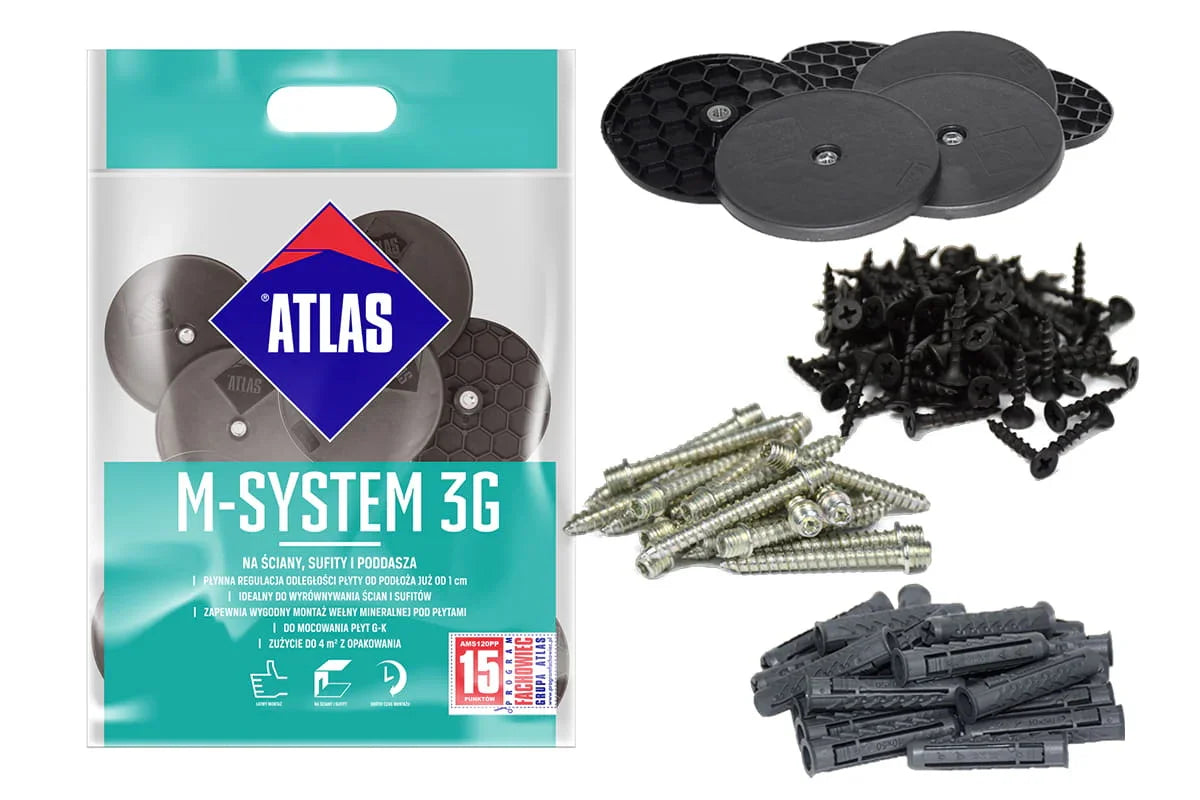
Atlas packs the Atlas M-System 3G 50mm as a kit for 21 fixing points.
- 21 mounting plates, 120 mm across, with the ball joint and M8 thread.
- 21 fixing pins, 3GL M8/ø6.5, with a collar that stops at the wall.
- 21 plastic sleeves for the wall.
- 84 corrosion-protected steel screws, ø3.5 mm, for the boards. At least four go into every plate.
Assembly instructions come in every pack.
Walls and Boards It Works With
The base must be sound and load-bearing, but it does not need to be flat. Atlas lists these bases for the anchors with sleeves: concrete from C20/25 up, aircrete blocks of at least 6 N/mm², solid clay brick of at least 15 N/mm², solid calcium-silicate brick of at least 20 N/mm² and clay hollow blocks with walls at least 12 mm thick. On structural timber of class C24 or better, at least 25 mm thick, the pin goes straight into the wood after a 5 mm pilot hole at least 24 mm deep, with no sleeve.
The boards can be gypsum plasterboard from 12.5 to 25 mm, fibre cement board from 8 to 25 mm, or wood-based board from 12 to 25 mm. Plasterboard on this system is for indoor use only.
Fitting the Atlas M-System 3G 50mm
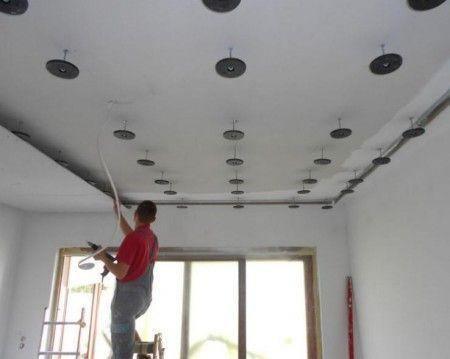
- Mark the anchor grid: 40 to 60 cm apart on walls, 40 cm by 40 to 60 cm on ceilings.
- In masonry, drill each hole and set the sleeve; in timber, drill the 5 mm pilot hole.
- Screw the pin in deep enough: at least 24 mm into timber. On concrete or masonry Atlas sets the 50mm pin in its smaller UNO-08 sleeve, at least 32 mm deep.
- Fit a plate on each pin and set its distance and angle until all the plates form one flat face.
- Offer up the board and screw it to every plate behind it, with at least four screws per plate.
Because each board is held at points, stress between boards evens out as you fit them. Once the joints are filled the boards act as one rigid sheet, which Atlas says keeps cracks from forming at the joints. Keep the lining separate from the walls and ceiling around it, so it can move on its own.
How Many Packs for Your Wall
| Where | Anchor spacing | Area from one pack |
|---|---|---|
| Walls | 40 × 50 cm | about 4 m² |
| Walls | 60 × 40 cm | about 5 m² |
| Walls | 60 × 50 cm | about 6 m² |
| Ceilings | 40 × 40 cm | about 3.5 m² |
| Ceilings | 40 × 50 cm | about 4 m² |
| Ceilings | 40 × 60 cm | about 5 m² |
The spacings are for a single layer of board. A double layer is for walls only, with anchors at 60 × 60 cm, and needs screws long enough for both boards.
Finishing the Lining
For a painted wall, fill the board joints with a reinforcing tape such as the Flizelina fibreglass joint tape, skim the surface with a polymer finish such as Atlas GTA, prime and paint. Ceramic, porcelain or glass tiles up to 25 kg/m² can go straight onto the boards with a flexible tile adhesive.
If the wall is flat enough that the boards only need sticking on, a bonding adhesive such as Atlas Bonder is the simpler route; M-System earns its place where the wall is out of true, cracked or carrying services.
Fire Rating and Approvals
Plasterboard fixed with M-System 3G does not lower the fire resistance of the wall or floor behind it and may raise it, according to Atlas, for walls and floors rated from EI or REI 15 to 60. The system holds a Polish national technical assessment, ITB-KOT-2020/1421.
Atlas M-System 3G 50mm: Common Questions
How close to the wall can the board sit?
From 14 mm. On timber the Atlas M-System 3G 50mm covers 14 to 40 mm, on concrete or masonry 14 to 32 mm.
Do I need battens or a metal frame?
No. Each anchor is its own fixing point, and the board is screwed straight to the plates.
Can I use it on a floor?
No. Atlas makes the floor version with a thicker 3GL M8/ø8.5 pin in other lengths; the 50mm kit is for walls, ceilings and attic slopes.
Can I tile over it?
Yes. Atlas allows ceramic, porcelain and glass tiles up to 25 kg/m² on walls lined with the system, in any format, laid with a flexible tile adhesive after priming.
How many packs for a 3 × 2.5 m wall?
That is 7.5 m². At 60 × 50 cm one pack covers about 6 m², so two packs; at 40 × 50 cm, two packs as well.