
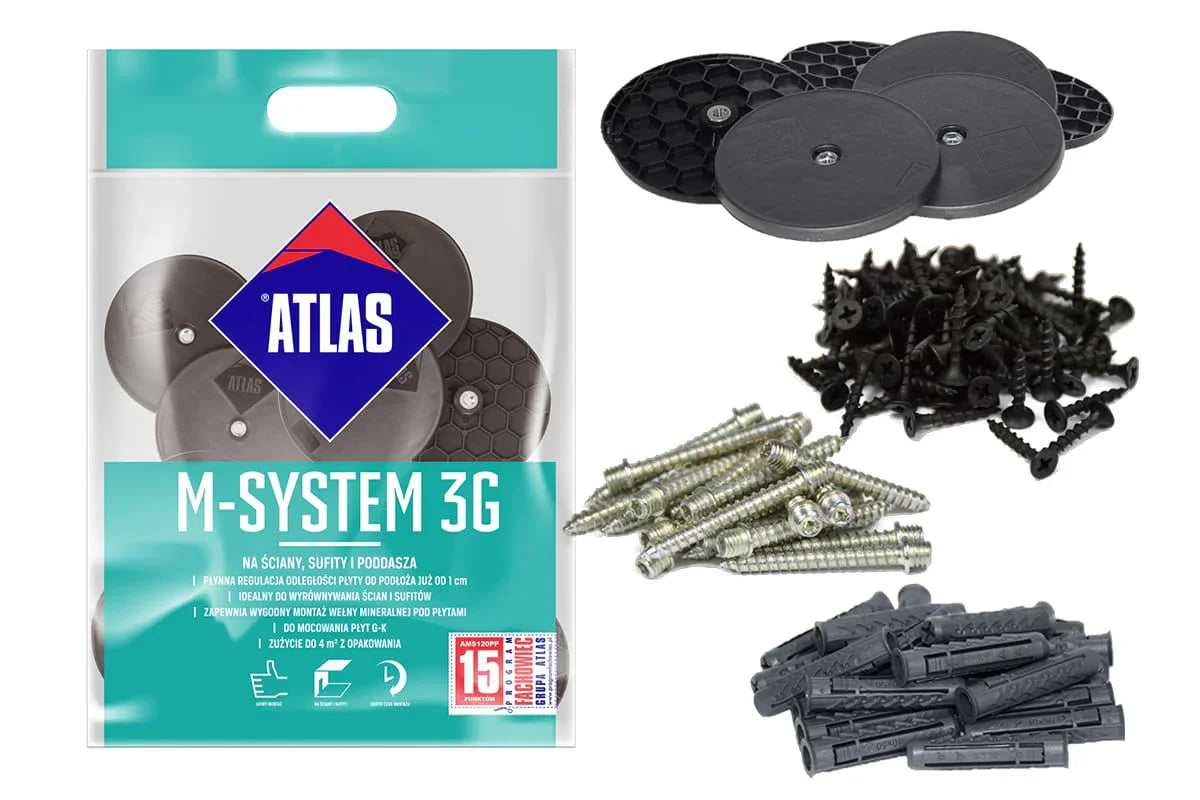


Description
Atlas M-System 3G 50mm takes plasterboard over walls that are badly out of true, or over cables and small pipes you would rather not chase in. Boards screw straight onto the plates, so there is no frame to build. You will find it with the rest of the drylining materials at Renders World, alongside the 100, 150 and 200 mm lengths.
Why Fitters Pick the Atlas M-System 3G 50mm
- It swallows real unevenness. A hollow or bulge of several centimetres disappears behind a flat board; Atlas suggests the anchors wherever boards would otherwise be stuck onto a wall more than 20 mm out of true.
- It starts as low as the shortest pin. Like the 50 mm length it reaches down to 14 mm, so one length can cover a whole wall whose depth varies.
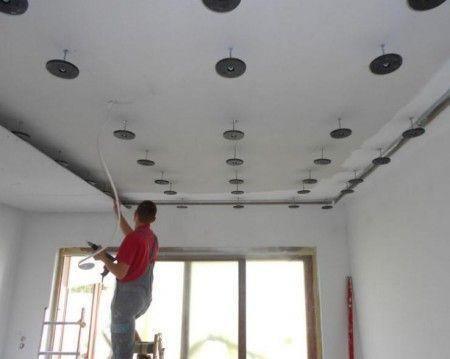
- Services stay put. Cable runs, water and waste pipes can stay on the wall behind the lining.
- One pair of hands. Point fixing lets one person set the anchors and hang the boards.
- Light to carry. A pack fits in a car boot, and the parts take up little space on site.
| Property | Atlas M-System 3G 100mm |
|---|---|
| Fixing pin | 3GL M8/ø6.5, length 50 mm |
| Gap behind the board, timber base | |
| Gap behind the board, concrete or masonry | |
| Plate | polypropylene disc, 120 mm across, M8 thread on a ball joint |
| Lining tilt | up to ±27° |
| Pin pull-out, C20/25 concrete | at least 1 kN (about 100 kg) |
| Board pull-off per plate, 12.5 mm plasterboard | at least 0.5 kN (about 50 kg) |
| Pack | 21 plates, 21 pins, 21 sleeves, 84 screws |
Matching the Length to the Gap
Pick the length by the biggest distance between the wall and the back of the new board, and by what the wall is made of.
| Length | Board to timber base | Board to concrete or masonry |
|---|---|---|
| 50 mm | 14–40 mm | 14–32 mm |
| 100 mm | 14–90 mm | 14–50 mm |
| 150 mm | 90–140 mm | 50–100 mm |
| 200 mm | 140–190 mm | 100–150 mm |
Measure from the wall to where the face of the new board must sit at its deepest point, cables and pipes included, then find the row for your wall. On brick, block or concrete the Atlas M-System 3G 100mm stops at 50 mm; on timber it reaches 90 mm.
What You Can Fix Into
- Concrete from C20/25 to C50/60, reinforced or plain.
- Aircrete blocks with a compressive strength of at least 6 N/mm².
- Solid clay brick of at least 15 N/mm² and solid calcium-silicate brick of at least 20 N/mm².
- Clay hollow blocks of at least 15 N/mm² with walls no thinner than 12 mm.
- Structural timber of class C24 or better and at least 25 mm thick: pre-drill 5 mm and screw the pin in directly, without a sleeve.
The base must be sound and load-bearing. Loose or cracked plaster on top of it can stay: there is no hacking off, levelling or priming.
Boards and Screws
Gypsum plasterboard from 12.5 to 25 mm, fibre cement board from 8 to 25 mm and wood-based board from 12 to 25 mm can all go onto the plates, indoors. Each plate takes at least four of the 84 screws in the pack. A double layer of plasterboard is allowed on walls only, with plates at 60 × 60 cm and screws long enough to pass through both layers; KSSG drywall screws come in 35 and 45 mm lengths.
Plate Spacing and Packs Needed
One pack of Atlas M-System 3G 100mm has 21 fixing points. Spread over a single layer of board, that covers:
| Surface | Spacing | Area per pack |
|---|---|---|
| Wall | 40 × 50 cm | about 4 m² |
| Wall | 60 × 40 cm | about 5 m² |
| Wall | 60 × 50 cm | about 6 m² |
| Ceiling | 40 × 40 cm | about 3.5 m² |
| Ceiling | 40 × 50 cm | about 4 m² |
| Ceiling | 40 × 60 cm | about 5 m² |
| Utility attic, rafters at 70 or 80 cm | every 50 or 45 cm along the rafter | about 7 m² |
Whether the board is 9.5 or 12.5 mm thick makes no difference to the spacing.
How the Wall Goes Up
Atlas reduces each board to two steps: drill the dozen or so holes for its anchors, then screw the board to the plates. In practice, mark the grid, set the sleeves or pilot holes, drive the pins, then turn and tilt each plate until together they form one flat face. Hang the board and screw it to every plate behind it. Where the lining meets the next wall or the ceiling, keep it free of them so it can move on its own; once the joints are filled the boards act as one sheet.
To finish, tape and fill the joints and skim with Atlas GTA for paint, or tile directly onto the boards with a flexible adhesive, up to 25 kg/m². On a wall that is already flat, gluing the boards with Atlas Bonder is the quicker route.
Fire Resistance
Atlas states that plasterboard fixed on M-System 3G does not reduce, and may raise, the fire resistance assumed for the wall or ceiling it covers, for classes EI or REI 15 to 60, based on Polish Building Research Institute classification tests.
Atlas M-System 3G 100mm: Common Questions
What gap does the 100mm anchor cover?
The Atlas M-System 3G 100mm covers 14 to 90 mm between board and a timber base, and 14 to 50 mm on concrete, brick or block.
My wall is out by more than 50 mm. Which length then?
On masonry, the 150mm length takes over from 50 mm up to 100 mm. On timber the 100mm still reaches 90 mm.
Do I need to remove the old plaster?
No. As long as the wall behind is sound and load-bearing, cracked or uneven plaster can stay.
Can I hang the board at an angle?
Yes. The plate sits on a ball joint and the lining can lean by up to 27° either way, which suits sloping walls and attic rooms.
Is it for floors?
No. This kit is for walls, ceilings and attic slopes; Atlas makes the floor version with a different, thicker pin.