


Description
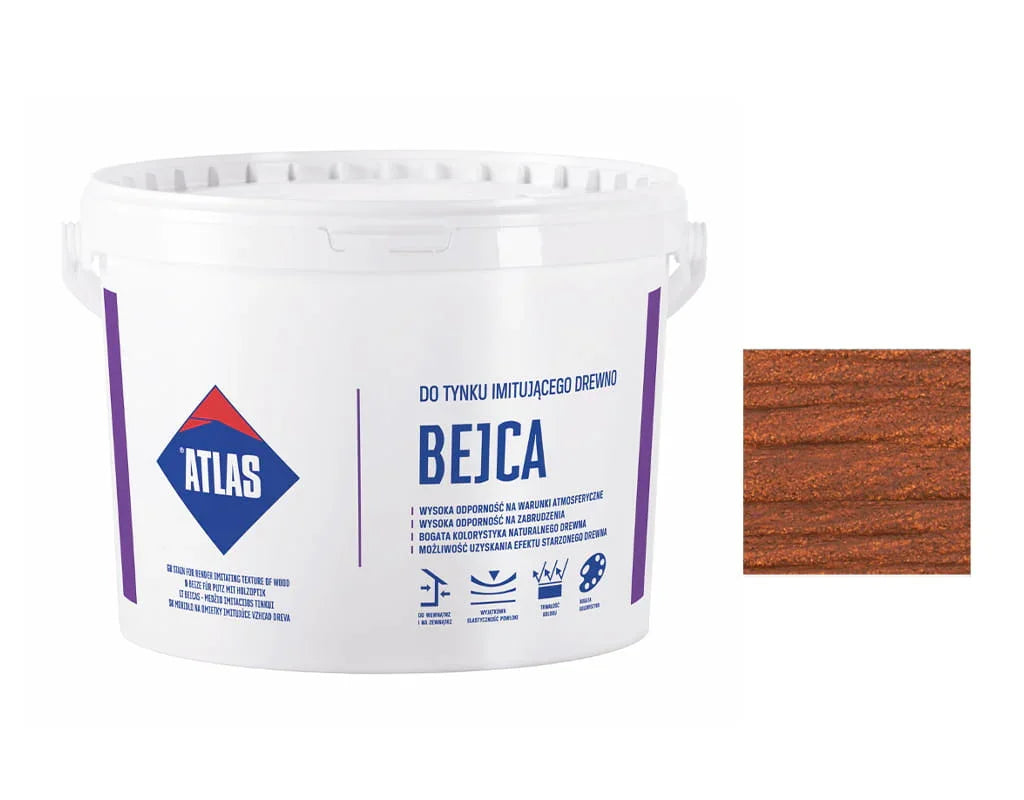
Atlas Bejca Ebony is shade 09 of the ten-colour Atlas Bejca range, the darkest shade it is made in. Renders World keeps it on the shelf beside the walnut, teak and birch shades. It is a semi-transparent tinted impregnant for Cermit WN wood-texture render, supplied in a 4-litre bucket that covers 16–20 m² a coat.
What Atlas Bejca Ebony Is
Atlas Bejca Ebony does one job: a thin coloured protective coating on Cermit WN decorative render, the surface pressed into the texture of natural timber. The colour is carried by semi-transparent pigments chosen for high UV resistance, with small additions of inorganic pigments, so the grain still reads through the tone instead of being painted out.
- Binder: a blend of low-molecular polymer dispersions and silicone resins.
- Backgrounds permitted: Cermit WN first, then concrete, mineral renders of every kind, smooth or textured, gypsum plasters and fillers, and plasterboard.
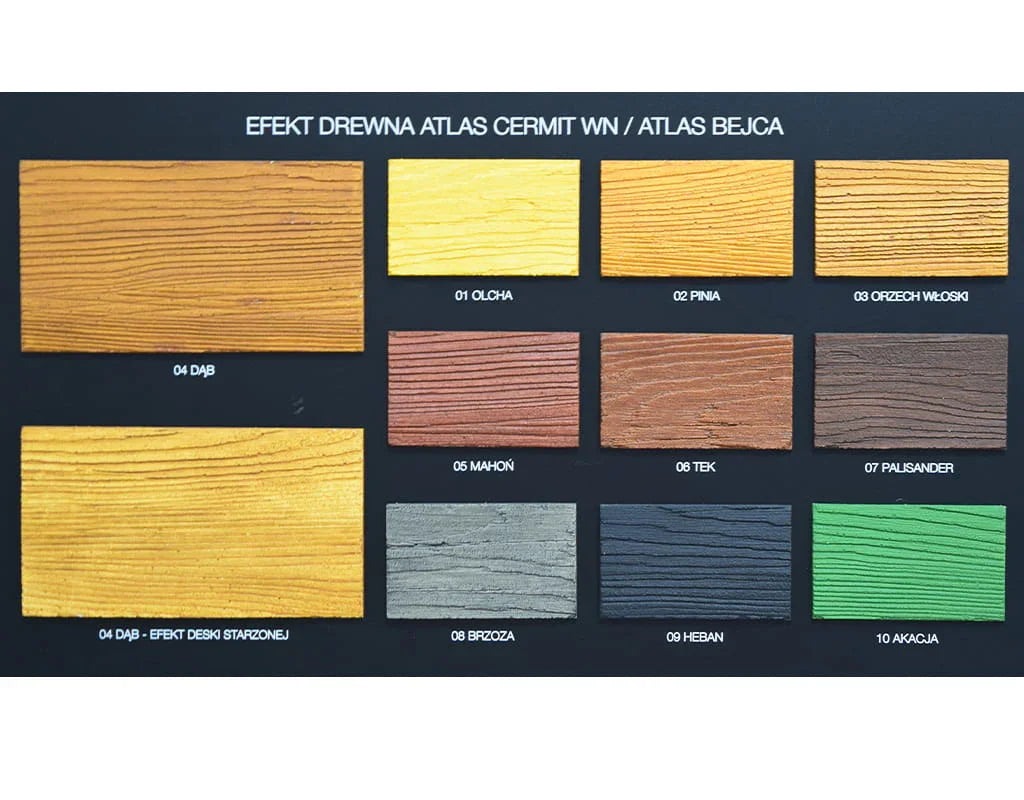
- Range: ten shades — 01 alder, 02 pine, 03 walnut, 04 oak, 05 mahogany, 06 tekwood, 07 rosewood, 08 birch, 09 ebony, 10 acacia. The ten Atlas Bejca shades differ in pigment alone.
Atlas Bejca Ebony is supplied in a 4-litre pack with a storage life of 12 months from the production date printed on it.
Coverage, and How Many Buckets a Wall Takes
Consumption for Atlas Bejca Ebony is stated per litre rather than per pack: 4–5 m² from one litre at a single coat. The pack holds 4 litres, so 4 L × 4–5 m²/L gives 16–20 m² per coat. The Atlas data sheet adds that exact consumption is settled by a trial on the substrate to be painted, which matters here, because a porous freshly cured panel drinks more than a well-closed one.
- Divide the area by 16 m² per bucket per coat — the tight end, not the generous one — and round up.
- Multiply by the number of coats the finish calls for. A 30 m² gable takes two buckets for one coat, four for two.
- One or two layers are both permitted and no second coat is required, so depth of tone is the applicator's decision rather than a rule.
What the Darkest Shade Changes on a Facade
Atlas Bejca Ebony carries one warning about dark colour, and it is aimed at the render underneath: dark, intensive render colours with an HBW below 20 are recommended for limited areas of a facade, since they absorb more solar radiation. It is the deepest tone in the range and the darkest shade Renders World stocks, so on a large, sunny elevation it belongs on limited areas rather than across the whole wall.
- It is not applied to strongly sunlit parts of a facade.
- The painted face is kept out of direct sun before the work and for some 24 hours after it.
- Protective nets go on the scaffold.
- On a large dark elevation this is a working order rather than a ban: south and west faces are coated early or late in the day, and the shade is agreed with the insulation supplier before the buckets are ordered. The wall's side of the same question is covered in our note on dark colours on render and solar heat.
Applying Atlas Bejca Ebony Over Cured Cermit WN
Cermit WN is seasoned at least 3 days first, and its own documentation says the same from the other side: after three days the surface may be covered with the tinted impregnant. Those times hold for setting at +20 °C and 50 % air humidity, so a cold damp week is not three days. New cement and cement–lime renders take at least 14 days at 2 % moisture, concrete at least three months under 2 %, gypsum substrates and boards under 2 %. Whatever the background, it is dry, sound and free of contamination.
- Conditions. Substrate and air between +10 °C and +30 °C, relative air humidity under 80 %.
- Stir. The impregnant arrives ready to use and is never combined with any other material. Stir it thoroughly with a slow-speed paint mixer before starting, and again during the work if the consistency needs evening out.
- Lay it on. Brush, roller or sponge, worked along the pressed grain of the plank rather than across it. One even thin layer, no runs and no missed patches, every recess of the grain covered. Leaving unpainted spots is not acceptable, and on this shade a missed groove is visible from across the road.
- If sprayed. Mask the adjoining facade, the windows and the doors first.
- Drying. Roughly 30 minutes, widening to between 30 minutes and some two hours with substrate, temperature and humidity. Early resistance to rain comes after some 24 hours, and until the film has dried through the face is protected from dust and rain.
- One wall, one batch. Coating of a single production date goes on a single surface, because different dates can differ slightly in shade.
- Afterwards. Tools are cleaned with clean water straight after use.
There is also a two-stage method for an aged timber look: the stain is worked back with a sponge and left to dry fully, then a coat of transparent Bejca goes over it to protect the surface. The transparent grade is a separate product from the ten tinted shades, so both materials are planned before the first stage starts.
The Rest of the Wood-Effect Set
The tone is the last step of a four-part method, and the other three sit on the same shelf.
- Cermit WN mineral render — laid some 4 mm thick at roughly 2.5–3.0 kg per square metre, in 25 kg bags. The pattern is pressed into it 20 to 60 minutes after laying, and that window is what the whole job turns on.
- Silicone wood stamp, 200 × 20 cm — presses the grain.
- Anti-adhesive agent for silicone moulds — keeps render off the stamp. The Cermit WN documentation requires the mould to be greased thoroughly before use.
- The full sequence from substrate to finish is set out in our step-by-step guide to decorative effect renders, and shade choice in our guide to sealers for decorative renders.
The Four Shades Renders World Stocks
- 08 Birch — the palest of the four.
- 06 Teak — the warm mid tone.
- 03 Walnut — the mid brown.
- 09 Ebony — this one, the darkest.
Since the shades differ in pigment alone — same binder, same consumption, same permitted backgrounds, same pack — choosing between them is a choice of colour and of nothing else, and Atlas Bejca Ebony is the end of that scale rather than a different material.
Technical Data and the Limits Atlas Sets
| Property | Value |
|---|---|
| Density | 1.02 kg/dm³ |
| Consumption | 4–5 m² per litre, one coat |
| Pack | 4 litre bucket |
| Application temperature | +10 °C to +30 °C |
| Air humidity during the work | under 80 % |
| Drying | 30 minutes to two hours |
| Early resistance to rain | after about 24 hours |
| Water absorption, 24 h | 200 g/m² or less, over Cermit WN |
| Relative diffusion resistance | 1.0 m or less |
| Scrub resistance | over 5000 strokes, PN-C/81913 |
| VOC content | under 129.9 g/l, category A/f/FW |
| VOC permitted | 130.0 g/l for that category |
| Storage life | 12 months from the production date on the pack |
| ATLAS ETICS kit | ITB-KOT-2020/1616, issue 3 |
| ATLAS ROKER kit | ITB-KOT-2021/1919, issue 2 |
| ATLAS ROKER EPS kit | ITB-KOT-2020/1188, issue 1 |
The coating is excluded on horizontal surfaces, on surfaces under permanent direct action of water and snow, and where damp rises by capillary action.
Questions Buyers Ask
- Does it have to go on Cermit WN? No. Cermit WN is what Atlas Bejca Ebony is designed around, but concrete, mineral renders of every kind, gypsum plasters and fillers and plasterboard are all permitted, each with its own seasoning and moisture limit.
- What keeps the tone from fading? Bejca's colour is carried by semi-transparent pigments selected for high UV resistance. An unopened bucket keeps for 12 months from the production date on the pack.
- Can it go indoors? Gypsum plasters, fillers and plasterboard are permitted backgrounds, so an interior wall is within what Atlas Bejca Ebony is made for.
Technical Documentation
- ATLAS BEJCA karta techniczna, update date 2023-09-04 (PDF)
- ATLAS BEJCA Technical Data Sheet, English edition, update date 2023-04-05 (PDF)
Atlas Bejca Ebony is the shade to pick when the brief wants the darkest end of the timber range. The rest of the method, and the walnut, teak and birch shades Renders World stocks beside it, sit together in our range of decorative effect renders.