

Description
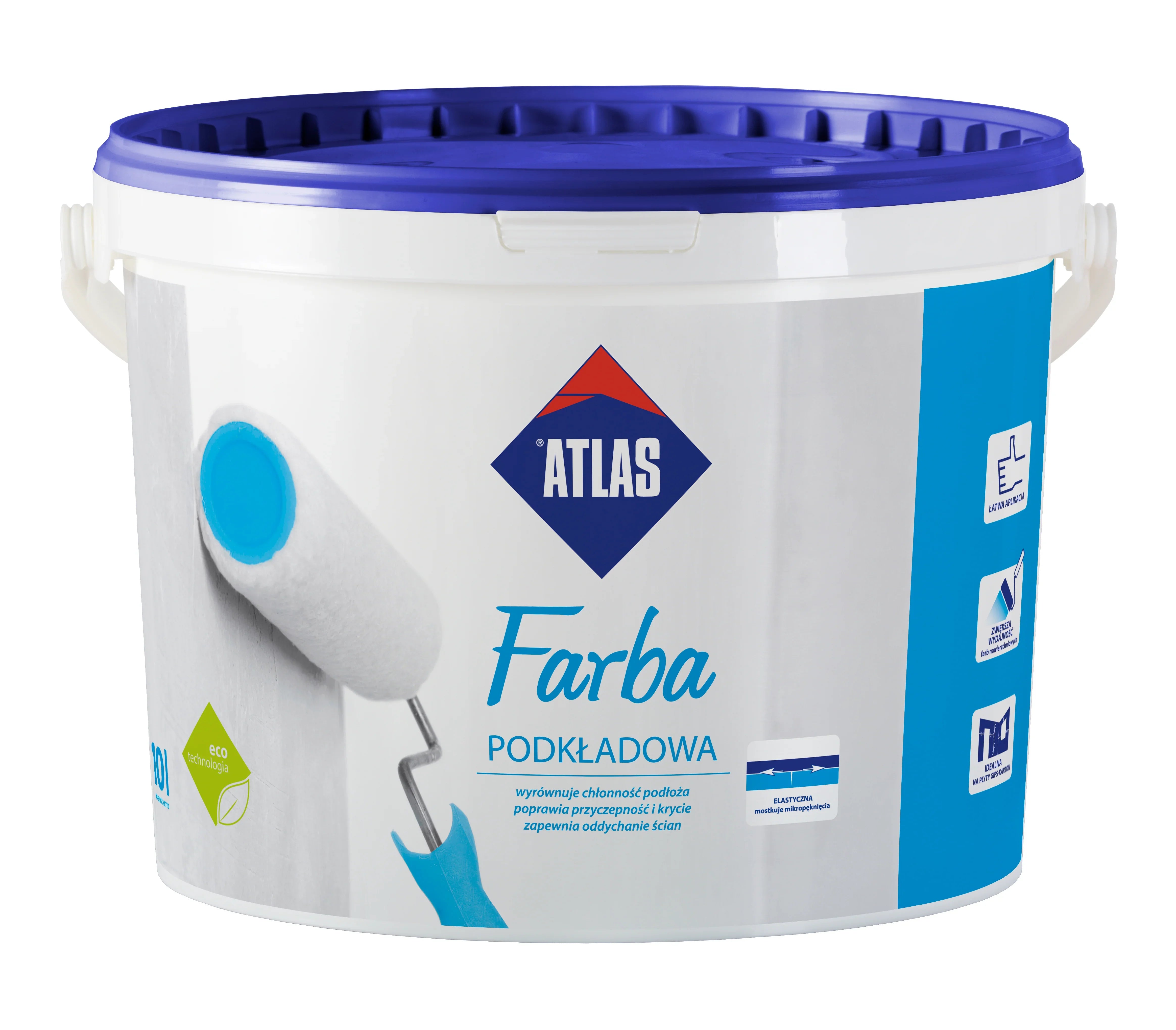
Atlas Base Coat Paint is a white, matt acrylic base coat for interior walls and ceilings, sold in a 10 litre bucket. It goes on before an acrylic or latex topcoat and makes a patchy wall take paint like one even surface — so the colour comes up in one tone and the first coat of topcoat is no longer needed. On plasterboard, made-good plaster and old matt emulsion it is the coat that stops ghosting at joints and patches. It sits with the rest of the primer range at Renders World.
What Atlas Base Coat Paint Does Before the Topcoat
A wall made of different materials pulls water out of paint at different speeds. Filled board joints, fresh skim and old emulsion sit side by side, and a topcoat laid straight onto them dries unevenly — the joints and patches show through as shadows. Atlas Base Coat Paint evens that out first. Atlas builds it on an acrylic binder with fillers, and lists four main uses:
- Interior walls and ceilings — the base coat under an acrylic or latex topcoat.
- Plasterboard and uneven textures — the two cases Atlas singles out as particularly suitable.
- Renovation over latex — over existing matt and semi-gloss latex coatings.
- Wood — wood and wood-based products.
The substrate list is long: cement and cement-lime plasters, thin-layer mineral plasters, gypsum plasters and finish coats, polymer-based plasters, plasterboard, paper wallpaper, and unplastered walls of concrete, brick, block and hollow block.
Why Choose This Base Coat Paint for Walls
- One tone from the topcoat — it evens out the absorbency of the substrate, so the topcoat dries evenly.
- It stands in for a coat of paint — Atlas states that it effectively replaces the first coat of topcoat, which is where the saving comes from.
- Better hiding — it improves opacity and reduces how much the texture and colour underneath show through.
- Better grip for the topcoat — the topcoat adheres better to the wall.
- Hides hairline cracks — the dried film is flexible and bridges micro-cracks up to 100 µm.
- Lets walls breathe — the coat is vapour-permeable.
- Built for spraying — Atlas calls it ideal for airless spray work, with machine settings published for it.
Atlas Base Coat Paint Technical Data
| Property | Value |
|---|---|
| Type | White acrylic interior paint, matt finish |
| Coverage | Up to 8 m² per litre in one coat on a smooth surface |
| Coverage of the 10 l bucket | Up to 80 m² in one coat, smooth surface |
| Density | Approx. 1.45 kg/dm³ |
| Viscosity | 6,000–9,000 cP (Brookfield) |
| Drying to grade 3 | 2 hours at 23 °C and 55 % relative humidity |
| Topcoat after | Minimum 2 hours |
| Working temperature | +5 °C to +25 °C, during work and drying |
| Crack bridging | Micro-cracks up to 100 µm |
| Wet scrub resistance | PN-C-81914, Type I |
| Thinning | Max 0.2 l of water per 10 l bucket |
| VOC content | Below 29.9 g/l (limit 30 g/l, Cat. A/a/FW) |
| pH value | 7–9, undiluted |
| Approval | PZH hygiene approval |
| Storage | +5 °C to +30 °C, tightly closed, protected from frost |
| Shelf life | 24 months from the production date |
Drying in Real Rooms
Drying and topcoat times are measured at 23 °C and 55 % relative humidity. A cool or humid room needs longer before the topcoat goes on, and the room must stay between +5 °C and +25 °C until the coat is dry.
Does the Wall Need a Primer First?
Only if it is highly absorbent or dusty. Then a priming emulsion from Renders World goes on first, and in every case it should dry to a matt surface before the base coat follows. A wall already painted with emulsion is non-absorbent and takes Atlas Base Coat Paint without a primer.
| Wall | What goes on first |
|---|---|
| Absorbent or dusty, no mixing wanted | Atlas NKP gel primer, undiluted |
| Absorbent or dusty | ATLAS Uni-Grunt, 1:3 with water by weight |
| Absorbent or dusty, concentrate | Atlas Uni-Grunt Ultra concentrate, 1:8 with water by weight |
| Painted with emulsion | Nothing — the base coat goes straight on |
| Wallpapered | Test the bond first; loose paper can blister |
| Mould patches | Clean and protect them with Atlas Mykos Plus |
How to Apply Atlas Base Coat Paint
How Long New Walls Need to Cure
Cement and cement-lime plaster: 3–4 weeks. Gypsum plaster: 2 weeks. Plasterboard: as soon as the jointing compound is dry.
- Prepare the wall. It must be air-dry, without cracks and clean of dust, dirt, wax and grease. Strip old distemper and any layer that holds poorly; wash old emulsion with water and detergent and let it dry.
- Repair the surface. Fill cracks and holes with Atlas GTA ready filler, one of the fillers Atlas names for surface repairs, and let it dry.
- Prime where needed. Use one of the priming emulsions in the table above on absorbent or dusty areas.
- Stir. The paint comes ready to use and must not be mixed with other materials. Stir it well with a low-speed mixer and a paint paddle.
- Thin only for hand work, if at all. Add up to 0.2 l of water per 10 l bucket and keep the same ratio over the whole wall.
- Apply thin and even. Use a roller, brush or spray. Airless settings from Atlas: Graco CED StMax II 595, PAA517 nozzle, 60 mesh filter, 220 bar, undiluted or with 5 % water.
- Topcoat after 2 hours. Wait at least 2 hours, longer in a cool or damp room, and keep the room between +5 °C and +25 °C.
On drywall, prime before any painter's tape goes on, and take the tape off carefully. Wash tools in clean water straight after use, before the paint dries on them. The room is ready to use once it has been aired and the smell has gone.
Base Coat Paint or Render Primer?
Atlas Base Coat Paint is made for the inside of a building: walls and ceilings under an acrylic or latex paint. A façade under thin-coat render needs a different product — a quartz-filled key coat that gives the render grip. Use this table to pick the right one:
| Job | What to use |
|---|---|
| Interior walls and ceilings before emulsion | Atlas Base Coat Paint |
| Bare, dusty or very absorbent wall, any stage | A priming emulsion first (NKP, Uni-Grunt, Uni-Grunt Ultra) |
| Outside wall before thin-coat render | A quartz key coat from the render primer range |
For the outside of the house, the primer comparison for UK render systems picks the key coat by wall type, and the guide to rendering on brick, block and painted walls covers what each wall needs first.
How Much Base Coat Paint to Order
Atlas Base Coat Paint gives up to 8 m² per litre in one coat on a smooth surface; consumption rises with the absorbency of the wall. Work from the bucket:
- One 10 l bucket — up to 80 m² of smooth wall in one coat.
- A room with 40 m² of walls and ceiling — one bucket.
- 100 m² of walls — two buckets, with paint left over.
- A bare or dusty wall — order a primer with the paint, so both arrive together.
Orders are processed the same day when the stock is there, and the team quotes delivery after the order. You can also collect in person from the Renders World counter in Southampton during opening hours.
FAQ — Coverage, Drying and Use
How many buckets do I need?
Divide the area by 80 m² — one 10 l bucket of Atlas Base Coat Paint covers up to 80 m² in one coat on a smooth surface. A more absorbent wall uses more paint, so prime it first rather than planning a second coat.
How soon can I put the topcoat on?
After at least 2 hours. That time is measured at 23 °C and 55 % humidity; in a cool or damp room, give it longer.
Can I use it on new plasterboard?
Yes. Plasterboard is one of the two cases Atlas singles out. Paint it as soon as the jointing compound has dried; prime it before any painter's tape goes on.
Can it go over old emulsion?
Yes. Matt and semi-gloss latex coatings are a listed renovation use for Atlas Base Coat Paint. Wash them with water and detergent, let them dry, and apply it without a primer.
Can I thin it?
Only a little: up to 0.2 l of water per 10 l bucket for hand work, or up to 5 % water for airless spraying. Keep the same ratio across the whole wall, and never mix it with other materials.
What protection do I need when spraying?
Spraying can form fine droplets that should not be breathed, so wear respiratory, eye and hand protection. The paint is not classified as dangerous, but it contains a preservative that may cause an allergic reaction. Keep it out of reach of children.
Can it go under render outside?
No. It is an interior base coat for walls and ceilings under acrylic or latex paint. A façade under thin-coat render takes a quartz key coat.
How long does a bucket keep?
24 months from the production date on the bucket. Keep it tightly closed in a cool, dry place between +5 °C and +30 °C, and protect it from frost.
Technical Documentation