MOSAIC RENDERS
2 products
Showing 1 - 2 of 2 products
Mosaic Renders UK for Plinths — Quartz Decorative Finishes for High-Wear Facades
Product Overview — What This Category Covers
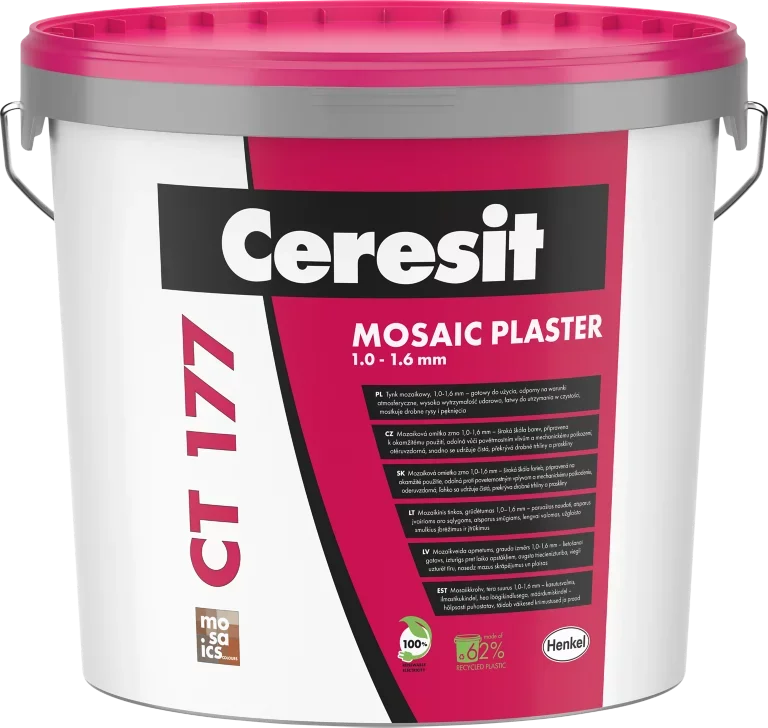
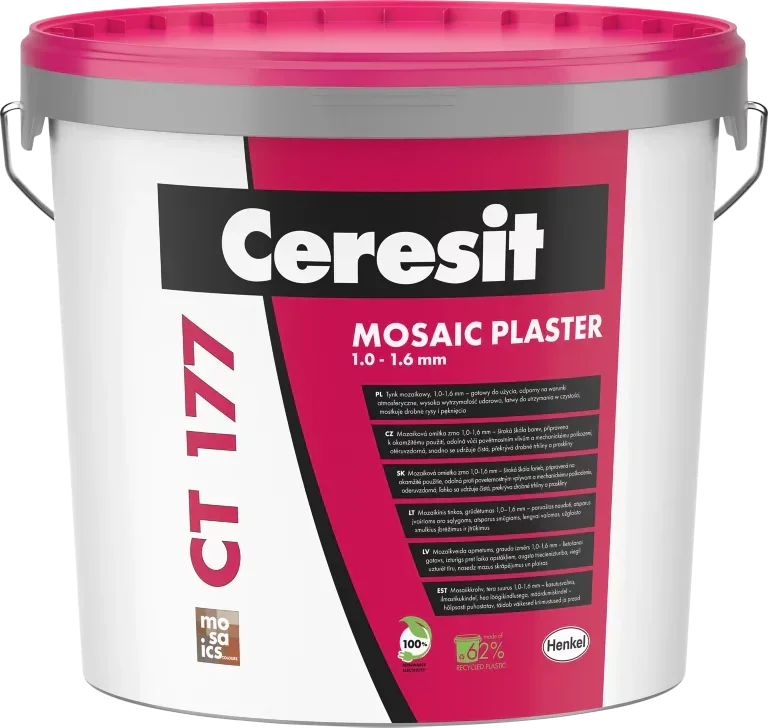
A long-lasting, impact-proof plinth finish starts with the right material — and mosaic render is the specialist decorative coating engineered specifically for the low-level zones that take the hardest punishment on any facade. Within the rendering materials range at Renders World, this collection features the Ceresit CT 177 system in two professional pack sizes — a 25 kg bucket covering approximately 6 m² and a 10 kg bucket covering approximately 2.5 m² — both delivering the same resin-bound quartz aggregate finish designed to protect plinths, entrance surrounds, window reveals, and any area exposed to splashback, mechanical impact, and daily wear.
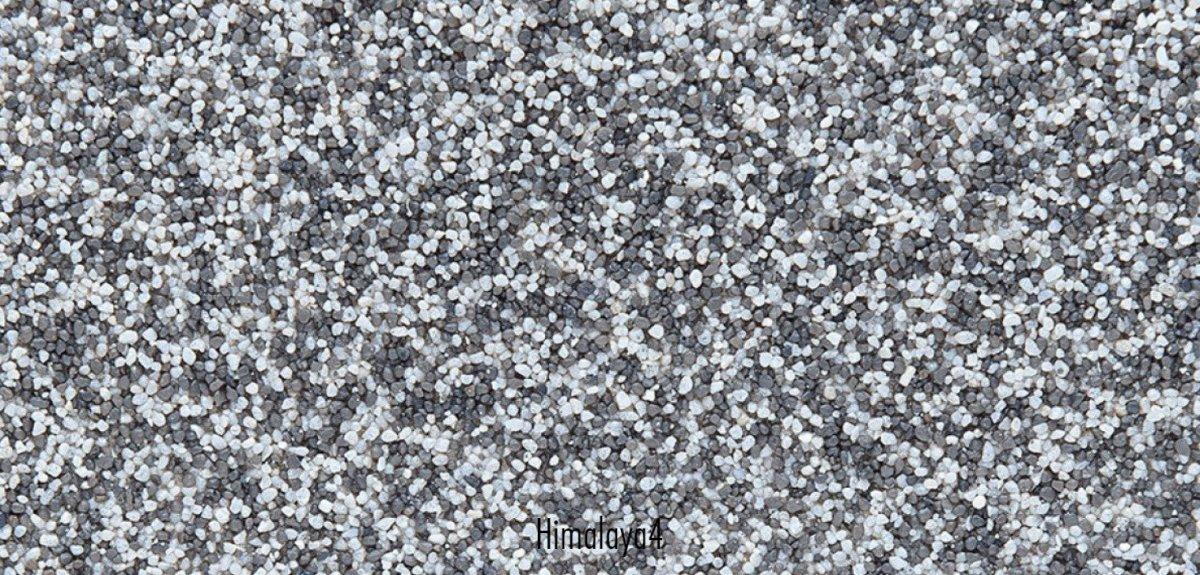
Both packs use the identical formulation — transparent acrylic resin blended with 1.0–1.6 mm coloured quartz aggregate — so the choice between them is purely about project scale, not performance. The finished surface resists driven rain, tolerates regular cleaning, and retains its colour for years because the pigment sits within the aggregate itself rather than on top as a paint film. For specifiers, the CT 177 carries European Technical Assessments across multiple Ceresit Ceretherm insulation systems and a Declaration of Performance (No. 00469) under EN 15824:2017 (current edition as of March 2026), confirming its classification for water absorption, vapour permeability, and impact resistance in certified facade build-ups.
Key Benefits & Technical Advantages
- Impact-Proof Plinth Protection: Your plinth stays intact even when hit by lawnmowers, bicycles, or foot traffic, because the resin-bound quartz aggregate achieves Category I impact resistance under ETAG 004 (current edition as of March 2026) — the highest classification for thin-layer decorative plasters, meaning the finish absorbs everyday knocks without cracking or chipping.
- Rainwater Repellency That Still Lets Walls Breathe: Splashback and driven rain bead off the surface instead of soaking in, thanks to a Class W3 water-absorption rating (w ≤ 0.1 kg/m²·h⁰·⁵ under EN 15824:2017). At the same time, V2 vapour permeability (Sd 0.14–1.4 m) allows internal moisture to migrate outward, so damp never builds up behind the finish — essential for solid-wall properties without a cavity.
- Colour That Lasts Without Repainting: The mosaic textured finish keeps its appearance year after year because colour is embedded within the quartz grains themselves, not applied as a surface coating. There is no paint film to peel, chalk, or fade under UV exposure, which eliminates the cyclical repainting cost that conventional masonry paint demands.
- Easy Cleaning for Mud, Road Spray, and Pollution: Dirt from ground-level splashback rinses off with a garden hose or a soft-pressure wash, keeping plinths presentable between maintenance cycles and reducing long-term upkeep to a simple seasonal rinse.
- Crack-Free Finish Through Seasonal Temperature Swings: The flexible acrylic-resin binder stretches with the substrate as masonry expands and contracts across seasons (the transparent resin matrix absorbs micro-movement rather than resisting it), so the finish stays seamless where a rigid cement-based plinth coating would develop hairline cracks.
- Certified System Compatibility for Specification Confidence: CT 177 holds European Technical Assessments across Ceresit Ceretherm Popular, Classic, Premium, Visage, and Wool Classic systems, giving architects and developers a clear compliance pathway when specifying the plinth zone of an insulated facade.
Technical Specifications / Selection Guide
Both products share the same Ceresit CT 177 formulation, so every performance value below applies equally to the 25 kg and 10 kg pack. The only variable is bucket weight and the area each one covers — use the table to confirm the right size for your project and to cross-check specification requirements.
| Property | CT 177 — 25 kg | CT 177 — 10 kg |
|---|---|---|
| Grain Size | 1.0–1.6 mm | 1.0–1.6 mm |
| Approximate Coverage | ~6 m² per bucket | ~2.5 m² per bucket |
| Yield | ~4.0 kg/m² | ~4.0 kg/m² |
| Density | ~1.75 kg/dm³ | ~1.75 kg/dm³ |
| Adhesion (EN 15824:2017) | 0.6 MPa | 0.6 MPa |
| Water Absorption (EN 15824:2017) | W3 — w ≤ 0.1 kg/m²·h⁰·⁵ | W3 — w ≤ 0.1 kg/m²·h⁰·⁵ |
| Vapour Permeability (EN 15824:2017) | V2 — Sd 0.14–1.4 m | V2 — Sd 0.14–1.4 m |
| Impact Resistance (ETAG 004) | Category I | Category I |
| Interlayer Adhesion After Ageing (ETAG 004) | ≥ 0.08 MPa | ≥ 0.08 MPa |
| Water Absorption 24 h (ETAG 004) | < 0.5 kg/m² | < 0.5 kg/m² |
| Thermal Conductivity (EN 15824:2017) | λ = 0.61 W/(m·K) | λ = 0.61 W/(m·K) |
| Application Temperature | +10 °C to +25 °C | +10 °C to +25 °C |
| Preliminary Drying Time | ~30 min | ~30 min |
| Rain Resistance | ~3 days | ~3 days |
| Fire Reaction (EN 13501-1) | B-s1,d0 / B-s2,d0 (system-dependent) | B-s1,d0 / B-s2,d0 (system-dependent) |
| Best For | Full-house plinths, trade volumes | Small repairs, feature panels, reveals |
Application & System Compatibility
Mosaic render delivers its full performance when applied over the correct prepared substrate and primed with a quartz-based primer such as Ceresit CT 16 or Atlas Cerplast. The primer evens out substrate suction and creates a keyed surface for the resin to grip — and tinting the primer close to the mosaic aggregate colour prevents the grey basecoat from showing through the transparent binder, giving you a richer, more uniform finish from the first coat.
- EWI Plinth Integration: Mosaic render is the recommended decorative finish for the plinth zone (typically 300–600 mm above ground level) of external wall insulation systems using XPS or high-density EPS boards, providing combined impact protection and water resistance where the facade meets the ground.
- Substrate Preparation: The finish works best on mature cement or cement-lime plasters (28+ days old), concrete (3+ months old, moisture content ≤ 4 %), and reinforced basecoat layers made with Ceresit ZU, CT 85, CT 190, or CT 100 mortar (3+ days old). Each substrate type requires CT 16 quartz primer; gypsum substrates (interior only) need CT 17 deep-penetration primer first, followed by CT 16.
- Wet-on-Wet Application: Each elevation must be completed in a single uninterrupted pass, because the resin begins curing within approximately 30 minutes. Planning each wall as one session eliminates visible lap joints between dry and fresh material.
- HBW Colour Guidance: Lighter aggregate shades suit any facade area without restriction, while darker, more heat-absorbing blends — those with a light-reflectance value (HBW) below 20 — perform best on smaller zones such as plinths and reveals, because large south-facing elevations in dark mosaic can absorb enough solar heat to warm the insulation layer beneath. Our decorative facade design guide covers safe colour-zoning strategies for mixed-finish projects.
Trade Insight: Pro Application Notes
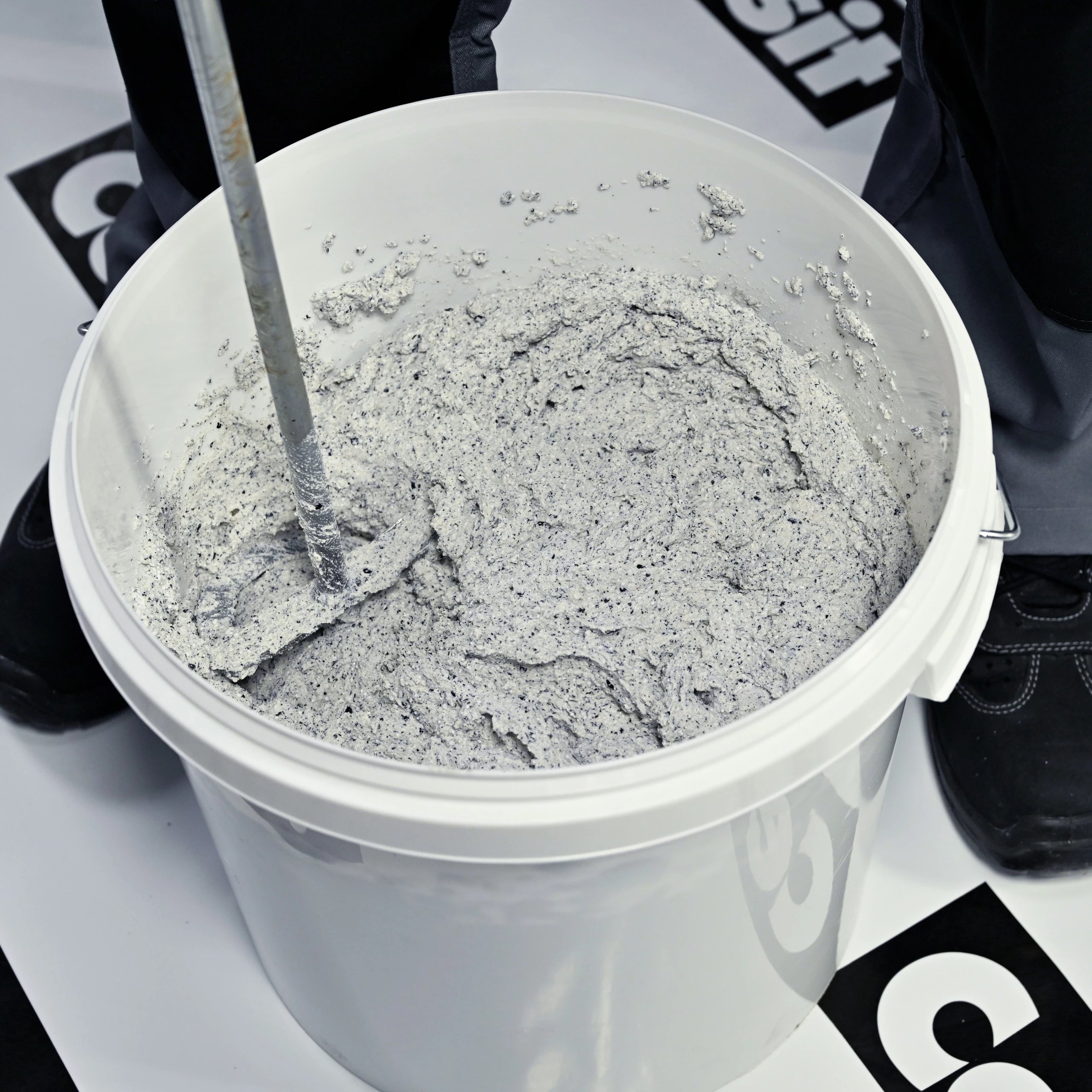
Getting a seamless mosaic finish comes down to preparation and pace. Stirring each bucket on a slow-speed drill with a basket mixer gives you a homogeneous consistency without aerating the resin or shifting pigment — fast mixing introduces air bubbles that cure as cloudy patches. Applying with a stainless-steel float at roughly 1.5 × grain thickness in one consistent direction lets the aggregate settle into its natural texture, and avoiding circular trowelling preserves the even, unpatterned surface that clients expect. If a break mid-wall is unavoidable, masking a straight line with adhesive tape, rendering up to it, and removing the tape while the material is fresh gives you a clean restart edge. Protecting the finished surface from rain for at least three days with scaffold netting or tarpaulins prevents the temporary milky appearance that can occur when uncured resin contacts water — a cosmetic effect that clears completely on drying, so protecting the surface keeps your handover on schedule. For a full step-by-step plinth application guide covering DPC junction detailing and primer colour-matching, see our installer walkthrough.
Is This Right for Your Project?
- Yes — if you need a durable plinth or low-level finish: Mosaic render is the right specification when standard masonry paint would mark too easily and a conventional thin-coat render would be more vulnerable to impact at ground level. Choose it for plinths, entrance surrounds, window reveals, and any facade zone exposed to splashback, knocks, and regular cleaning.
- Pick the right pack size for your area: The 25 kg Ceresit CT 177 bucket covers approximately 6 m² and suits full-house plinths and trade-volume jobs, while the 10 kg Ceresit CT 177 bucket covers approximately 2.5 m² and is the practical choice for small repairs, feature panels, and reveal zones.
- Consider a silicone render for full main elevations: If your project requires a self-cleaning decorative finish across a large wall area above plinth height, a silicone or silicone-silicate topcoat from the premium silicone render collection offers superior vapour permeability and hydrophobic performance over broad exposed surfaces — and our guide to managing algae on rendered facades explains why breathability matters most on larger elevations.
Frequently Asked Questions
How many buckets of mosaic render do I need for a typical house plinth?
A standard semi-detached house plinth of roughly 15–18 m² usually requires three to four 25 kg buckets at the stated yield of approximately 4.0 kg/m² (each 25 kg bucket covers around 6 m²). To calculate your quantity, measure the full perimeter length and multiply by the plinth height — typically 300–600 mm — then add 5–10 % for corners, reveals, and normal site wastage. For short sections or repairs, a 10 kg bucket covering approximately 2.5 m² keeps waste to a minimum.
Can I apply mosaic render myself, or should I hire a professional?
For the most consistent visual result, mosaic render is best treated as a professional-application product — an experienced renderer controls float pressure, timing, and the wet-on-wet technique to deliver a seamless, uniform finish across each elevation. Each wall must be completed in a single pass before the resin begins curing — roughly 30 minutes — so planning and preparation are essential. A small feature panel or short plinth section is a reasonable starting project for a confident DIYer with rendering experience, and for a full-house plinth, hiring an experienced renderer is the most reliable route to a flawless result.
Is mosaic render breathable enough for solid-wall properties?
Trapped moisture migrates outward through the render rather than building up behind it, which is essential for older solid-wall substrates that lack a cavity. Ceresit CT 177 achieves a V2 vapour permeability rating (Sd 0.14–1.4 m) under EN 15824:2017, confirming that water vapour passes through the coating at a rate compatible with masonry substrates. For properties where maximum breathability across an entire elevation is the primary concern, a silicone or silicone-silicate render offers a lower Sd value — but at the plinth zone specifically, the superior impact and water resistance of mosaic render outweighs the marginal vapour-permeability difference.
What is the minimum application temperature for mosaic render?
Both the air and the substrate must stay between +10 °C and +25 °C throughout application and for at least three days afterwards while the acrylic resin cures. Applying within this window ensures the binder cross-links fully, producing a hard, weather-resistant surface with stable colour. In practice, the UK's April-to-October window gives you six to seven months of ideal application conditions, and fully sheeting the scaffold extends that window further into the shoulder months — keeping relative humidity below 80 % ensures a clean cure free of surface condensation.
How do I keep mosaic render free of algae over time?
The dense, low-porosity surface of mosaic render naturally resists biological colonisation more effectively than open-textured finishes, so most elevations stay clean with nothing more than an occasional garden-hose rinse. North-facing plinths shaded by vegetation may develop green or red algae over several years; a preventive application of a professional biocidal wash every two to three years stops spores from establishing before they become visible. If growth does appear, treating with a specialist algae remover and a soft brush — rather than high-pressure jetting — preserves the resin binder and keeps the aggregate surface intact for the long term.