

Description
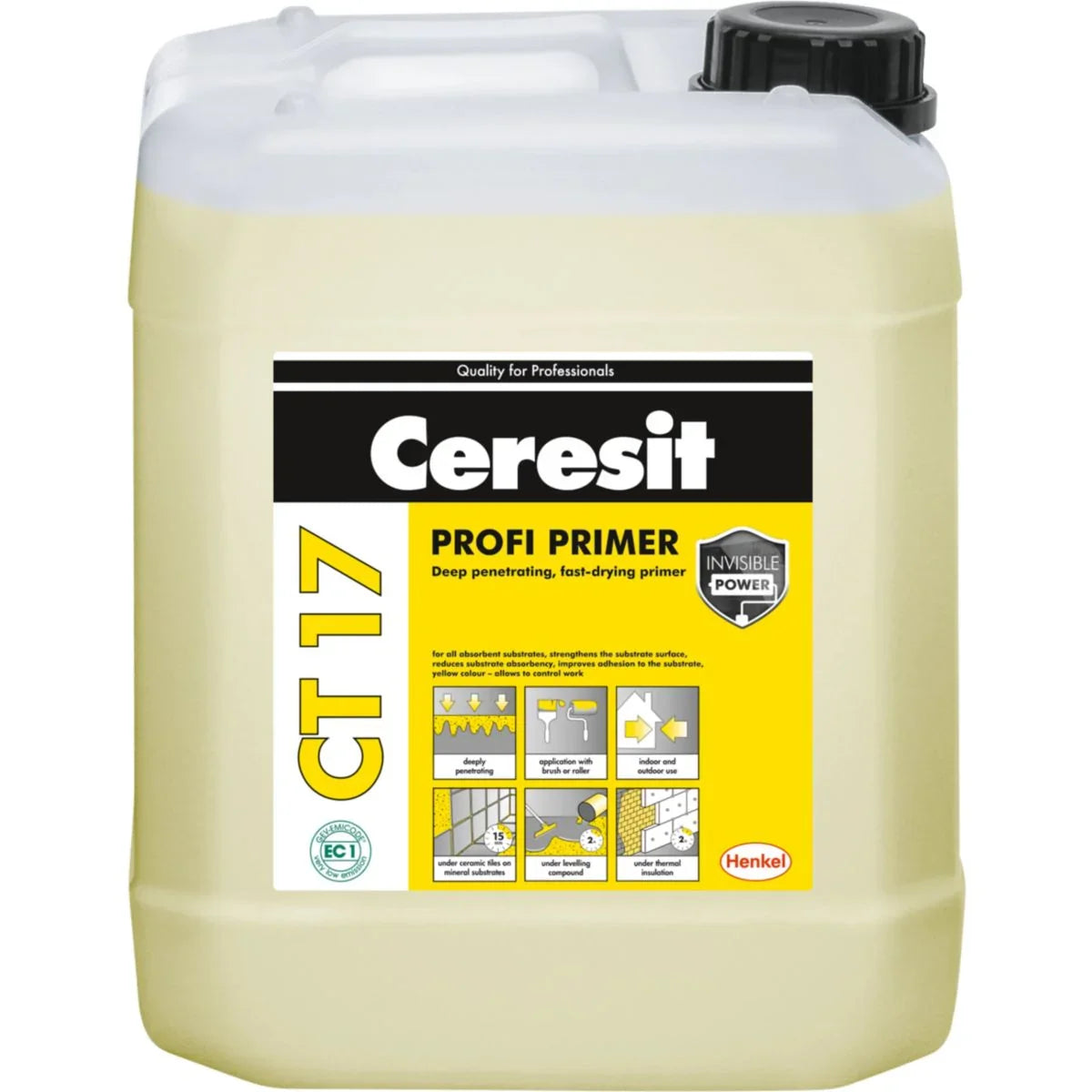
Ceresit CT17 Profi is a ready-to-use deep penetrating primer in a 5 l container. It soaks into absorbent walls, floors and ceilings, binds the loose grains at the surface and lowers how much water the substrate pulls out of the next layer. Brush or roll it onto the bare substrate first, before tiles, screeds, insulation boards, filler or paint. For the layer directly under thin-coat render, Renders World stocks a quartz primer instead — both sit in the render primer range.
What Ceresit CT17 Does to an Absorbent Wall
Ceresit CT17 is a water-based dispersion of synthetic resins. It penetrates the surface, binds the aggregate grains together and leaves the substrate stronger and less absorbent, so the adhesive, screed, filler or paint that follows bonds better. It goes on yellow, so you can see at a glance which parts of a wall are done.
Henkel, the maker, recommends Ceresit CT17 above all for three substrates:
- Gypsum and anhydrite — plasters and screeds that are soft or dusty at the surface.
- Aerated concrete — blocks that draw water fast.
- Everything else absorbent — all kinds of plaster, concrete and screeds, including screeds with underfloor heating, plus chipboard and non-impregnated plasterboard.
Walls, floors and ceilings are all in scope, inside and outside. If you are unsure what the wall itself needs before any primer, the guide to rendering on brick, block and painted walls walks through each wall type.
Why Choose This Primer
- Strengthens, not just seals — the Ceresit primer soaks in and binds the grains, so a dusty or crumbly surface turns firm.
- Less suction for the next layer — a primed substrate absorbs less, which helps tile adhesive, screed, filler and paint grip.
- Yellow, so nothing is missed — Ceresit tints it so you can see every patch you have primed, a quick check on a big wall.
- Ready to use — shake the container and start; there is nothing to mix.
- Water-based and solvent-free — a water-based Ceresit formula, so tools and fresh splashes wash off with water.
- Breathable — the primed surface stays vapour permeable.
- Tiles in 15 minutes — on cement and cement-lime walls you can start fixing ceramic tiles a quarter of an hour after priming.
Ceresit CT17 Profi Technical Data
| Property | Value |
|---|---|
| Base | Water-based dispersion of synthetic resins, solvent-free |
| Density | Approx. 1.0 kg/dm³ |
| Consumption | 0.1–0.5 l/m², by how even and absorbent the substrate is |
| Coverage of this 5 l container | 10–50 m², by substrate |
| Drying time | Approx. 2 hours |
| Before ceramic tiles | Approx. 15 minutes, on cement and cement-lime substrates |
| Working temperature | +5 °C to +25 °C, air and substrate |
| Air humidity | Below 80 % |
| Dilution | 1:1 with water, first pass on very absorbent walls |
| Application | Brush, roller or airless spray |
| Colour | Yellow, shows primed areas |
| Vapour permeability | Vapour permeable |
| Shelf life | 12 months, cool and frost-free |
Drying and waiting times are given at +23 °C and 50 % relative humidity; colder, damper or more absorbent conditions stretch them.
How to Apply CT17 Profi
- Get the surface ready. It must be dry and load-bearing, with grease, bitumen and dust removed and any weak or stained layer taken off. Scrape off old adhesive paints and wash the wall down with water.
- Sand the hard spots. Grind gypsum and anhydrite substrates and strong paint coats with coarse sandpaper, then clean and vacuum them.
- Shake and apply. Shake the container several times and apply with a brush or roller, between +5 °C and +25 °C and below 80 % air humidity.
- A second pass on very absorbent walls. Dilute the first pass 1:1 with clean water, then apply the next one undiluted.
- Floors: pour and spread. Under floor layers, pour the primer on and spread it evenly with a brush, without leaving puddles.
- Check the suction. If the dried surface still soaks up water, apply the Ceresit primer again.
- Wait before the next layer. 15 minutes before ceramic tiles on cement and cement-lime substrates; for anything else, until the primer is completely dry, about 2 hours.
Wash tools with water straight after use. If the primer gets into your eyes, rinse with plenty of water and get medical advice. The full order of work on a façade is in the step-by-step wall preparation method.
CT17 Profi or a Quartz Key Coat?
Ceresit CT17 and a quartz primer do different jobs at different stages, and Henkel says so in the data sheet: "For substrate priming under thin-layer plasters, apply the Ceresit CT 16 or CT 15 priming paint." Of those, Renders World stocks Ceresit CT 16.
| Primer | Where it goes | What it does |
|---|---|---|
| CT17 Profi | On the bare, absorbent substrate, at the start | Strengthens the surface and lowers its suction |
| CT 16 | Directly under thin-layer render | Quartz-filled key coat that gives the render grip |
On an insulated façade, Ceresit CT17 goes on the old wall before the boards; the quartz key coat comes much later, over the cured base coat and just before the silicone render. How the key coat is applied is covered in the quartz primer guide for EWI systems.
Henkel also makes a CT 17 Transparent version, meant for priming before interior acrylic paints. Check that the Ceresit label on your container says Profi.
How Much CT17 Profi to Order
How much Ceresit CT17 you need depends on the substrate, so work from both ends of the consumption figure:
- One 5 l container — 5 ÷ 0.5 = 10 m² on a very absorbent surface, 5 ÷ 0.1 = 50 m² on an even, low-suction one.
- A 100 m² wall — 2 containers at the low end, 10 at the high end.
- A second pass — a very absorbent wall takes a diluted first pass and a second one, so plan towards the high end.
Not sure how absorbent the wall is? Prime a small area first and see how much it takes before ordering the rest from Renders World.
Is CT17 Profi Right for Your Job?
- Yes — for dusty, crumbly or uneven-suction surfaces before tile adhesive, insulation boards, screed, filler or paint.
- Yes — for gypsum, anhydrite and aerated concrete, the three substrates it is recommended for most.
- Yes — before wallpaper and filler indoors, and before thermal insulation boards outside.
- No — as the layer directly under thin-coat render; use a quartz primer for that stage.
Painting the façade rather than rendering it? Prime absorbent areas with CT17 Profi first, then finish with a silicone masonry paint. For a side-by-side look at the primers for render work, see the primer comparison for UK render systems.
FAQ — Coverage, Tiling and Drying
How many containers do I need for 100 m²?
Between 2 and 10. An even, low-suction wall takes about 0.1 l/m², so one 5 l container covers 50 m²; a very absorbent wall takes up to 0.5 l/m², so one container covers 10 m². Prime a test patch to see where your wall sits.
Can it go on screeds with underfloor heating?
Yes. Screeds with underfloor heating are listed among the substrates, alongside plaster and concrete. Pour the primer on, spread it with a brush without puddles, and let it dry fully before the levelling compound or tile adhesive.
Does it replace a quartz key coat before render?
No. Ceresit CT17 strengthens the bare substrate at the start; the quartz key coat, such as Ceresit CT 16, goes directly under the thin-layer render. A wall that needs both gets both.
How soon can I tile after priming?
On cement and cement-lime substrates, about 15 minutes after priming. On every other substrate, and under every other top layer, wait until the primer is completely dry — about 2 hours.
Why does the drying time change so much?
The 2 hours applies at +23 °C and 50 % humidity. A cold, damp or very absorbent wall takes longer, so give it more time rather than rushing the next layer.
Can I use it on plasterboard or chipboard?
Yes, on non-impregnated plasterboard and on chipboard. Make sure the surface is dry, clean and free of dust first.
How long does CT17 Profi keep?
CT17 Profi keeps for up to 12 months from production in its original, undamaged packaging, stored cool. Protect it from frost.
Technical Documentation for Ceresit CT17 Profi