
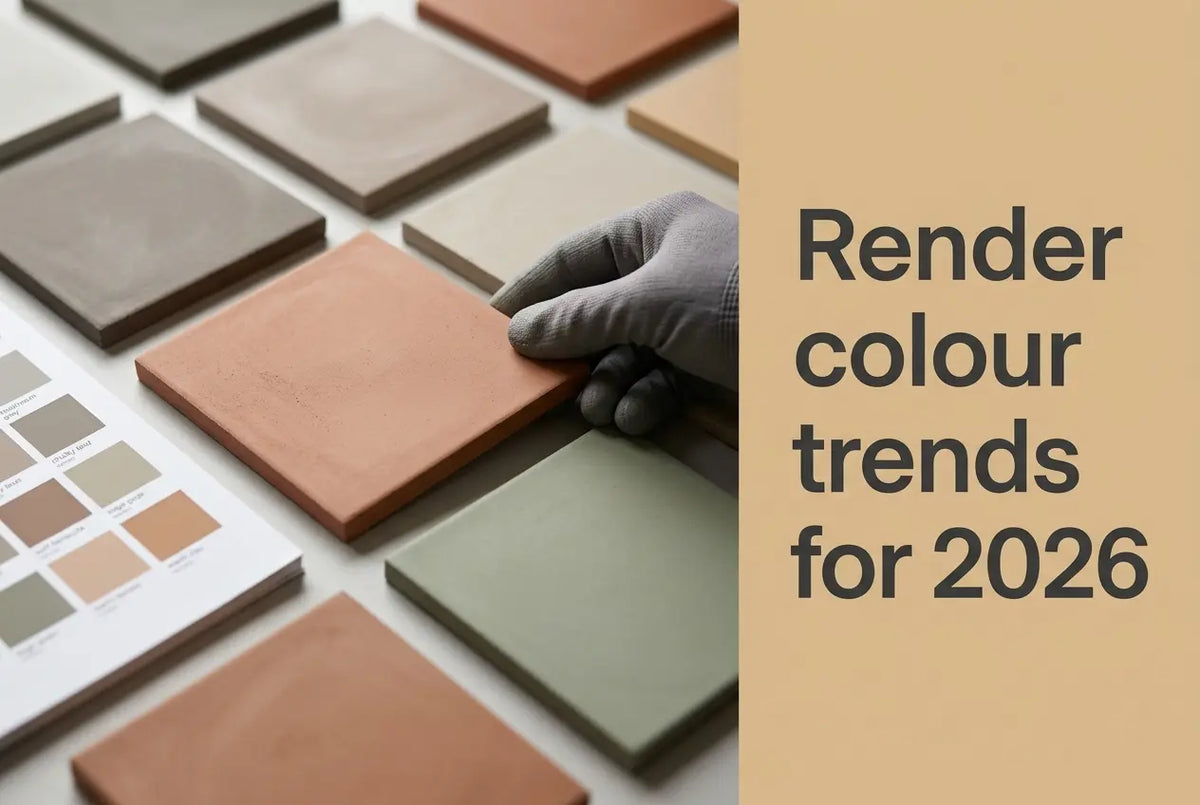
Warm mineral shades have displaced cool grey as the default request on UK facade work, and the 2026 conversation now runs past colour into whether the render behind it can carry the shade at all. The physical render colour charts and catalogues Renders World holds are the right place to begin, because the limit that governs a deep earth tone is printed on the render's own data sheet rather than on the chart.
Reading the 2026 Earth-Tone Direction on a UK Facade
Colour drenching and earth tones lead UK render trends in 2026, and the Atlas Silicone Render sheet sets the limit that decides them: shades above 6% light reflectance are permitted only over a STOPTER K-100 reinforced layer. Reflectance, not fashion, is what makes a mushroom or clay elevation straightforward and a charcoal one a specification exercise.
That single number reorders the whole design conversation. A warm mid-tone sits comfortably above every threshold the three stocked sheets name, which is why the softer end of the 2026 palette is spreading so quickly across UK streets. The saturated end is equally available — it simply arrives attached to an adhesive choice, and the earlier that pairing is settled, the freer the palette becomes.
- Mushroom and chalky taupe: soft grey-brown mid-neutrals, the easiest entry to the trend and the least constrained by reflectance.
- Warm clay and soft terracotta: peach-brown tones that sit well beside brick plinths and stone surrounds.
- Sage and muted olive: biophilic greens for rural and suburban settings, reading well against mature planting.
- Sandstone and warm beige: light earth tones giving brightness without the starkness of true white.
- Anthracite and deep clay: the saturated end, specifiable once the reinforced layer is chosen alongside the shade.
Method for working a shortlist down belongs elsewhere: the silicone render colour selection guide owns reflectance, orientation and palette coordination, and the staged chart comparison method covers how a professional narrows a set of swatches on site.
Which Renders Carry an Earth-Tone or Drenched Scheme
Three renders in the Renders World silicone render range have readable sheets, and they declare three different palettes and three different deep-shade routes. Read side by side, they show that the same charcoal can be routine on one product and conditional on another.
| Render | Declared palette | Deep-shade rule on the sheet | Grain declared |
|---|---|---|---|
| Atlas Silicone Render | 480 SAH colours | HBW above 6% over STOPTER K-100; above 15% over HOTER U2 | N-15 to 1.5 mm, N-20 to 2.0 mm |
| Atlas Gemini RS | 406 SAH colours | HBW above 15 over STOPTER K-50, K-20 or GRAWIS U at 5 mm minimum with double ATLAS 150 mesh; no HBW limit on up to 10% of the elevation | Lambskin to 1.5 mm |
| Ceresit CT 76 Solar Protect | Colours of Nature and Intense | HBW at or above 15 recommended; below that, consult the Ceresit technical department | 1.5 mm or 2.0 mm |
The palette divergence is a purchasing instruction, not trivia. Where render and paint must agree across one building, 406 is the working figure, because a code drawn from the 480-colour range may not exist in the narrower one.
Gemini RS, the reflective sheet and the 10% accent rule
The Polish-language Gemini RS grey base sheet dated March 2023 is the one document in the range that describes a reflective mechanism: a MIRROR EFFECT giving a high light-reflection coefficient, lowering the surface temperature of the render and so minimising thermal deformation. The sheet states no figure for it, so none is quoted here. Its more immediately useful line is the allowance for intense shades with no reflectance limit on up to a tenth of the elevation — exactly how an accent band or recessed entrance panel gets specified without reworking the adhesive across the whole building.
What the CT 76 Solar Protect sheet actually declares
The Ceresit CT 76 Solar Protect render answers UV exposure and colour stability rather than heat. Its sheet claims no infrared or heat reflection at all; the stated mechanism is an increased quantity of UV absorbers giving colour light fastness, together with a self-healing surface effect on microcracks. It recommends use at HBW 15 or above to prevent excessive heating of the facade surface, and consultation with the Ceresit technical department below that value to select an appropriate insulation system. The same sheet also asks that the render is not applied on highly sunny walls and is protected from drying too fast.
Specifying a Drenched Elevation From Base Coat to Trim
Drenching means render, oversills, verge trims, soffits and rainwater goods sitting in one tonal family rather than relying on white reveals for contrast, and the effect is unification: massing and proportion become the dominant features. Getting there is a sequence, and the sheets settle most of it.
- Fix the reinforced layer first. The adhesive decides which reflectance values are open, so the shortlist narrows before a chart is opened.
- Confirm the code exists in the product being bought — 480 shades for Atlas Silicone Render, 406 for Gemini RS.
- Decide hand or machine before the shade. Both Atlas sheets state the two textures differ and rule that combining them on one object is not permissible.
- Plan the technological breaks at corners, building folds, under downpipes and at colour junctions, working wet-on-wet.
- Order one production date per elevation, and for CT 76 one production batch number, since mineral fillers alone can shift a tone.
On a historic or listed property the palette follows the fabric. Historic England's guidance on materials for historic building repairs makes compatibility with the existing fabric the governing test, weighing physical properties and future maintenance alongside appearance — a useful order of priorities for any drenched scheme on an older wall.
Key Takeaway: the 2026 palette is warmer and more unified than anything UK facades have carried for two decades, and it is a two-part specification. Fix the reflectance value and the reinforcing adhesive together, confirm the code against the product actually being ordered, and the earth-tone or drenched elevation is a straightforward job with long-term protection built into it.
Which Earth-Tone Claims Came Off This Page
This page previously carried several figures with no document behind them, and naming the gap serves a specifier better than a confident number would.
- Removed — surface temperatures "exceeding 70°C": no sheet read this session states a facade surface temperature, so none is published.
- Removed — a ten to fifteen degree reduction from "cool pigments": no source, and the product it was attached to makes no reflection claim.
- Removed — an LRV threshold of 20 to 25: replaced by the reflectance values the three sheets actually declare, set out above.
- Removed — third-party colour-of-the-year attributions: nothing was fetched to support them, so the palette directions now stand on design reasoning alone.
The reflectance question in depth, across south and west elevations, belongs to the dark shades and solar exposure guide.
Matching Grain to a Warm Shade, and What It Costs in Buckets
Warm pigments catch shadow more obviously than cool greys, so aggregate depth changes how an approved shade reads on the wall. Atlas Silicone Render is declared in two textured versions, lambskin N-15 to 1.5 mm and N-20 to 2.0 mm, and only the finer version can be machine-applied.
The quantity consequence is declared and it is worth budgeting for. On a 120 m² elevation at the sheet's hand rate of 2.2 kg/m² for the 1.5 mm version: 120 × 2.2 = 264 kg ÷ 25 kg per bucket = 10.6, so 11 buckets. At the 2.8 kg/m² hand rate for the 2.0 mm version: 120 × 2.8 = 336 kg ÷ 25 = 13.4, so 14 buckets — a step of three buckets for the coarser texture on the same wall.
- Ask which grain a swatch was made at before judging a warm shade from it; the same pigment reads differently at each depth.
- Machine application lowers consumption to from 1.9 kg/m² on both Atlas renders, though the finish cannot then be mixed with hand work on the same building.
- Plan the renovation route early — the Atlas Silicone Render sheet names ATLAS SALTA N as its repainting product, so plan the repaint against that sheet before choosing a paint from the Renders World facade materials.
Turning a 2026 Palette Into an Order
A colour decided this way reaches the order with everything attached to it: a code, the product that code belongs to, a reflectance value, and the reinforcing adhesive tied to it. Order the physical reference first, assess it on the actual wall across a full day, then match the approved code to a system.
- Full palette or a named code: the Atlas 480-colour catalogue covers the declared SAH range end to end.
- First conversations and site shortlists: the 24-shade Atlas sample set is the easier reference to carry.
- Ceresit and decorative schemes: the remaining physical colour references Renders World stocks cover the Ceresit books and the mosaic and concrete-effect finishes.
Written by Mariusz Saja. Technically reviewed by Renders World Team. Last reviewed Aug 2026.
Earth Tones and Colour Drenching — Common Questions
How much render does a drenched 120 m² elevation take?
Eleven 25 kg buckets at the 1.5 mm hand rate of 2.2 kg/m², or fourteen at the 2.0 mm rate of 2.8 kg/m², before detailing waste. Both figures are minimums for even substrates, so add reveals and soffits separately and order the full elevation in one production date.
Can trims and rainwater goods really match the render shade?
They can, provided the matching is done by code and confirmed per product rather than per colour scheme. An SAH number belongs to the Atlas system and does not transfer to a Ceresit render, and within Atlas the render declares 480 shades against 406 for Gemini RS and the Salta paint — so check the narrower palette before committing a matched order across render, trim and paint.
Which of the three renders suits a saturated 2026 shade best?
It depends entirely on the reinforced layer already specified, which is why the adhesive is settled first:
- Atlas Silicone Render opens the widest door, permitting above 6% HBW over a STOPTER K-100 layer.
- Gemini RS asks for above 15 HBW over its named adhesives, and allows unrestricted intense shades on up to 10% of the elevation.
- CT 76 Solar Protect is recommended at HBW 15 and above, with a technical consultation below it.
Are there conditions that rule out a colour-drenched application?
Two are declared. Hand and machine application produce different textures and the Atlas sheets do not permit combining them on one object, so the method is chosen before the shade. CT 76 additionally asks not to be applied on highly sunny walls and to be protected from drying too quickly, with scaffold sheeting recommended.
Do earth tones help in a conservation area?
They tend to sit closer to traditional lime-render and oxide palettes, which helps the discussion, though the governing test on historic fabric is material compatibility rather than appearance. Submit physical sample boards rather than digital swatches, reference the manufacturer code in correspondence, and confirm consent requirements with the local planning authority before ordering.