
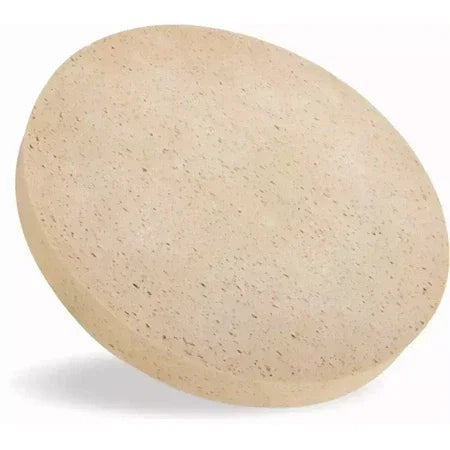

Description
The DED77671 is Dedra's power float disc in flexible polyurethane foam, made for the DED7767 plaster trowel and used for floating and smoothing lime-cement and gypsum plaster. It fixes to the machine's trowel disc with four hook-and-loop straps. Renders World sells it on its own, as the replacement sponge in the range of power float machines, pads and sponges.
DED77671 Power Float Disc: What Dedra States
| Property | Value |
|---|---|
| Code | DED77671 |
| Producer barcode | 5902628776716 |
| Material | Flexible polyurethane foam |
| Hardness | Medium-hard (Polish catalogue title) |
| Fixing | Hook-and-loop, four straps |
| Diameter, technical data line | 400 mm |
| Diameter, attribute field | 390 mm |
| Work | Floating and smoothing lime-cement and gypsum plaster |
| Recommended for | Dedra DED7767 |
Thickness is not given in the English or the Polish catalogue entry, so none is stated here.
400 mm or 390 mm: Order by Code
Dedra's own catalogue entry carries two diameters for this one disc, and the Polish entry repeats both. The line under technical data reads 400 mm; the attribute field beneath it reads 390 mm, which is also the disc diameter in the DED7767 manual. Neither document explains the difference.
For a DED7767 owner the answer is simple: order the power float disc on its code. DED77671 is the disc Dedra recommends for that machine and lists as its sponge trowel disc, whichever diameter a listing quotes. For any other make of float, Dedra publishes no fitment, so measure the backing plate you have before ordering.
Medium-Hard Foam and What That Means for the Finish
Only the Polish catalogue title grades this disc, as medium-hard. The DED7767 manual confirms that sponge discs come in different hardness and names DED77671 as the sponge trowel disc among its accessories, with the finishing passes on a wall as the sponge disc's job.
- Sponge disc: finishing passes on wall surfaces, and floating and levelling lime-cement and gypsum plaster, inside and outside.
- Plastic disc with mesh: larger irregularities, or plaster that has dried out too far for a sponge.
The manual also lists DED77674 and DED77675 as discs bought separately. Before ordering either, ask the Renders World team to confirm the code for the work you have in mind.
Fitting the Disc to the DED7767
- Unplug the machine. Dedra requires all preparation with the supply disconnected.
- Fit the trowel disc to the spindle, matching the hole to the spindle's shape, and tighten it with the screw.
- Press the DED77671 onto the trowel disc so the four hook-and-loop straps hold it.
- Start the machine horizontal and off the wall, and let it reach full speed before it touches the plaster.
On the wall, the manual asks for a steady stance, pressure matched to the work and semicircular movements, checking the surface until it is smooth. Plaster that has stiffened may be moistened as you work. The machine itself, its speed and its duty rating are on the Dedra DED7767 page.
When the Sponge Disc Needs Replacing
The manual ties the disc's condition to the result, and a worn power float disc shows first as slow work.
- Before each use: check the disc for wear.
- After every job: clean the machine and its working disc of plaster, with the plug out.
- When work slows: the manual's fault table gives low sanding efficiency one cause, a worn disc, and one fix, a new one. Do not overload the machine to make up for it.
Keeping a spare DED77671 on the van means a job does not stop when the disc goes.
Buying a New DED7767? Check the Box First
The DED7767 box list includes a sponge disc, a plastic disc with mesh and the trowel disc, so a new machine can float plaster on the day it arrives. The manual does not give the boxed sponge disc a code. Order the DED77671 as the spare for when that disc wears, and check your own delivery against the box list.
Technique for each pass, and how the discs fit into a render finishing job, is in the guide to power float techniques and tool selection. Where the plastered wall is to be finished in a thin-coat render, the renders in the silicone range follow once the surface is sound.
Ordering, Delivery and Returns
Renders World processes orders the same day when the stock is there.
- Delivery: quoted by the team after the order, always kerbside. Small parcels up to 25 kg go next day.
- Collection: from the counter at Unit 9A, Central Trading Estate, Southampton SO14 5JP, Monday to Friday 7am to 5pm and Saturday 7am to 12pm.
- Returns: goods bought directly from Renders World can go back within 14 days in their original condition; special orders and promotion purchases are excluded.
FAQ
Which machine does the DED77671 fit?
Dedra recommends it for the DED7767 plaster trowel, where it presses onto the trowel disc with four hook-and-loop straps. Dedra gives no fitment for other makes.
Is it 400 mm or 390 mm?
Dedra's catalogue shows both figures on the same entry, 400 mm in the technical data line and 390 mm in the attribute field. On a DED7767, order by the code DED77671.
Can it be used on external plaster?
Yes. The manual puts sponge discs to work on lime-cement and gypsum plaster inside and outside.
How hard is the foam?
Medium-hard, according to Dedra's Polish catalogue title. The English entry does not grade it.
Do I need one with a new machine?
Not straight away. A sponge disc comes in the DED7767 box; this power float disc is the replacement for when it wears.
Technical Documentation