
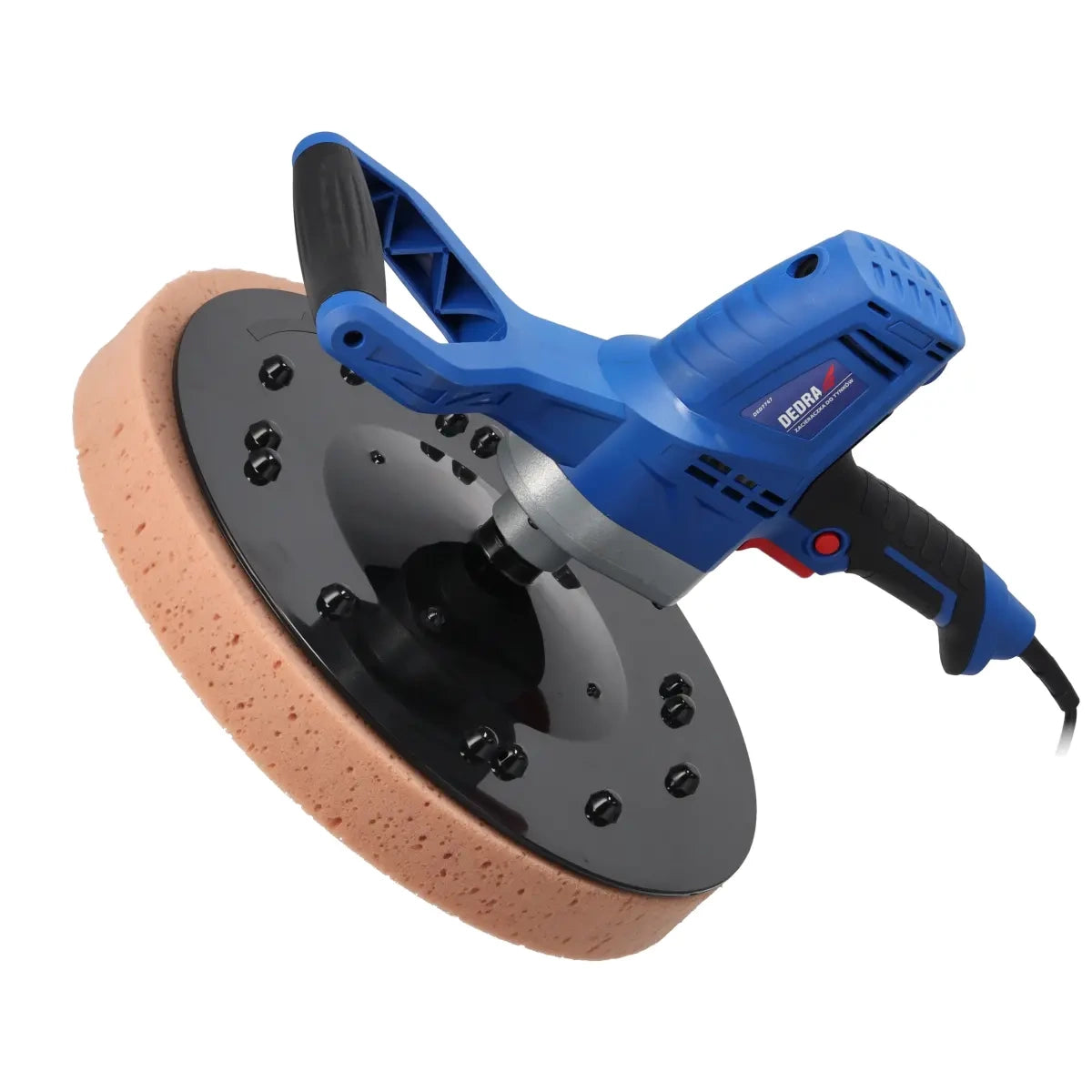

Description
The Dedra DED7767 is a 710 W render float machine that turns a 390 mm disc at 110 rpm, and the disc on its head decides the job: floating and smoothing plaster, levelling it with sponge discs, or taking old layers and unevenness off walls and floors. A plastic disc with mesh and a sponge disc come in the box, and the other Dedra discs made for it are in the rendering sponge and power float range.
What the DED7767 Render Float Machine Is Made For
Dedra's manual calls this render float machine a plaster trowel and lists its work plainly. With sponge discs of different hardness it trowels and levels lime-cement and gypsum plaster, inside and outside. With peeling discs it removes unevenness and old layers from walls and floors.
- Floating and smoothing lime and gypsum plaster, and levelling lime-cement plaster, interior and exterior.
- Clearing a surface: removing irregularities from existing plaster, peeling off wallpaper, taking mortar leaks from between bricks and dried plaster off concrete floors.
- Where it may be used: repair and construction work, repair workshops and amateur work, within the working conditions in the manual.
Decorative thin-coat finishes, such as the renders in the silicone range, are not on Dedra's list. On those jobs the machine's place is the plaster underneath.
Why Choose the DED7767
- One render float machine, several jobs. Change the disc, not the tool: the same head floats, smooths, levels and strips.
- Ready to work from the box. A plastic disc with mesh and a sponge disc are included, with the trowel disc they fix to.
- A full set of discs made for it. Six Dedra working discs (foam, plastic, polystyrene, scraping and two abrasive grades) and a spare mounting disc, all in the range.
- Brushes you can change yourself. They sit under caps on the motor, and a spare set comes in the box.
- Inside and outside. Dedra lists interior and exterior lime-cement and gypsum plaster among its work.
DED7767 Technical Data
| Property | Value |
|---|---|
| Model | DED7767 |
| Rated voltage and frequency | 230 V, 50 Hz |
| Nominal power | 710 W |
| Protection class | Class II |
| Ingress protection | IP20 |
| Speed | 110 min⁻¹ |
| Disc diameter | 390 mm |
| Permitted working conditions | S2, 15 minutes |
| Sound pressure level, LPA | 83.4 dB(A), uncertainty 3 dB(A) |
| Sound power level, LWA | 94.4 dB(A), uncertainty 3 dB(A) |
| Hand-arm vibration, ah | below 2.5 m/s², uncertainty 1.5 m/s² |
| Test standards | Noise EN 60745-1:2009, vibration EN 60745-2-3:2011 |
| Supply cable, minimum | 1 mm² for 700–1400 W tools |
| Fuse, minimum | 10 A, type C |
| Manual revision | 7767.100725.V6, for devices made after 01.01.2023 |
At 94.4 dB(A) sound power, Dedra's instruction is to wear hearing protection whenever the machine runs.
What Comes in the Box
- The DED7767 machine and its trowel disc, the backing plate every working disc fixes to.
- A plastic disc with mesh, for larger irregularities or plaster that has dried out too far.
- A sponge disc, for the finishing passes on a wall.
- A set of screws, a screwdriver and a set of carbon brushes.
Working discs fix to the trowel disc with hook-and-loop.
The S2 15-Minute Rating on a Working Day
Dedra rates this render float machine S2, 15 minutes: a short-time duty, meaning a working spell of up to fifteen minutes and then a rest before the next. On a wall that suits the work anyway, because the surface is inspected between passes. The same section of the manual adds two conditions:
- avoid moisture;
- never leave the machine switched on unattended.
How to Set Up and Use the Machine
- Unplug first. All preparation is done with the machine disconnected from the supply.
- Fit the trowel disc to the spindle, matching the hole to the shape of the spindle, and tighten it with the screw supplied.
- Press on the working disc: sponge, plastic or peeling disc, held by hook-and-loop.
- Check the supply matches the rating plate. With an extension lead, keep the conductor at 1 mm² or more.
- Start it horizontal and off the wall: press and hold the round button on the left of the main handle, then press the switch.
- Wait for full speed, then work in semicircular movements, adjusting pressure to the job and checking the surface until it is smooth.
Stand steady with feet slightly apart and the upper body leaning in a little. Where the plaster has stiffened, the manual allows it to be moistened as you work. Between passes, do not leave the machine idling, and do not overload it.
Choosing Discs for the DED7767
A render float machine is only as useful as the disc on its head. Dedra makes each disc below for the DED7767, and each is in the Renders World range:
| Disc | What Dedra makes it for |
|---|---|
| DED77671 replacement sponge pad | Floating and smoothing plaster; medium-hard foam |
| DED77670 plastic pad | Floating and smoothing plaster |
| DED77674 polystyrene pad | Floating and smoothing plaster |
| DED77675 stripping pad | Six steel blades: unevenness, old paint, wallpaper |
| DED7767G24 grid pad, grade 24 | Abrasive: old paint off, surface levelled for new plaster |
| DED7767G16 grid pad, grade 16 | Abrasive for the same jobs as grade 24 |
| DED776701 mounting pad | Spare trowel disc the working discs fix to |
The plastic, polystyrene and foam discs all float and smooth lime-cement and gypsum plaster. The two grid pads are silicon carbide and also smooth polystyrene insulation. The mounting pad is screwed to the machine and carries four hook-and-loop fasteners. The working discs press onto it by hook-and-loop; change them with the machine unplugged. Order by the code: each disc here carries Dedra's own code and barcode.
Keeping It Running: Vents, Discs and Brushes
- Vents: keep the motor air inlets clean. Dedra calls this very important and suggests compressed air. A machine that heats up usually has clogged vents.
- Discs: check the abrasive disc for wear before each use. Poor sanding performance points to a worn disc.
- Carbon brushes: check them at least every 20 to 30 hours of use and replace them once they are shorter than 5 mm. They have no wear stop, which is why the check matters.
The brushes sit under caps on the sides of the motor. Unscrew the cap, lift the brush out with a small screwdriver, slide the new one into the holder and screw the cap back. A spare set is in the box, and a motor that starts with difficulty is the usual sign they are due. Clean the machine of plaster after every job, always with the plug out.
Guarantee and Spare Parts
- Guarantee: Dedra's guarantee card gives the machine 36 months from the date of purchase and names Poland and the EU as the territory it covers.
- Spare parts: ordered with the lot number from the rating plate and the part number from the assembly drawing.
Ordering, Delivery and Returns
Renders World processes orders the same day when the stock is there.
- Delivery: quoted by the team after the order, always kerbside.
- Collection: from the counter at Unit 9A, Central Trading Estate, Southampton SO14 5JP, Monday to Friday 7am to 5pm and Saturday 7am to 12pm.
- Returns: goods bought directly from Renders World can go back within 14 days in their original condition; special orders and promotion purchases are excluded.
Technique for each stage, from disc choice to pass pattern, is in the guide to power float techniques and tool selection.
FAQ
What supply does it need?
A 230 V, 50 Hz supply. The manual asks for a type C fuse of at least 10 A and a supply conductor of at least 1 mm², extension leads included.
How long can it run in one go?
Up to fifteen minutes. The S2 15-minute rating of the render float machine means a working spell followed by a rest before the next one.
Which discs does it take?
The Dedra working discs in the table above, pressed onto the trowel disc by hook-and-loop. The plastic disc with mesh and the sponge disc come in the box; the others are sold separately.
Can it be used outside?
Yes, for exterior lime-cement and gypsum plaster. Keep it out of moisture, as the manual instructs, and plan exterior work for dry conditions.
How often do the brushes need checking?
At least every 20 to 30 hours of use, more often under heavy use. Replace them below 5 mm.
Technical Documentation