

Description
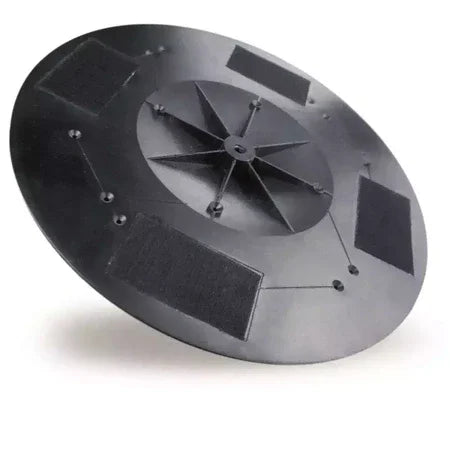
The DED776701 mounting disc is the Dedra backing disc that sits between a plaster power float and its working discs: it is screwed to the machine and carries four strong hook-and-loop fasteners, and the sponge, plastic, polystyrene and scraping discs press onto that face. Dedra lists it for the Dedra DED7767 plaster trowel, which Renders World sells with its working discs in the DED7767 disc and sponge range.
What the DED776701 Mounting Disc Does
Dedra's catalogue entry for this code, in English and in Polish, describes one part with one job. The disc is secured to the trowel with a screw, and its four hook-and-loop fasteners are there for attaching the accessories that work the wall. It does no floating or scraping itself; it is the face every working disc hangs on.
The DED7767 manual describes the same arrangement from the machine's side. A trowel disc goes onto the spindle, its hole matched to the shape of the spindle, and is tightened with the screw; the working tips, whether sponge, plastic or peeling disc, are then mounted onto it with hook-and-loop.
DED776701 Data From the Dedra Catalogue
| Property | Value |
|---|---|
| Code | DED776701 |
| Barcode (EAN) | 5902628776839, the same on the Renders World listing |
| Fixing to the machine | Screw |
| Face for working discs | Four strong hook-and-loop fasteners |
| Diameter | 390 mm |
| Recommended for | Dedra DED7767, DED7769, DED7170, DED7774 |
The entry prints 390 mm in both its description and its attribute table, and the DED7767 manual gives the same 390 mm as the machine's disc diameter. Thickness and weight are not given in either language.
Which Dedra Machines the Disc Is Listed For
Most discs in this range name the DED7767 alone. This one is broader: the catalogue recommends it for four Dedra machines, the DED7767, DED7769, DED7170 and DED7774, and the Polish title of the entry says it fits all four. Renders World stocks the DED7767 of those four, so an owner of one of the other three machines orders this part by its code and barcode and checks it against the model plate on the machine.
For any float by another maker, Dedra publishes no fitment, and the spindle and screw should be matched against that machine's own documentation before ordering.
Already in the Box, or a Separate Purchase?
A new DED7767 does not need this part to start work. Its box holds the machine, a trowel disc, a plastic disc with mesh, a sponge disc, a set of screws, a screwdriver and electrographite brushes. The manual's trowel disc is fitted exactly the way the catalogue describes this one: screwed to the spindle, with the working discs held on by hook-and-loop.
The manual gives the boxed trowel disc no code, and its list of accessories for separate purchase names only DED77671, DED77674 and DED77675. The DED776701 is the code to order when a worn mounting disc on the machine has to be replaced, or when a second disc is wanted; the code on the part being replaced and the barcode above are the safe way to order it.
Working Discs That Press Onto It
Each DED7767 working disc below is fixed by hook-and-loop. Each one's own Dedra entry names the DED7767:
- the DED77671 foam disc, flexible polyurethane, for floating and smoothing lime-cement and gypsum plaster;
- the DED77670 plastic disc, for the same floating work;
- the DED77674 polystyrene disc, again for floating lime-cement and gypsum plaster;
- the DED77675 scraping disc, with six steel blades for removing unevenness, old paint and wallpaper.
The DED776701 mounting disc stays on the machine while these are changed over, which is why a worn or clogged hook-and-loop face shows up as working discs that will not stay put.
Fitting the Disc and Keeping the Face Clean
The manual's sequence for the trowel disc applies, and every step before the start is done with the machine unplugged.
- Remove the working disc, then release the screw and take the old mounting disc off the spindle.
- Fit the DED776701 onto the spindle with its hole matched to the shape of the spindle, and tighten it with the screw.
- Press the working disc onto the hook-and-loop face so that the fasteners hold it all the way round.
- Check the supply voltage against the nameplate before plugging in.
The manual asks for the working disc to be checked for wear before each use and for the tool to be cleaned of the worked material after every job, and it gives low working efficiency as the sign of a worn disc. Start-up, duty cycle and hearing protection are set out on the DED7767 machine page, and the Renders World guide to finishing with a power float covers the passes on site.
Ordering, Delivery and Returns
Orders are processed the same day when the disc is in stock, and delivery is not calculated at checkout: the Renders World team quotes it after the order comes in.
- Courier: small parcels up to 25 kg go on a next-day service, and every delivery is kerbside.
- Collection: Unit 9A, Central Trading Estate, Southampton SO14 5JP, Monday to Friday 7am to 5pm and Saturday 7am to 12pm.
- Returns: a change-of-mind return runs to 14 days, with the disc in its original condition.
DED776701 Questions Buyers Ask
Do I need one with a new DED7767?
No. The machine's box already holds a trowel disc that is screwed to the spindle and takes the working discs by hook-and-loop. The DED776701 mounting disc is for replacing that disc or keeping a spare.
Does it fit machines other than the DED7767?
Dedra recommends it for the DED7767, DED7769, DED7170 and DED7774. For any other float, check that machine's own documentation first.
What size is it?
390 mm, in both the description and the attribute table of the Dedra entry, and the same figure the DED7767 manual gives for the machine's disc.
Can the mounting disc float plaster on its own?
No. It carries the working disc; the floating, smoothing or scraping is done by the sponge, plastic, polystyrene or scraping disc pressed onto it.