


Description
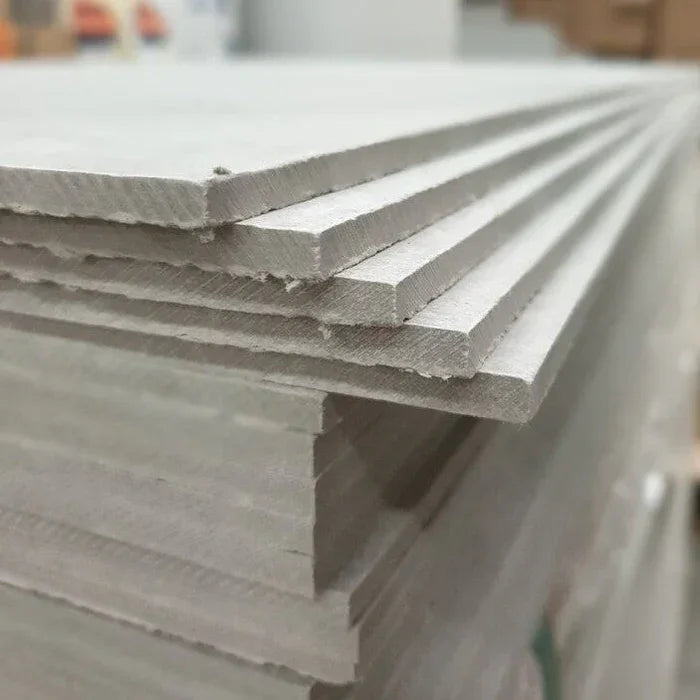
The STS NoMorePly half-size 1.2 m × 0.8 m × 12 mm fibre-cement render carrier board is the small-format substrate in our rendering cement boards range — sized for dormer cheeks, window reveals, soffit returns, and small-panel infills on timber-frame and steel-frame facades where a full 2.4 m × 1.2 m sheet would generate excessive cutting waste. At 15.8 kg per board with a 0.96 m² coverage area, the format suits single-installer handling above first-lift scaffolds, and the EN 12467:2016 mechanical performance matches the full-size sheet exactly — Euroclass A1 non-combustible, 1.28 g/cm³ density, 12.46 MPa dry bending strength. Trade collection or next-day UK dispatch from our Southampton warehouse.
What the STS Half-Size Render Carrier Board Does on UK Detail Areas
The 1.2 m × 0.8 m × 12 mm carrier board is the small-format render substrate for detail areas where a 2.4 m × 1.2 m sheet would leave significant off-cuts — typically window reveals, dormer cheeks, soffit returns, narrow infill strips between openings, and any small geometry on a timber-frame or steel-frame facade. Density holds at 1.28 g/cm³ and the EN 12467 mechanical class is identical to the full-size sheet, so the specification narrative on a project compliance dossier reads the same regardless of which format covers each area.
What changes between the two formats is handling. At 15.8 kg the half-size board sits comfortably within single-installer lift limits, which matters most for reveal panels above first-lift scaffold level where two-person handling becomes awkward. The 0.96 m² format also lines up with the typical reveal width on UK domestic openings — two boards trimmed sympathetically can clad a full reveal-and-soffit run with a single horizontal joint to detail.
What Makes the 1.2 × 0.8 m Carrier Board Worth Specifying for Detail Work
- Single-person handling at height: the 15.8 kg weight lets one installer lift, position, and fix the board single-handed above first-lift scaffold without needing a mate — meaningful productivity on detail-heavy elevations where most of the work sits at or above reveal level.
- Lower cut-waste on detail panels: the 0.96 m² format suits the reveal-and-soffit areas where a full sheet leaves substantial off-cuts, reducing both material cost and the time spent moving offcuts down from scaffold to skip.
- Identical mechanical performance to the full sheet: 12.46 MPa dry / 12.91 MPa saturated bending strength means the smaller format carries no specification penalty in the compliance dossier — the project narrative is unchanged whether the elevation uses one format, the other, or a planned mix.
- Class A1 non-combustible: tested under EN 13501-1, EN ISO 1182, and EN ISO 1716, supporting facade specifications where the project fire strategy specifies a non-combustible carrier — subject to design verification under current Approved Document B guidance.
- Render-ready primed face: primed water impermeability shows no damp patch after 192 hours of contact testing, giving basecoat consistent suction across the panel and a uniform cure across the small face area where edge effects would otherwise dominate.
- Dimensionally stable through moisture cycling: linear variation with moisture sits at 0.16% — the same dimensional stability that keeps joints tight after basecoat application across the larger sheet, applied to the small-format work where joint count per square metre is higher.
Technical Specifications — STS Half-Size Render Carrier Board Data
| Property | Value |
|---|---|
| Dimensions | 1,200 × 800 × 12 mm (thickness tolerance 0.2%) |
| Coverage per board | 0.96 m² |
| Board weight | 15.8 kg (single-person handling) |
| Density | 1.28 g/cm³ |
| Bending strength (dry / saturated) | 12.46 MPa / 12.91 MPa |
| Linear variation with moisture | 0.16% |
| Reaction to fire | Euroclass A1 / A1fl — non-combustible |
| Fire test references | EN 13501-1 · EN ISO 1182 · EN ISO 1716 |
| Water impermeability (primed face) | No damp patch after 192 hours |
| Manufacturing standard | BS EN 12467:2016 + A1:2016 |
| Matched fixing | STS 38 mm Ruspert-coated screws (sold separately) |
| Typical screw count per panel | 14–18 screws on stud framing |
How the Half-Size Carrier Board Installs on Reveals and Detail Panels
The half-size board fixes directly to the timber or steel framing behind, ahead of any render layers, using the matched STS 38 mm Ruspert-coated screws at 200 mm centres on board perimeters and 300 mm in the field — typically 14–18 screws per 0.96 m² panel on stud framing. Drive flush with the board face: flush is the target, never proud and never over-driven, so the basecoat layer bridges cleanly without dimples telegraphing through the finish coat or fractures forming around over-driven heads.
For the cleanest joint result, leave a 3–4 mm gap between boards, fill with a flexible cementitious adhesive, and embed reinforcement mesh while the adhesive is still wet. Stagger joints between adjacent rows so no four boards meet at a single point — that geometry is where reflective cracking concentrates if joints align. Where the carrier sits within an EWI build-up, the assembly may also require mechanical anchors back to the structural wall behind, and the insulation fixing accessories range covers the matched anchors and spiral fixings. For the complete carrier-board installation sequence — joint treatment with mesh embedment, primer selection, and thin-coat finish integration — the cement boards for rendering guide walks through the worked process with site examples.
Installation Notes — Joint Spacing, Mesh Embedment, Stagger Pattern
For the best result on small-panel work, treat the higher joint-count-per-square-metre of the half-size format as the planning constraint to design around. On a reveal-and-soffit run cladded with three or four half-size boards, the joint geometry can stack visually if the stagger is shallow — plan the cutting layout so that joints fall on a clear offset between rows rather than on a half-board step that reads as a near-alignment from the elevation view.
Embed reinforcement mesh across every joint while the bedding adhesive is still wet — embedded mesh in cured adhesive is mechanically much weaker than mesh worked into a fresh bed, and that distinction is the single most reliable predictor of whether reflective cracking shows through the finish coat at year three or stays invisible at year ten. On reveal panels above first-lift level, the single-person handling weight earns its value most: the same lift that would tie up two installers on a full sheet ties up one on a half-size, and the second installer is free to work mesh embedment in parallel on the panel just fixed below.
How the Half-Size Board Compares to the Full-Size 2.4 × 1.2 m Sheet
Both formats share the same fibre-cement composition, the same EN 12467 mechanical class, the same 12 mm thickness, and the same Euroclass A1 fire classification — the specification narrative is identical. The choice between them is a handling and cut-yield decision driven by the geometry of each area on the elevation.
| Format | Coverage · Weight | Best For |
|---|---|---|
| Half-size (this product) | 0.96 m² · 15.8 kg | Reveals, dormer cheeks, soffit returns, infills · single-person handling at height |
| Full-size 2.4 × 1.2 m | 2.88 m² · ~45 kg | Storey-height panels, continuous wall runs · two-person handling |
On most domestic timber-frame and steel-frame facades, a planned mix between the two formats is the most efficient ordering pattern — full sheets for the main elevation areas where continuous stud bays favour fewer joints, half-size for reveals and detail work where small geometry favours less cut-waste. Both formats take the same STS 38 mm Ruspert-coated screw, so the fixing schedule simplifies to a single SKU even when the board mix is split.
What UK Installers Do Differently With the Half-Size Render Board
- Order the format mix from the elevation drawings, not from the site survey: count reveal area and infill panel area off the elevations at takeoff stage, then order half-size boards to that quantity plus 10% — site-survey ordering routinely under-counts detail areas because the eye averages across the main wall faces.
- Keep a stack on the van for repair and patch work: the half-size board is the practical SKU for remediation calls where opening up a full 45 kg sheet would be wasteful. Two or three boards stowed flat behind the bulkhead cover most patch and replacement jobs without needing to schedule a fresh delivery.
- Cut the reveal layout in pairs: two half-size boards trimmed to match the reveal width clad a full reveal-and-soffit run with one horizontal joint to treat — plan the cut pair as a set rather than two independent panels and the joint geometry stays consistent across multiple openings.
- Pre-cut at ground level wherever practical: the small format makes ground-level cutting fast, and bringing pre-sized boards up to scaffold is meaningfully quicker than carrying full sheets up for measuring at height. Tungsten-carbide scoring tool plus a straight edge handles most cuts cleanly without resorting to a diamond-blade saw and the silica-extraction kit that goes with it.
- Pair the fixing schedule with the screw box count: at 14–18 screws per 0.96 m² panel, one 250-piece screw box covers around 14–17 half-size boards — keep the ratio in mind when ordering screws against a board count that mixes formats, because the per-board screw figure changes with format size.
Is the Half-Size Render Carrier Board Right for Your Project?
- Reveals, dormers, and soffit returns: the right format — the 0.96 m² coverage minimises off-cut waste on detail areas and aligns with typical UK reveal-and-soffit geometry on domestic openings.
- Above-first-lift detail work with single-installer access: well suited — the 15.8 kg weight supports comfortable single-person handling at height, where two-person lifting of a 45 kg full sheet would be awkward.
- Repair, patch, and remediation work: the practical SKU for the van — two or three boards cover most patch jobs without scheduling a fresh delivery for each callout.
- Full elevations with continuous stud bays: the full-size 2.4 × 1.2 m board covers continuous wall runs with fewer joints and faster basecoat reinforcement — the right choice where wall geometry rewards larger sheets.
- EWI on solid masonry walls: a carrier board is rarely needed where render goes directly onto basecoated insulation over solid masonry — this range applies to frame construction where the carrier substrate is part of the build-up.
FAQ — STS Half-Size Render Carrier Board Coverage, Compatibility, Ordering
How does this board differ from the 2.4 × 1.2 m board?
Mechanical performance, fire classification, and dimensional stability are identical — both share the same TDS data and the same EN 12467 mechanical class. The difference is format: 0.96 m² coverage at 15.8 kg suits small-panel, reveal, and soffit work with single-person handling, while the full sheet covers 2.88 m² at around 45 kg with fewer joints on continuous wall runs. The specification narrative on a project compliance dossier is unchanged regardless of which format covers each area.
Can one installer handle the board on scaffold?
Yes. At 15.8 kg, the board is well within comfortable single-person handling limits at height. That is the main practical reason installers choose this format for above-first-lift detail work, where the productivity gain of one-person lifting outweighs the higher joint count that comes with smaller panels.
What render systems can be applied to this board?
Thin-coat silicone, mineral, and acrylic systems are all compatible once the board face is primed with a high-adhesion exterior render primer. Joints must be filled with a flexible cementitious adhesive and reinforcement mesh embedded across every joint while the adhesive is still wet. The cement boards for rendering guide walks through the full sequence with primer selection and basecoat detailing.
How many screws are needed per board?
Around 14–18 screws per 0.96 m² panel on stud framing — 200 mm centres on board perimeters and 300 mm in the field. A 250-piece box of STS 38 mm screws covers approximately 14–17 half-size boards. Always cross-reference the system designer's spacing schedule for the specific facade build-up the project specifies.
Can the board be cut on site?
Yes. Score and snap with a tungsten-carbide scoring tool and a straight edge handles most cuts cleanly, with the smooth face uppermost during scoring. For complex shapes — curved profiles, multiple internal cut-outs — a circular saw with a diamond blade gives a cleaner result but generates silica dust that requires RPE and on-tool extraction under current HSE construction-site guidance. On detail panels, ground-level cutting is meaningfully faster than measuring and cutting at height.
Can this format be used for internal applications?
Yes. The Class A1 fire rating and 192-hour primed water impermeability suit internal wet rooms, shower enclosures, and tile-backer applications equally well — the same SKU often covers internal patch work where a small panel is needed for a localised repair. Tanking and waterproofing membrane requirements should be confirmed against the manufacturer's current recommendations for the specific wet-room use case.
Is the half-size format intended only for detail areas?
It is sized for detail work, but it is not restricted to it. On constrained-access projects where carrying full sheets through narrow stair routes or up tight scaffold lifts is impractical, the half-size board often covers the full elevation as a practical handling decision — the joint count rises, but the specification narrative does not change and the same fixing schedule applies. The mixed-format order from elevation drawings is the most common pattern, but the format-only-half order pattern is legitimate where access dictates it.
Technical Documentation — STS Half-Size Carrier Board TDS and Fire Classification