
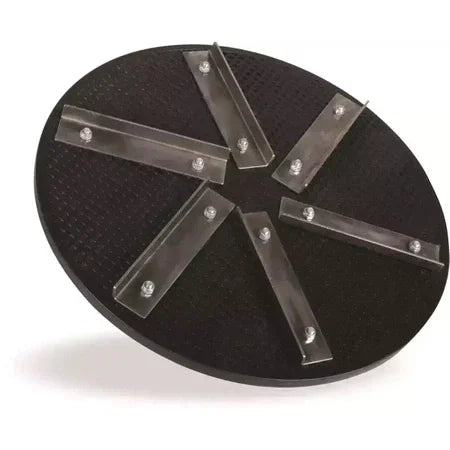

Description
Renders World lists the DED77675 as a separately ordered working disc for one machine only, and the paragraph below sets out what the Dedra manual fixes about that fitment before the ordering detail follows.
Ordering the DED77675 Disc for a Dedra DED7767
A replacement pad DED77675 for render power float work fits the Dedra DED7767 alone, mounting by hook-and-loop onto the machine's 390 mm trowel disc, so an order starts by confirming the model plate. It sits in the Renders World power float and finishing sponge range as an accessory bought on its own rather than as part of the machine kit.
The manual's packing list is what makes that a separate purchase, and it is worth reading before assuming a disc is already on the van. What ships with the machine is the float itself, the trowel disc, a plastic disc with mesh, a sponge plate, a set of screws, a screwdriver and a set of carbon brushes. The accessory discs appear in their own section, marked as not supplied and available to order.
- Host machine: the Dedra DED7767, the only tool this accessory list belongs to.
- Order unit: one disc at £29.50 each, shown as available, read from the product endpoint in August 2026.
- Barcode for ordering: EAN 5902628776754, which identifies the item independently of any product title.
Why Buyers Specify This Disc by Its Dedra Code
Codes travel better than descriptions on this platform, because the discs for the DED7767 are labelled differently in different places while the manufacturer's code stays fixed. Reading the code off the worn disc takes a second on site and puts the right line on the order first time.
- Named in the manufacturer's own list: DED77675 appears in the manual's accessory section alongside DED77671 and DED77674, so the code can be quoted straight from Dedra's document.
- Backed by a barcode: EAN 5902628776754 is carried on the live listing, which is the cleanest reference for a trade counter or a purchase order.
- Tool-free change-over: working discs press onto the trowel disc on hook-and-loop, so a swap needs nothing from the tool bag once the backing disc is on the spindle.
- A consumable, not a repair: the manual's fault table gives a worn disc as the cause of low working effectiveness and a fresh disc as the remedy, which makes a spare cheaper than a stalled afternoon.
- Platform-specific geometry: the fit is set by the machine's 390 mm disc, and the manual covers no other tool — a point worth checking when the machine is hired rather than owned.
DED77675 Order and Fitment Data From the Manual and the Live Listing
| Property | Value |
|---|---|
| Product code (SKU) | DED77675 |
| EAN | 5902628776754 |
| Host machine | Dedra DED7767, per the manual's accessory list |
| Machine disc diameter | 390 mm (machine specification, not the accessory) |
| Mounting | Hook-and-loop onto the trowel disc |
| Supplied with the machine | No — listed as a separate purchase |
| Disc function | Not published — manual and live title conflict |
| Price | £29.50 each, August 2026 |
| Availability | Available, August 2026 |
| Despatch weight | 2 kg endpoint field, packaging included — not a disc specification |
The two figures in that table that do the fitment work belong to the machine rather than the disc. The Dedra DED7767 render smoothing machine turns its 390 mm disc at 110 min⁻¹ on a 710 W motor, which is float speed rather than sander speed, and the disc diameter is the row any accessory has to match. No VAT treatment is displayed beside the £29.50 figure, so none is stated here.
How to Fit the Disc and Bring the Machine Up to Speed
Assembly takes a few minutes with the parts already in the box, and keeping to the manual's order is what makes the head run true from the first pass. Every preparatory step is carried out with the machine disconnected from the supply.
- Fit the trowel disc to the spindle pin, matching the hole to the shape of the pin, then tighten it with the screw provided.
- Press the working disc onto it, where the hook-and-loop face holds it, and check that it seats evenly all the way round.
- Start the machine horizontally and clear of the surface, holding the safety button on the left of the main handle, then pressing the switch.
- Let it reach full speed before it touches the work — the manual is explicit that floating begins only at maximum speed.
- Guide it in semi-circular movements, matching pressure to the task and checking the surface as you go; plaster that has dried a little too far may be dampened.
Stance does more for control here than downforce. The manual asks for a stable position with feet slightly apart and the torso leaning in, which puts the machine's torque through the body rather than the wrist, and the Renders World guide to power float finishing techniques works through the wider sequence and the site conditions around it.
Service Intervals That Keep a Disc and a Machine Working
The intervals on this platform are short, documented and easy to diarise, which is what keeps output steady from the first elevation of the day to the last.
- Check the disc before every start: the manual asks for a check that it is not worn out, and for work to be carried out with serviceable working ends only.
- Work in spells: permissible working conditions are S2, 15 minutes, so a run followed by a cool-down keeps the motor within its rating across a full day.
- Keep it dry: the machine is Class II, IP20 and the manual says to avoid damp, so external passes wait for dry conditions.
- Protect hearing: sound pressure is 83.4 dB(A) and sound power 94.4 dB(A), both with 3 dB(A) uncertainty, determined to EN 60745-1:2009 — hearing protection is a manual requirement, alongside eye and respiratory protection.
- Watch the brushes: carbon brushes are checked no less often than every 20 to 30 working hours and replaced below 5 mm, with a spare set already supplied.
- Clear the air inlets: the manual singles this out as very important and suggests compressed air, since blocked vents are its stated cause of overheating.
Declared vibration at the handle is below 2.5 m/s² with an uncertainty of 1.5 m/s², measured to EN 60745-2-3:2011, which keeps hand-arm exposure planning straightforward on long sessions — though the document is clear that real exposure depends on how the tool is used.
One Open Question to Settle Before the Order Goes In
The Dedra manual and the live product titles assign the DED77674 and DED77675 labels in opposite directions, consistently in both places, so one of the two sources is wrong about what is in the box. Where two sources conflict on the same property, the safe course is to publish neither and buy on the code, which is why no function is stated for this disc anywhere on this page.
Handled that way it costs a buyer nothing, and it is a purchasing instruction rather than a caveat.
- Replacing like for like: order the code printed on the worn disc — for this listing, DED77675 — or quote the EAN.
- Buying a first spare: describe the machine and the work to Renders World, and confirm the code before the order is placed.
- Ordering for a hired machine: check the model plate first, since the manual's accessory list covers the DED7767 only.
Does a DED77675 Order Suit Your Machine?
A replacement pad DED77675 for render power float use is a simple order wherever the machine and the code both match; the cases below cover the rest.
- You already run the DED7767: a direct fit — the disc presses onto the trowel disc already on the spindle, with no adapter in the manual's assembly sequence.
- You run another make or model: the manual documents this platform alone, so check the geometry against that machine's own documentation before ordering.
- You need a particular disc action: confirm the code with us first, because the labelling of the two separately sold codes is the open question above.
- You are finishing a decorative topcoat: the manual's declared purpose is floating lime-gypsum plasters and taking unevenness and old layers off surfaces, and a thin-coat silicone render is textured by hand, so the machine's contribution is the sound surface underneath it.
Check the code against the disc you are replacing, then add it to the order beside the DED7767 plaster float it fits, so the spare is on the van before the next programme starts.
FAQ — Fitment, Packing, Replacement and Site Use
Which machine does the DED77675 fit?
The Dedra DED7767, and no other tool in the manual, attaching by hook-and-loop to the trowel disc that carries the machine's 390 mm head. Other manufacturers' floats use different geometry, so confirm the model plate before ordering.
Is the disc supplied with the DED7767?
No. The packing list runs to the machine, trowel disc, plastic disc with mesh, sponge plate, screws, screwdriver and carbon brushes, and the accessory discs are marked as available to order separately — which is why many buyers add one to the machine order.
How does DED77675 differ from DED77674?
Both are listed in the manual as accessories bought separately, and the function labels attached to them there run opposite to the labels on the live listings. Until Dedra settles it, order the code you are replacing or confirm the code first; the two also differ in price and despatch weight, at £29.50 and 2 kg here.
When should the disc be replaced?
Before every start the manual asks for a check that the disc is not worn out, and its fault table treats low working effectiveness as a worn-disc symptom answered by a new one. Clearing residue at the end of each session and storing the disc flat keeps that check quick.
Can it be used outdoors on a damp day?
Plan it for dry conditions: the machine is rated IP20 and the manual asks that damp be avoided, so exterior work follows the weather window. Within a dry spell the S2, 15-minute duty cycle is the figure that shapes the session, with a cool-down between working periods.
Technical Documentation for the DED7767 Platform
- Dedra DED7767 instruction manual (PDF) — revision 7767.100725.V6, valid for devices manufactured after 01.01.2023.