
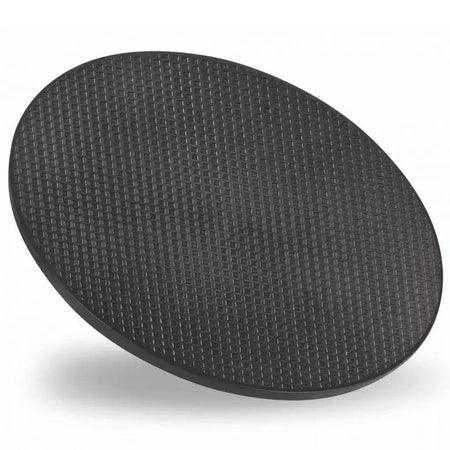

Description
Dedra sells the DED77670 as a PVC disc on four Velcro holders, and its own manual puts a plastic disc in the DED7767 kit box. That makes this a replacement part rather than a first purchase — and the disc a machine owner reaches for when plaster has gone off harder than planned.
Floating Plaster with the DED77670 PVC Disc
The render plastic pad for power float work is the DED77670, a PVC disc Dedra publishes at 400 mm on four Velcro holders for floating and smoothing lime-cement and gypsum plaster. Renders World stocks it in the power float machines, pads and sponges collection.
That is the whole of what the manufacturer claims for it, and the restraint is worth noting before ordering. Dedra names two plaster types and one action; anything beyond those two surfaces is a judgement about your own substrate rather than a published capability.
- Lime-cement plaster: floated and smoothed, named on both the English and Polish catalogue entries.
- Gypsum plaster: the second surface Dedra names, on the same two entries.
- Plaster that has stiffened: the manual gives its plastic disc the job of working larger irregularities, or plaster that has dried too hard for a softer pass — see the scope note below before relying on it.
What Dedra Publishes About the DED77670
| Property | Value | Where it comes from |
|---|---|---|
| Material | PVC | Polish catalogue entry; the English entry says "plastic" only |
| Diameter, descriptive line | 400 mm | DED77670 catalogue entry, technical data |
| Diameter, attribute field | 390 mm | DED77670 catalogue entry, attribute table |
| Fastening | Velcro, four robust holders | DED77670 catalogue entry |
| Stated use | Floating and smoothing lime-cement and gypsum plaster | DED77670 catalogue entry |
| Recommended for | Dedra DED7767 plaster float | DED77670 catalogue entry |
| Producer code | 5902628776723 | Catalogue entry and store record, in agreement |
Two diameters sit on the same catalogue page, which is the practical point to carry away. Dedra's description gives 400 mm and the attribute field beneath it gives 390 mm — the same number the manual gives for the machine's own mounting disc. Order on the code DED77670, and treat any supplier quoting either figure as quoting the same part.
One scope note belongs with that table. The item in the manual's kit list is a plastic disc with mesh, and the manual gives it no catalogue code; the DED77670 entry describes a PVC disc and mentions no mesh. Whether they are the same disc is not settled by any document read here, so if the mesh face is what you are replacing, confirm it with Renders World before the order goes in.
Fitting the Disc and Running It on the Wall
Fitting it to the machine
The plastic disc is a working end rather than a fixing: it presses onto the Velcro face of the mounting disc, which is itself screwed to the spindle. Every step happens with the machine unplugged, as the manual requires.
- Disconnect the machine from the supply before touching the head.
- Fit the mounting disc to the spindle, matching the bore to the shaft, and tighten its screw.
- Press the plastic disc onto the Velcro face until all four holders are engaged.
- Start the machine horizontally and clear of the wall or ceiling, and let it reach full speed before floating.
Running it on plaster
Dedra's method is short and specific: take a stable stance with the feet slightly apart and the torso leaning in, match the pressure to the work, guide the machine in semicircular movements, and keep checking the surface until the smoothness you want appears. The manual adds the variable most operators find out the hard way — the plaster may be dampened as required while it is being worked, which is the documented answer to a surface stiffening faster than the pass.
Two standing instructions sit alongside that. The manual says not to overload the machine and not to leave it running idle, both of which point the same way: the disc cuts through contact and technique at 110 min⁻¹, not through force. Where the floated wall is heading outdoors for a decorative finish, the Renders World silicone render range covers that stage, and the guide to power float techniques and tool selection owns the wider sequencing question.
Which Disc the Manual Sends You To
| Disc type | Job the manual gives it | Supply |
|---|---|---|
| Plastic disc with mesh (this disc, subject to the scope note above) | Larger irregularities, or plaster that has dried too hard | In the kit list |
| Foam disc | Finishing pass across wall surfaces | In the kit list, and sold separately as DED77671 |
| Stripping disc | Mortar squeeze-out from raw brickwork, old plaster and paint coatings, and floating lime-cement plaster before ceramic tiling | Bought separately — code disputed, see below |
| Polystyrene disc | Smoothing pre-worked surfaces, for example before wallpapering | Bought separately — code disputed, see below |
The last two rows carry no product codes on purpose. The manual and the live product titles assign the two purchasable codes to opposite disc types, consistently and in both directions, so one of the two sources is wrong about what is in the box. Renders World is holding those descriptions until Dedra confirms them — order those two by code and check the contents on arrival. The disc types themselves, and the jobs above, are not in doubt.
Keeping the Disc Working Between Jobs
Dedra ties disc condition straight to output, which turns maintenance into a diagnostic rather than a chore. Low working efficiency appears in the manual's fault table with one cause and one remedy: a worn disc, replaced.
- Check before every start: the manual instructs verifying the disc is not spent, and working only with sound working ends.
- Clear residue after every session: the manual requires cleaning work residue off the machine and its ends once the job finishes.
- Read slow work as the signal: reduced efficiency means a fresh disc, not heavier pressure.
- Keep the air intakes clear: the manual singles them out as very important, best cleared with compressed air.
Ordering the DED77670 and What the Kit Already Holds
Renders World lists this render plastic pad for power float use at £19.50 per disc as displayed in August 2026, available, under SKU DED77670 and carrying Dedra's producer code as its barcode. No VAT treatment is shown against the price on the product endpoint, so none is stated here.
- Check the box first: the manual's kit list for the DED7767 includes the mounting disc, a plastic disc with mesh and a foam plate, so a machine bought new should already carry a plastic disc.
- Buy it as the spare: this SKU earns its place when the original wears, which is the point at which the manual tells you to replace it.
- Confirm the machine: Dedra recommends this disc for the DED7767 and names no other model.
- Note the accessory list: the manual's own list of accessories offered for sale covers three other codes and not this one, which is consistent with a kit-supplied part that the catalogue nonetheless sells separately.
Buyers assembling a machine and consumables together will find the full specification on the Dedra DED7767 plaster float page, and the power float pad and sponge range holds the other working ends for the same platform.
FAQ — Fitment, Surfaces, Care and Spares
What does the DED77670 need to run?
The Dedra DED7767 plaster float, which is the machine Dedra recommends it for, plus the mounting disc that screws to the spindle and carries the Velcro face. The plastic disc attaches to that carrier by its four holders rather than to the machine head directly.
Which surfaces does Dedra name for this disc?
Lime-cement plaster and gypsum plaster, for floating and smoothing. No other substrate appears on either catalogue entry, so anything further — basecoats, sand-cement mixes, board faces — is a site judgement rather than a published application.
How should the disc be looked after?
Clear work residue off it at the end of each session, as the manual instructs for the machine and its working ends, and check its condition before every start. Replace it when the work slows, since Dedra gives a worn disc as the cause of low efficiency and a new disc as the fix.
Do I need one if the machine is new?
Probably not straight away. The manual's kit list puts a plastic disc in the box with the DED7767, so a new machine arrives able to float — order this render plastic pad for power float work as the spare that keeps a job moving, and check your own delivery against that list.
Technical Documentation
- Dedra DED7767 instruction manual (PDF) — disc types and their jobs, assembly, operating method, maintenance, fault table, accessory list and kit contents.
- Dedra DED77670 catalogue entry, English — diameter, fastening, stated use and recommended machine.
- Dedra DED77670 catalogue entry, Polish — the only source read that names PVC as the material.