


Description
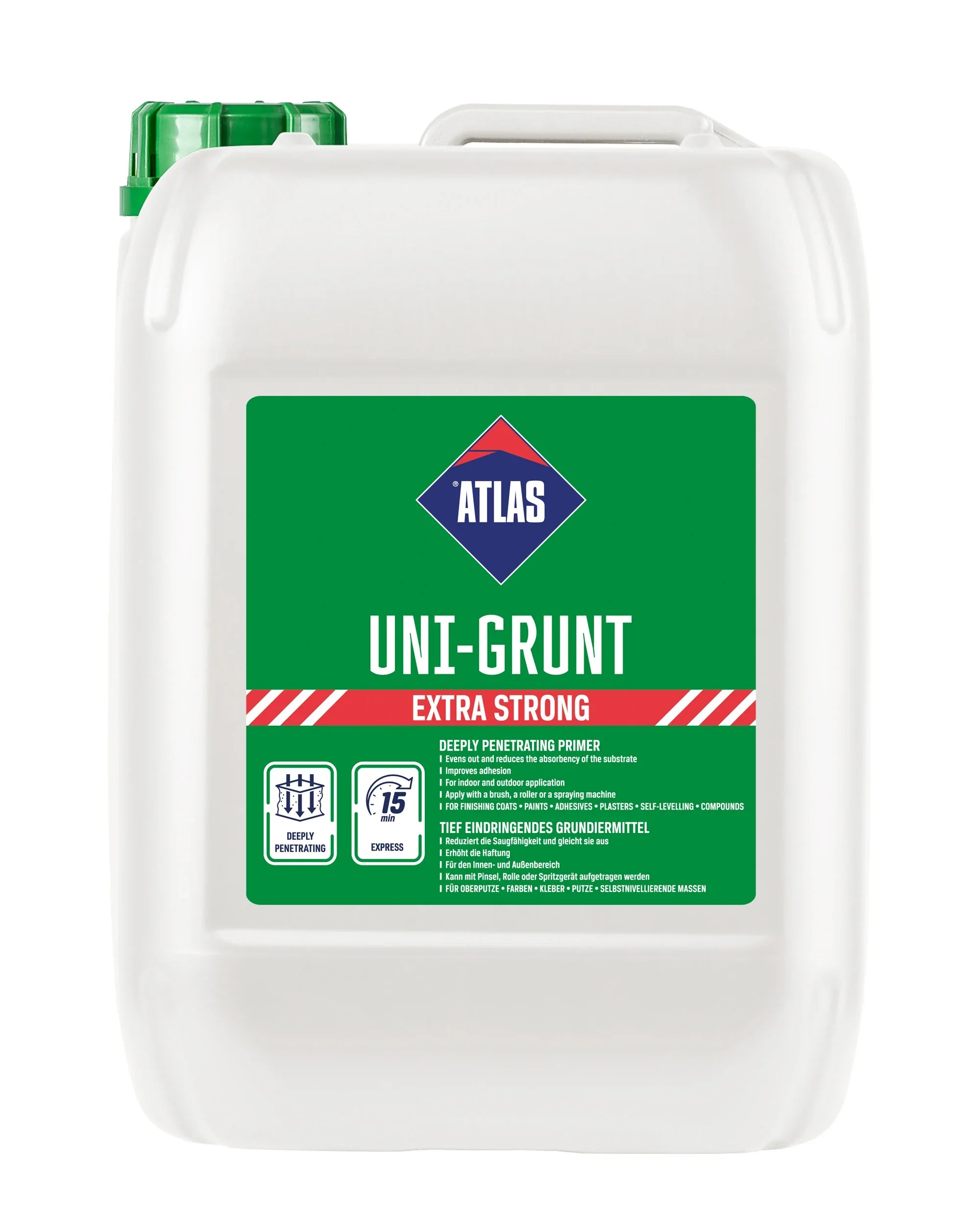
A wall that drinks unevenly finishes unevenly. Atlas Uni-Grunt is the deep-penetrating primer that levels absorbency out before adhesive, render or paint goes anywhere near it, and the 10 kg container is the size that covers whole elevations rather than one patch. The primer is a water dispersion of polymer resins: it soaks into the top layer of a mineral substrate, binds the dust sitting in it, and leaves the wall taking the next coat the same way from one end to the other.
What the Atlas Uni-Grunt Sheet Declares
Every value in this table comes from the manufacturer's technical data sheet for Atlas Uni-Grunt, updated June 2025, and from no other source.
| Property | Declared value |
|---|---|
| Product type | Deep-penetrating primer |
| Binder base | Water dispersion of polymer resins |
| Emulsion density | Approx. 1.0 g/cm³ |
| Average consumption | 0.05–0.2 kg/m² |
| Substrate and air temperature | +5 °C to +30 °C |
| Next layer, Atlas adhesive mortars | After approx. 15 minutes |
| Next layer, paints and screeds | After approx. 2 hours |
| Surface after drying | Colourless and matt |
| VOC content | 1.92 g/l against 30 g/l permitted |
| Shelf life | 12 months from production date |
| Classification | Not a construction product |
That last line changes how the primer is specified rather than how it is applied. Because Atlas Uni-Grunt is not classified as a construction product there is no declared performance and no DoP number to quote for it — the data sheet is the document, and any certified performance on an insulated wall belongs to the system built above the primed substrate.
How Far One 10 kg Container Goes
The manufacturer publishes two figures that answer this, and they answer it from opposite ends. The first is average consumption, 0.05–0.2 kg/m², which describes the wall. The second is a yield table, which describes the container and the dilution the primer is used at.
| Wall and layer above | Dilution | One 10 kg container |
|---|---|---|
| Weak, highly absorbent masonry | Undiluted | Up to 200 m² |
| Standard absorbency, screeds and plaster | 1:1 | Up to 400 m² |
| Standard absorbency, finishes and adhesives | 1:3 | Up to 800 m² |
The two figures meet where a buyer needs them to. Every number in the yield column is an upper limit reached at the 0.05 kg/m² end of the consumption band; at the thirsty end of that band the arithmetic runs 10 kg ÷ 0.2 kg/m² = 50 m². A sound wall under a thin-coat finish, primed at 1:3, is therefore a different order from bare aerated blockwork taking the primer neat. Order against 0.2 kg/m² where the substrate is unknown — old brickwork beside new blockwork, say — and the wall is covered whichever way it behaves. Placing an unfamiliar elevation before ordering is what the guide to rendering on brick, block and painted walls is for.
Substrate, Dilution and the Coats Above
The substrate wants to be dry and free of dust, dirt, oil, grease and wax, with every loose layer taken off before priming starts. The sheet then sets the dilution by what the wall is and what is going on top of it:
- Weak and highly absorbent substrates — cement-lime plaster, aerated concrete, silicate brick, mixocrete screed — take Atlas Uni-Grunt undiluted, or twice at 1:1.
- Standard absorbent substrates under a screed or plaster take one coat at 1:1.
- Standard absorbent substrates under top finishes, paints, waterproofing, tile adhesive or insulation adhesive take one coat at 1:3.
Apply the primer thin and even with a roller, brush or sprayer, and stop at saturation rather than running puddles and streaks down the wall. The sheet asks for one check afterwards that takes a minute: wet the dried surface and watch how fast it takes the water in. If the wall still drinks, prime it again.
Timing above the primer splits in two. An Atlas adhesive mortar can follow after roughly fifteen minutes, which keeps priming and board fixing on the same visit. Painting, wallpapering and tiling wait for the surface to dry, roughly two hours, and the sheet ties both intervals to temperature and humidity rather than to a clock. The cleaning and repair sequence ahead of all of this sits in the substrate preparation guide.
Where Atlas Sends the Job Elsewhere
A penetrating primer works by soaking in, so a surface that cannot absorb anything defeats it. Renders World keeps stock for both cases, because the sheet routes these substrates away from Uni-Grunt and onto a keyed film instead:
- existing ceramic and stone cladding, and terrazzo;
- OSB board, stable linoleum and PVC;
- concrete varnish and oil-based paint coatings.
On the Renders World shelf that keyed film is Atlas Ultragrunt for critical substrates. One further boundary is worth publishing with both of its sources, because the manufacturer's own documents do not agree on it. The current sheet marks gypsum plaster, plasterboard, anhydrite screed and monolithic concrete as suitable for Atlas Uni-Grunt. The earlier English sheet, dated August 2021, recommended Atlas Uni-Grunt Ultra on exactly those substrates. The newer document permits more; the older one permits less. On gypsum, anhydrite and dense concrete the safer specification is still the Ultra concentrate, and that is a different formulation rather than a different pack size.
Priming is also not keying. A thin-coat silicone or acrylic finish bonds to a quartz key coat above the consolidated substrate, not to the penetrating primer underneath it — that layer is Cerplast quartz top coat primer, and a key coat and a penetrating primer sit in very different consumption bands. The comparison is in the primer comparison for thin-coat render and the method in the quartz primer application guide. Dried splashes come off with Atlas Szop 2000; wet ones come off with clean water, which is why tools get washed straight after use.
Ten Kilos or Five
One primer, one data sheet, one consumption band. What separates the two containers is the size of the job and the twelve-month shelf life.
| Job | Container | What decides it |
|---|---|---|
| Whole elevations, EWI substrate priming | Uni-Grunt 10 kg | Up to 200 m² undiluted |
| One wall, interior room, repair patch | Uni-Grunt 5 kg container | Up to 100 m² undiluted |
Past roughly one elevation the larger container is the simpler order and keeps one batch across the wall. Below it, a part-used container has to survive until the next job. The rest of what Renders World keeps for render and external wall insulation preparation sits on the primer shelf, and the finish this preparation usually leads to is in the thin-coat silicone topcoats from Renders World.
Coverage, Dilution and Working Limits
How much wall does one 10 kg container prime?
Up to 200 m² undiluted, up to 400 m² at 1:1 and up to 800 m² at 1:3, all of them upper limits from the Atlas yield table. Against the thirsty end of the 0.05–0.2 kg/m² consumption band the same container covers 50 m², so the wall decides and the table sets the ceiling.
Which dilution does my wall need?
It is set by what is going on top, once the wall has been placed as weak or normally absorbent:
- weak and highly absorbent masonry — undiluted, or twice at 1:1;
- normal absorbency under a screed or plaster — 1:1;
- normal absorbency under finishes, paints, waterproofing and adhesives — 1:3.
Can render go straight onto the primed wall?
Treat Atlas Uni-Grunt as substrate preparation and take the coat directly beneath the finish from the render manufacturer's own instruction, which for Atlas thin-coat systems is a quartz key coat rather than a penetrating primer.
What temperatures does the sheet allow?
Substrate and air both between +5 °C and +30 °C, indoors or outdoors. Drying is stated as dependent on temperature and humidity, so the fifteen-minute and two-hour intervals are guides rather than promises.
Is it suitable for occupied interiors?
Maximum VOC content is declared as 1.92 g/l against 30 g/l permitted under Cat. A/h/FW, and the primer is solvent-free, water-soluble and colourless once dry. Normal ventilation while it dries is the sensible precaution.
Technical Documentation