
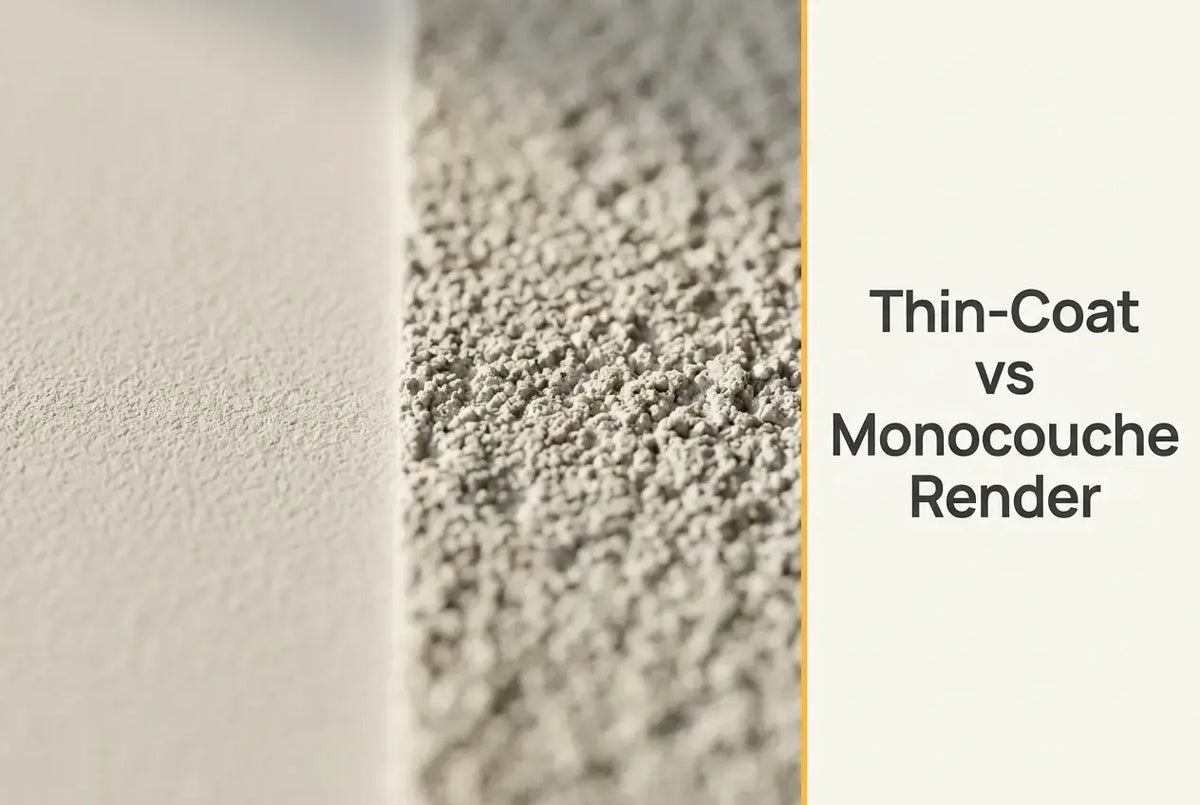
A monocouche render cost is built from different parts than a thin-coat one, though both systems end in the same thing: a coloured, weather-resistant skin on a wall. Both are sold as though the render itself decides the budget. It rarely does. What follows separates them on cost alone, with the finish coat priced from Renders World stock; the technical choice belongs to the performance comparison of silicone against monocouche.
Why a Monocouche Render Cost Is Not a Bag Price
Monocouche is a single through-coloured cementitious coat, applied thick and scraped back. A thin-coat silicone finish is a millimetre-scale decorative layer over an adhesive basecoat with mesh embedded in it. The two are priced from different places, and a 25 kg bag set against a 25 kg bucket says nothing until coverage is applied to both.
Three lines carry the money, and only the first is the render you choose.
- Labour — the largest line on almost every facade, and the one that decides which system is cheaper.
- The layers underneath — primer, adhesive basecoat, mesh and beads on the thin-coat side; a different sequence on the monocouche side.
- The finish coat itself — the line buyers spend the most time on, and the smallest of the three.
Material cost and installed cost are therefore kept apart throughout, and neither is folded into the other.
What the Thin-Coat Finish Coat Costs per Square Metre
Prices as displayed in the Renders World shop, September 2026. Consumption is each product's own published figure at 1.5 mm grain, hand-applied.
| Finish coat | Price per 25 kg | Consumption, 1.5 mm by hand | Material per m² |
|---|---|---|---|
| Atlas Silicone Render White Base | £59.50 | average below 2.5 kg/m² | £5.95 at 2.5 |
| Atlas Silicone Render Grey | £59.50 | average below 2.5 kg/m² | £5.95 at 2.5 |
| Atlas Gemini RS Grey Base | £63.80 | from 2.3 kg/m² | from £5.87 |
| Ceresit CT 74 | £65.00 | 2.1–2.5 kg/m² | £5.46–£6.50 |
| Ceresit CT 76 Solar Protect | £65.00 | 2.1–2.5 kg/m² | £5.46–£6.50 |
The working on the first row: £59.50 ÷ 25 kg = £2.38 per kg, and £2.38 × 2.5 kg/m² = £5.95 per m², so one bucket covers 25 ÷ 2.5 = 10 m². The Ceresit pair runs £65.00 ÷ 25 = £2.60 per kg, giving £5.46 at 2.1 kg/m² and £6.50 at 2.5, or 10 to 11.9 m² a bucket. Across the whole range the finish coat sits between £5.46 and £6.50 per square metre.
Why the Atlas rows are costed at 2.5 and not 2.2
Atlas publishes two numbers for the same render at the same grain: from 2.2 kg/m² applied by hand, and an average below 2.5 kg/m² for the N-15 grain. The first is a floor and the second is a planning figure, and quoting the floor as though it were typical understates every bucket count that follows from it. Checkatrade's own materials list makes the same assumption from the other direction, allowing a 25 kg tub of silicone silicate render to cover up to 10 m² — which is 2.5 kg/m² exactly.
The gap is worth about 70p per square metre on a job priced at the floor, and about three buckets on a semi-detached house. Order to the average and the spare bucket is a rounding decision rather than a second delivery.
What a Facade Costs in Finish-Coat Material
Three project sizes on the Atlas white base at its September 2026 price of £59.50, costed at 2.5 kg/m², with the arithmetic shown so any other product substitutes cleanly.
| Project | Area | Buckets at 2.5 kg/m² | Finish-coat material |
|---|---|---|---|
| Extension or gable | 50 m² | 125 kg ÷ 25 = 5 | £297.50 |
| Semi-detached house | 120 m² | 300 kg ÷ 25 = 12 | £714.00 |
| Detached house or small block | 250 m² | 625 kg ÷ 25 = 25 | £1,487.50 |
Add 5 to 10% for reveals, corner detailing and uneven substrates; on a tinted render that spare material is ordered with the main delivery, because a later top-up arrives on a different batch number and a different shade. Quantities for other grains and other products are set out in the coverage calculator for thin-coat render, and the primer, adhesive basecoat, mesh and beads that sit under the finish are priced in the EPS adhesive and basecoat range.
Installed Cost, the Only Figures That Compare the Two Systems
A monocouche render cost only becomes comparable at the installed rate, and labour never comes from a materials supplier, so those rates come from Checkatrade's cost guides, September 2026. Each guide states when it was last revised, and those dates are ten months apart — which matters more than the difference between the two averages.
| Rate, per m² | Range | Average | Guide last updated |
|---|---|---|---|
| Monocouche rendering, installed | £55–£75 | £65.00 | May 2024 |
| Thin-coat silicone system, installed | £65–£80 | £72.50 | February 2025 |
| Thin-coat silicone system, materials only | £11.80 | — | February 2025 |
On those ballparks monocouche comes out cheaper installed: £72.50 − £65.00 = £7.50 per square metre, or roughly £900 on a 120 m² house. The gap is real but imprecise: the two guides were revised ten months apart and neither is a quotation.
The number that changes how the decision is made is the other one. A thin-coat finish coat at £5.46 to £6.50 per m² is under a tenth of an installed rate of £65 to £80. Moving between the cheapest and the dearest render in the range shifts the total by about a pound a square metre, so the system choice is a labour and build-up decision, and the render choice is a performance decision made inside a budget that has already been set.
Key Takeaway: the thin-coat finish coat costs £5.46 to £6.50 per square metre in material, from Renders World prices in September 2026. Monocouche cannot be costed by material at all without a consumption rate from its supplier. Installed, Checkatrade puts monocouche about £7.50 per m² below a thin-coat silicone system — a gap set by labour and build-up, not by the price of the render.
What to Ask Before Anyone Can Price the Monocouche Side
Renders World stocks the thin-coat side and does not sell monocouche, so a monocouche render cost by material has to come from whoever supplies it. Weber's technical datasheet for weberpral M carries the consumption rate, and without a figure in kilograms per square metre no material cost per square metre exists for monocouche — a bag price on its own will not produce one.
- Consumption in kg/m² at the specified finished thickness. That single number is what makes a bag price comparable with a bucket price.
- Whether the quote is supply-and-fit or supply only. A monocouche rate quoted against a thin-coat material price is not a comparison at all.
- What sits under the coat. Substrate preparation, beading and any reinforcement belong in the comparison on both sides, or on neither.
Where the Cost Actually Moves
The savings that survive scrutiny come from method and sequencing, not from specifying a cheaper render.
- Machine application. Atlas publishes from 2.2 kg/m² by hand and from 1.9 kg/m² mechanically at the same grain — floor against floor, 14% less material. The sheet gives no machine counterpart to its 2.5 kg/m² average, so the saving is real on the published pair and cannot be carried across to the planning figure.
- One batch per elevation. Ordering a whole elevation in a single delivery costs nothing and removes the shade variation a partial re-order introduces on any tinted finish.
- The calendar. Atlas renders are set for +5 to +30 °C and the Ceresit pair for +5 to +25 °C, both below 80% relative humidity. Work that slips past the window needs ATLAS ESKIMO setting accelerator to reach down towards 0 °C on the Atlas renders — a cost the programme can usually avoid.
Product choice is the one place where the old rule of thumb has stopped applying. Ceresit CT 74 and Ceresit CT 76 Solar Protect are the same price today, £65.00 for 25 kg, so there is nothing to trade off between them on cost. What separates them is mechanism: CT 76 carries an increased quantity of UV absorbers, which Ceresit names as the source of its colour light fastness, and it declares a light reflection value of 15 or above. The name refers to that UV-absorber package rather than to any thermal property. Ceresit also states that the render should not be applied onto a wall in strong sun, so CT 76 is specified for colour stability on an exposed elevation, and that elevation is still worked while it is shaded. Which criteria decide the rest is set out in the criteria for choosing between silicone renders, and the full range with prices per bucket sits on the thin-coat silicone render shelf. A layer-by-layer breakdown of the whole system is in the per-square-metre cost guide for silicone render.
Written by Mariusz Saja. Technically reviewed by Rafał Wyrzykowski. Last reviewed Sep 2026.
Costing Questions on Thin-Coat and Monocouche
What is the monocouche render cost per square metre, and is it cheaper?
Installed, £55 to £75 with an average of £65.00, and yes — by about £7.50 per square metre on Checkatrade's averages of £65.00 against £72.50, quoted in September 2026 from guides last revised in May 2024 and February 2025. On material alone no comparison can be made, because the monocouche consumption rate has to come from the supplier. The finish coat is a small enough share of either total that it is rarely where a budget is won.
How much render does a 120 m² facade need?
Twelve 25 kg buckets of the Atlas base at its published average: 120 m² × 2.5 kg/m² = 300 kg, divided by 25 kg, is 12 exactly. Costed at £59.50 a bucket that is £714.00 in finish coat, before 5 to 10% for waste and detailing.
Can monocouche be priced by the bag the way thin coat is priced by the bucket?
Only once the merchant states consumption in kilograms per square metre at the finished thickness being specified. Without it a bag price is a number with no area attached to it, and the arithmetic that produces a cost per square metre cannot start.
Does machine application really change the cost?
On material, yes and measurably: Atlas publishes from 2.2 kg/m² by hand and from 1.9 kg/m² mechanically at 1.5 mm grain, which is 14% less render on the same wall. Whether the saving survives once machine hire and a larger crew are priced is a labour question, and the labour rate is not a figure a materials supplier can supply.
Is Ceresit CT 76 worth more per square metre than CT 74?
Neither costs more: both are £65.00 for 25 kg in September 2026, at the same consumption band. CT 76 is specified where colour stability on an exposed elevation matters, on the strength of its increased UV-absorber content and a declared light reflection value of 15 or above.