

Description
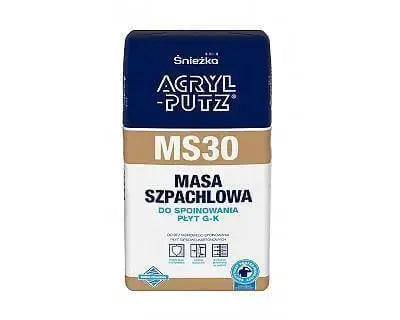
Acryl-Putz MS30 is a plasterboard joint filler made to close the joints between boards without tape. It comes from Śnieżka, the Polish maker of the Acryl-Putz range, as a dry powder in a 20 kg bag: gypsum with cellulose fibres and a polymer resin, mixed with water on site. The fibres hold the joint together and keep it flexible, and once sanded the joint is smooth and ready for paint or wallpaper. It is classed to EN 13963 as type 4B, a jointing compound for plasterboard used without tape, and it is for interior work.
What This Plasterboard Joint Filler Does
The main job is jointing plasterboard. Śnieżka lists it for boards with half-round, flattened half-round and sharp bevelled edges, and the same powder takes on smaller repairs around the room:
- Tapeless board joints — fill the joint, then go over it with wider coats until it is flat.
- Taped joints on a timber frame — on boards fixed to a timber attic frame, the maker advises bedding a reinforcing tape in the filler.
- Repairs — scratches and cracks in walls and ceilings, filled flush and sanded smooth.
- Perforated corner beads — bedding them in place.
- Screw heads — covering them flush with the board.
- Cracked mineral plaster indoors — reinforced with glass-fibre mesh bedded in the filler.
Why Choose a Tapeless Joint Filler
A plasterboard joint filler that needs no tape on straight runs saves a step on every joint. MS30 adds a few things to that:
- No tape on straight runs — on a sound frame you fill and finish the joint with the compound alone.
- Cellulose fibres — they make the set filler flexible, so the joint stays sound.
- Strong and well bonded — a polymer resin raises the strength of the joint and its grip on the board.
- Smooth after sanding — the worked surface takes paint or wallpaper.
- No VOC — the maker lists no volatile organic compounds.
Acryl-Putz MS30 Technical Data
| Property | Value |
|---|---|
| Type | Jointing compound for plasterboard, dry powder |
| Made from | Gypsum with cellulose fibres and polymer resin |
| Standard | EN 13963, type 4B — for joints without tape |
| Pack | 20 kg bag |
| Colour | Cream |
| Water | About 0.55 l per kg (about 11 l for a full bag) |
| Working time | Use within 1 hour of mixing |
| Setting time | About 120 minutes |
| Consumption | About 0.3 kg per metre of joint for each mm of thickness |
| Joint strength | At least 300 N |
| Reaction to fire | B-s1, d0 |
| Working conditions | +5 °C to +30 °C |
| Use | Interior work only |
| Shelf life | 12 months from the production date; keep dry |
How to Joint Plasterboard with MS30
Prepare the Boards
Fix the boards to the frame the way their system requires, and put right any fault in the frame before you start. Metal studs, tracks and ceiling profiles are in the drylining range. The surface must be stable, dry and free of grease, loose grains and dust. Bevel any cut board edge with a plane or knife and prime it before jointing; primers are in the primers range. Widen a crack slightly so the filler can fill it fully.
Mix the Filler
Pour the powder into clean water at about 1 kg to 0.55 litres, about 11 litres for a full bag, stirring all the time. A slow drill and paddle gives the most even, lump-free mix. Leave it for about 5 minutes, stir again and use it within an hour. Mix each batch with clean tools in a clean bucket.
Fill the Joints
- Without tape. Fill the joint with a spatula or stainless steel trowel and take off the excess. Apply the second coat with a wide trowel across the joint area until it is level and smooth. Once that is dry, add a third, still wider coat if it needs one. Never finish a joint in a single coat.
- With tape. Spread filler along the joint and bed a paper tape or mesh into the wet coat, bulge towards the wall and centred on the gap. Press out any air bubbles with the spatula. When it is dry, spread a wider levelling coat over it, and another if needed.
- Cracked plaster. Spread a 2–3 mm coat over the plaster and bed glass-fibre mesh into it, overlapping the sheets by at least 5 cm. Cover the whole surface so the mesh disappears in the filler, then finish as you would a skim on mineral plaster.
- Sand. Sand the last dry coat with paper or mesh of grit 150, dust it off and paint. Trowels and spatulas are in the skimming blades and spatulas range.
Work only when the boards and the air are between +5 °C and +30 °C.
After Jointing: Paint, Paper or Skim
A sanded MS30 joint is ready for paint or wallpaper. If the boards should look like one smooth wall, skim the whole surface once the joints are done: Atlas Gipsar Uni is a white finishing skim for full-board skimming to levels Q2 to Q4, and Atlas Gipsar Plus levels and finishes from one bag.
Compare it with the ready-mixed joint compound on the Renders World shelf; they suit different ways of working:
| Compound | Comes as | Tape | Also used for |
|---|---|---|---|
| Acryl-Putz MS30 | Powder, 20 kg bag, mixed with water | Not needed on sound joints (EN 13963 type 4B) | Repairs, screw heads, corner beads, mesh |
| Atlas GTA | Ready-mixed, 18 kg tub | Used with tape (EN 13963 type 3A) | Thin finishing coats over the board |
The ready-mixed compound and the skims that go over the joints are in the finishing plasters and fillers range at Renders World.
How Much to Order
This plasterboard joint filler uses about 0.3 kg for each metre of joint at 1 mm thick:
- One 20 kg bag — about 66 metres of joint at 1 mm.
- Thicker or wider coats — more filler per metre, so plan by the length of your joints and the coats each one takes.
Orders are processed the same day when the stock is there, and the team quotes delivery after the order. You can also collect in person from the Renders World counter in Southampton during opening hours.
FAQ — Acryl-Putz MS30 Joint Filler
Do I need tape with MS30?
Not on sound joints: this plasterboard joint filler is made for tapeless jointing. On boards fixed to a timber attic frame, Śnieżka advises bedding a reinforcing tape in the joint.
Which board edges can I joint with it?
Half-round, flattened half-round and sharp bevelled edges. Bevel a cut edge with a plane or knife and prime it first.
How long can I use a mixed batch?
Up to 1 hour after mixing. The filler sets in about 120 minutes.
What grit should I sand it with?
Grit 150 paper or sanding mesh on the last dry coat, then dust off before painting.
Can I use it outside?
No. It is made for interior work. Keep the bag dry until you use it.
Technical Documentation