

Description
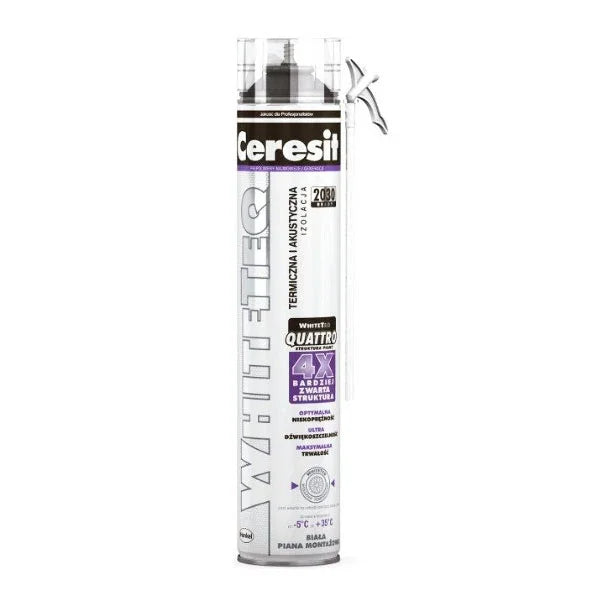
Ceresit WhiteTeq foam with hose is a white polyurethane foam in a 750 ml hand-held can, made by Henkel for fitting and gap-filling work inside and outside. The hose comes in the pack and screws straight onto the valve, so no foam gun is needed. Ceresit gives the foam a structure four times more compact than standard foam and half its expansion pressure, and one can gives about 33 litres of foam. It is part of the Renders World foams and adhesives range.
Ceresit WhiteTeq Foam with Hose at a Glance
What the hose can brings to a job:
- No gun to buy. The hose supplied with the can screws onto the valve, and the foam comes out as soon as you press.
- Gentle on frames. Expansion pressure is half that of standard foam, so window and door frames are not pushed out of shape while it rises.
- A tighter joint. The compact structure adds to the thermal and sound insulation of the gap, with sound insulation of up to 63 dB.
- Longer life outdoors. UV resistance four times that of standard foam slows ageing, though exposed foam still needs a cover.
- More foam per can. About 33 litres from 750 ml, slightly more than the gun version.
| Property | Ceresit WhiteTeq, hose version |
|---|---|
| Can | 750 ml, hand-held, hose included |
| Base | Polyurethane resin; propellant propane and isobutane |
| Colour | White |
| Yield per can | about 33 litres, depending on how the foam rises |
| Joint length per can, worked out | about 55 m of a joint 2 cm wide and 3 cm deep |
| Density | about 25 kg/m³ |
| Tack-free | about 6 to 12 minutes at 23 °C and 50 % humidity |
| Ready to trim | about 30 minutes for a 2 cm layer |
| Fully cured | about 8 hours at +20 °C; about 20 hours at −5 °C |
| Application temperature | −5 °C to +35 °C for air and surface; can at least +5 °C |
| Temperature range once cured | −40 °C to +80 °C |
| Water absorption, 24 h | ≤ 2.0 kg/m² |
| Compressive stress at 10 % deformation | ≥ 20 kPa |
| Tensile strength, perpendicular | ≥ 75 kPa |
| Shear strength | ≥ 100 kPa |
| Air permeability | class 4 (1200 Pa) |
| Watertightness | class E 1200 |
| Dimensional stability | ±5 % |
| Shelf life | 12 months from the production date printed on the base |
Hose Can or Gun Can?
Ceresit makes WhiteTeq in two 750 ml cans from one technical sheet. The foam behaves the same way in both; what changes is how it leaves the can and a few figures:
| Hose can | Gun can | |
|---|---|---|
| How you dispense it | hose screwed onto the valve | can screwed onto a foam gun |
| Foam per can | about 33 litres | about 31 litres |
| Density | about 25 kg/m³ | about 23 kg/m³ |
| Shelf life | 12 months | 15 months |
Ceresit WhiteTeq foam with hose suits a one-off job or a few frames with no gun to hand. If you already work with a foam gun, the Ceresit WhiteTeq gun foam is the same foam made for it.
What It Is For
Ceresit lists these jobs for WhiteTeq:
- setting window frames;
- setting door frames, always together with mechanical fixings;
- fitting roller-shutter boxes, service cabinets and similar housings;
- filling openings in roof structures and in insulation;
- closing gaps round pipes and other services.
The foam bonds well to concrete, brick and block, plaster, metal, wood, polystyrene, paper, painted surfaces and most plastics. It will not hold on polyethylene, PTFE or silicone.
Before You Start
- Leave the can at room temperature for 12 hours.
- Clean the surfaces: they must be sound, free of dust and grease, with any loose or weak layer removed.
- Mist the surfaces with water just before foaming. Damp is fine; ice or frost is not.
- Tape over the edges of anything the foam should not touch.
Applying Foam from the Hose
- Shake the can firmly, about 30 times, and take the protective cap off the valve.
- Screw the hose from the pack onto the valve.
- If the temperature is above freezing, dampen the surfaces first.
- Fill the gap to only half its depth; the foam expands into the rest.
- Spray the fresh foam lightly with water when you finish.
- Cut away the excess once it has cured. A 2 cm layer can be trimmed after about 30 minutes.
Once a can of Ceresit WhiteTeq foam with hose has been opened, Ceresit advises using it up as soon as possible, so plan the work to finish the can in one go. Fresh foam comes off with a foam cleaner or acetone; Ceresit names its own TS 100 cleaner, and the DEMSUN C80 foam cleaner in the same range removes fresh PU foam too. Cured foam can only be removed mechanically.
Curing, Cold Weather and Sunlight
- The foam can be applied from −5 °C to +35 °C, with the can itself no colder than +5 °C.
- Curing takes about 8 hours at +20 °C and about 20 hours at −5 °C.
- Even with its higher UV resistance, Ceresit advises keeping cured foam out of the sun: cover it with cement mortar, render, paint or similar.
Safety and Storage
- Wear safety glasses and gloves. Do not smoke, eat or work near a naked flame, and ventilate closed rooms well or wear respiratory protection.
- The can holds flammable gas under pressure. Keep it below +50 °C, do not pierce or burn it, and carry it in the boot, never in the passenger compartment.
- Store and transport cans upright, dry and cool, at +5 °C to +25 °C. A single can may lie flat if it is secured against falling.
- Keep out of the reach of children.
WhiteTeq Foam with Hose: Common Questions
Do I need a foam gun for this can?
No. Ceresit WhiteTeq foam with hose comes with its own hose, which screws onto the valve, and the foam is dispensed straight from the can.
How far does one can go?
About 33 litres of foam, depending on temperature and humidity while it rises. In a joint 2 cm wide and 3 cm deep that works out at roughly 55 metres per can.
Can I keep a part-used can for later?
Ceresit advises using an opened hose can as soon as possible, so plan to empty it on the same job.
Will it bend a uPVC window frame?
Ceresit states that WhiteTeq does not deform window and door frames during fitting, as its expansion pressure is half that of standard foam. Fill each gap only halfway and let the foam rise.
Can I use it in cold weather?
Yes, down to −5 °C for air and surface, as long as the can is at +5 °C or warmer. Allow about 20 hours to cure at −5 °C.