

Description
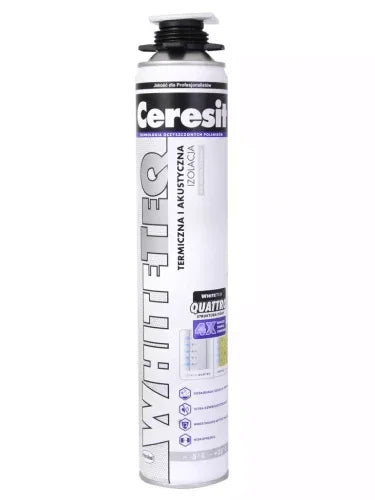
Ceresit WhiteTeq is a white polyurethane foam in a 750 ml can for a foam gun, made by Henkel for installation and fitting work inside and outside. Ceresit gives it a structure four times more compact than standard foam and two times lower expansion pressure, so window and door frames are not pushed out of line while it cures. One can gives about 31 litres of foam, and it bonds to concrete, masonry, plaster, metal, wood, polystyrene and plastics other than polyethylene, PTFE and silicone. It sits in the Renders World foams and adhesives range.
Ceresit WhiteTeq Gun Foam at a Glance
Why fitters choose this foam:
- Frames stay true. Low expansion pressure, half that of standard foam by Ceresit's comparison, protects profiles from bowing and does not deform window or door frames during fitting.
- Dense structure. A structure four times more compact than standard foam raises the thermal and sound insulation of the joint.
- Quiet joints. Sound insulation of up to 63 dB.
- Slower ageing. Four times the UV resistance of standard foam, though the cured foam still needs covering outside.
- Made for the gun. About 31 litres of foam from one 750 ml can, dispensed through a foam gun.
| Property | Ceresit WhiteTeq, gun version |
|---|---|
| Base | Polyurethane resin; propellant propane and isobutane |
| Colour | White |
| Yield per 750 ml can | about 31 litres, depending on how the foam rises |
| Joint length per can, worked out | about 50 m of a joint 2 cm wide and 3 cm deep |
| Density | about 23 kg/m³ |
| Skin forms | after about 6 to 12 minutes at 23 °C and 50 % humidity |
| Can be cut | after about 30 minutes for a 2 cm bead |
| Fully cured | about 8 hours at +20 °C, about 20 hours at −5 °C |
| Working temperature | −5 °C to +35 °C (air and surface); can at least +5 °C |
| Cured foam withstands | −40 °C to +80 °C |
| Sound insulation | up to 63 dB |
| Air permeability | class 4 (1200 Pa) |
| Watertightness | class E 1200 |
| Compressive stress at 10 % | ≥ 20 kPa |
| Tensile strength, perpendicular | ≥ 75 kPa |
| Shear strength | ≥ 100 kPa |
| Dimensional stability | ±5 % |
| Shelf life | 15 months from the production date on the base of the can |
Jobs and Surfaces It Suits
Ceresit names five main jobs for Ceresit WhiteTeq:
- fitting window frames;
- fitting door frames, together with mechanical fixings;
- fitting roller-shutter boxes, service cabinets and similar units;
- filling openings in roof structures and in insulation materials;
- filling gaps round pipes and other services.
Ceresit WhiteTeq sticks well to concrete, masonry, plaster, metal, wood, polystyrene, paper, painted surfaces and plastics. Polyethylene, PTFE and silicone are the exceptions: the foam does not hold on them.
Prefer a can with a straw? The WhiteTeq foam with hose is the same foam in a can that needs no gun.
Preparing the Gap
- Surfaces must be sound and free of dust and grease. Remove dirt and any weak, flaking layer.
- Spray the surfaces with water just before foaming. They may be damp but not frozen or covered in frost.
- Mask the edges of frames and finished surfaces with tape, so stray foam does not mark them.
- Bring the can to room temperature for 12 hours before use.
Using the Foam with a Gun
- Shake the can hard, about 30 times, and take the cap off the valve.
- Close the gun's valve, then screw the can onto a foam gun.
- Open the gun's valve and release foam with the trigger.
- Above freezing, dampen the surfaces first. Fill only half the depth of the gap: the foam expands to fill the rest.
- Mist the fresh foam with water when you finish.
- Trim the excess once it has cured; the bead can be cut after about 30 minutes for a 2 cm bead.
When you swap cans, make sure no air is left in the gun. After the last can, clean the gun with a foam cleaner: Ceresit names its own TS 100 cleaner, and a gun-grade foam cleaner is in the same range. Wet foam comes off tools and surfaces with a foam cleaner or acetone; cured foam only comes off mechanically.
Outside Joints and Sunlight
- Ceresit WhiteTeq resists UV four times better than standard foam, which slows its ageing.
- Ceresit still advises keeping cured foam out of sunlight: cover it with cement mortar, render, paint or similar.
Safety and Storage
- Wear safety glasses and gloves. Do not smoke, eat or work near an open flame, and keep closed rooms well ventilated or use respiratory protection.
- The can holds flammable gas under pressure: keep it below +50 °C, never pierce or burn it, and carry it in the boot of a car, never in the passenger area.
- Store and carry cans upright in a cool, dry place at +5 °C to +25 °C. Single cans may lie flat if they cannot fall.
- Keep out of reach of children.
Ceresit WhiteTeq: Questions Before You Order
How much foam does one can give?
Ceresit WhiteTeq gives about 31 litres from the 750 ml gun can, depending on temperature and humidity while the foam rises. For a joint 2 cm wide and 3 cm deep, that is roughly 50 metres of joint per can.
Will it push my window frame out of line?
Ceresit gives WhiteTeq half the expansion pressure of standard foam and states that it does not deform window and door frames during fitting. Fill only half the gap and let it rise.
Do I need a foam gun?
Yes, this version screws onto a foam gun. For work without a gun, choose the WhiteTeq can with hose.
Can I use it in winter?
Yes, down to −5 °C for the air and the surface, with the can itself at least +5 °C. At −5 °C it takes about 20 hours to cure, against about 8 hours at +20 °C.
How soon can I cut it?
A 2 cm bead can be trimmed after about 30 minutes at 23 °C; the surface skins over in about 6 to 12 minutes.
Can I leave it exposed outside?
No. Cover the cured foam with mortar, render or paint, even though WhiteTeq resists UV better than standard foam.