
The 2026 Energy Gap: Why Your Floor Level is Growing Mould
As we navigate the 2026 heating season under the full implementation of the Future Homes Standard, a recurring issue has emerged in UK retrofits: the appearance of black mould along the skirting boards of newly insulated homes. While the main elevations are often perfectly protected, many projects fail because they ignore thermal bridges in the plinth zone. This critical area, where the external wall meets the ground floor slab, remains a highway for heat loss if the insulation is not continued below the internal floor level. According to the 2026 technical guidelines from the BRE (Building Research Establishment), a missing plinth detail can lower the surface temperature of the internal wall-floor junction to the point of condensation, triggering rapid fungal growth even in well-ventilated properties.
Understanding the "Cold Bridge" at the DPC
The transition at the Damp Proof Course (DPC) is technically challenging. Many installers in the past stopped the insulation 150mm above ground level to avoid moisture absorption. However, in 2026, the Home Energy Model (HEM) penalizes these gaps heavily. A break in the thermal jacket at the plinth creates a "cold bridge" that sucks heat from the internal floor slab. To solve this without risking dampness, the industry has standardized the use of high-performance XPS insulation boards UK. Unlike standard EPS, the closed-cell structure of extruded polystyrene is 100% moisture-resistant, allowing it to be installed below the DPC and even below ground level to create a continuous thermal barrier.
The Physics of Mould Prevention in 2026
Mould is not just a cleaning issue; it is a symptom of a thermal imbalance. In 2026, professional plinth insulation UK strategies focus on moving the dew point entirely outside the masonry. When the plinth is left uninsulated, the internal wall base remains cold ($< 12^\circ\text{C}$), while the warm, humid indoor air hits it and condenses. By wrapping the foundation in at least 50mm to 100mm of XPS, you raise the internal surface temperature, effectively eliminating the environment where spores thrive. This is a critical step for properties in high-moisture cities like Manchester or London, where the 2026 mould crisis has led to stricter enforcement of Awaab’s Law for both social and private landlords.
2026 Best Practice: Detailing the Plinth Transition
| System Component | 2026 Technical Standard | Why it Matters |
|---|---|---|
| Insulation Type | High-density XPS (Extruded) | Zero water absorption below DPC level. |
| Adhesive | Ceresit CT 84 XPS Foam | Superior bond strength on damp foundations. |
| Drip Edge | PVC Bellcast Bead with Mesh | Directs rainwater away from the plinth zone. |
| Overlap | Minimum 200mm below internal floor | Eliminates the slab-edge thermal bridge. |
System Integration: Finishing with Mosaic Render
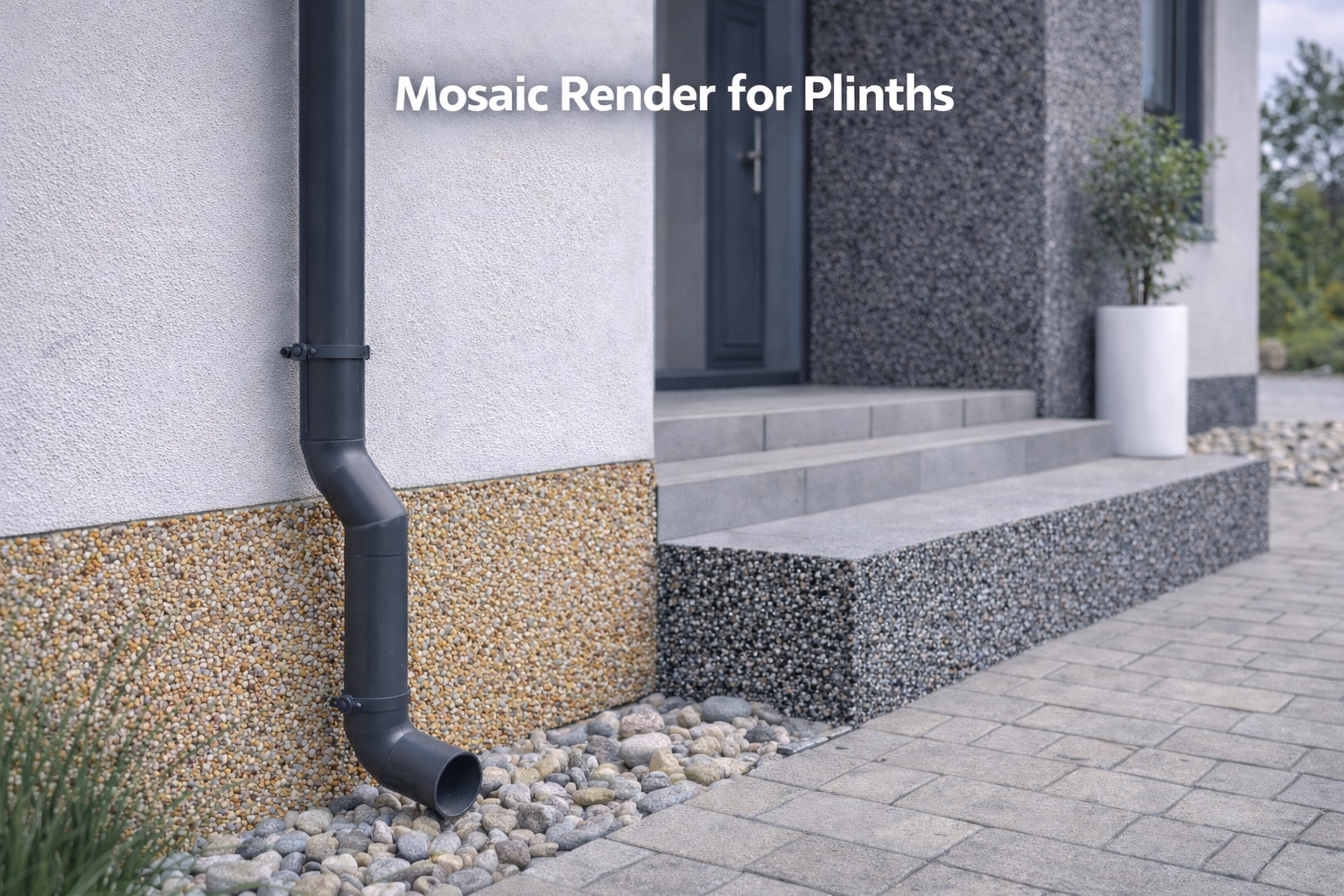
Because the plinth zone is subject to mechanical impact and heavy rain splashback, the final finish must be as robust as the insulation. In 2026, we recommend completing your thermal envelope with a vapour-permeable decorative finish from our external wall insulation systems range. Specifically, quartz-based mosaic renders provide a washable, impact-resistant "armour" that protects the XPS boards from damage while maintaining the building's aesthetic continuity.
Expert Verdict: The Integrated Foundation
Solving cold bridge prevention at floor level is the hallmark of a high-quality 2026 retrofit. If you are investing in a facade upgrade, do not allow the contractor to "save money" by skipping the plinth. The long-term cost of mould remediation and energy loss far outweighs the price of a few boards of XPS. For technical support on U-value calculations for foundations or to request a 2026-compliant plinth detail drawing, contact our technical hub today.