
The 2026 Insulation Dilemma: Balancing Efficiency and Compliance
As we navigate through 2026, the technical requirements for building envelopes in the UK have reached a peak of complexity. Under the full enforcement of the Future Homes Standard, achieving the mandatory wall U-value of $0.18\ W/m^{2}K$ is the primary objective for every new build and major retrofit. However, selecting the right core for your external wall insulation systems is no longer just about thermal performance; it is a critical decision involving fire safety legislation, acoustic requirements, and building height restrictions. In this 2026 comparison, we evaluate the two dominant technologies—Graphite EPS and Mineral Wool—to determine which material is the optimal fit for your specific project.
Thermal Performance: The Quest for the Slender Wall
In 2026, architectural space is at a premium. To meet the $0.18$ target, developers are constantly looking for ways to limit the overall thickness of the external wall. This is where the thermal conductivity ($\lambda$) of your chosen material becomes the deciding factor.
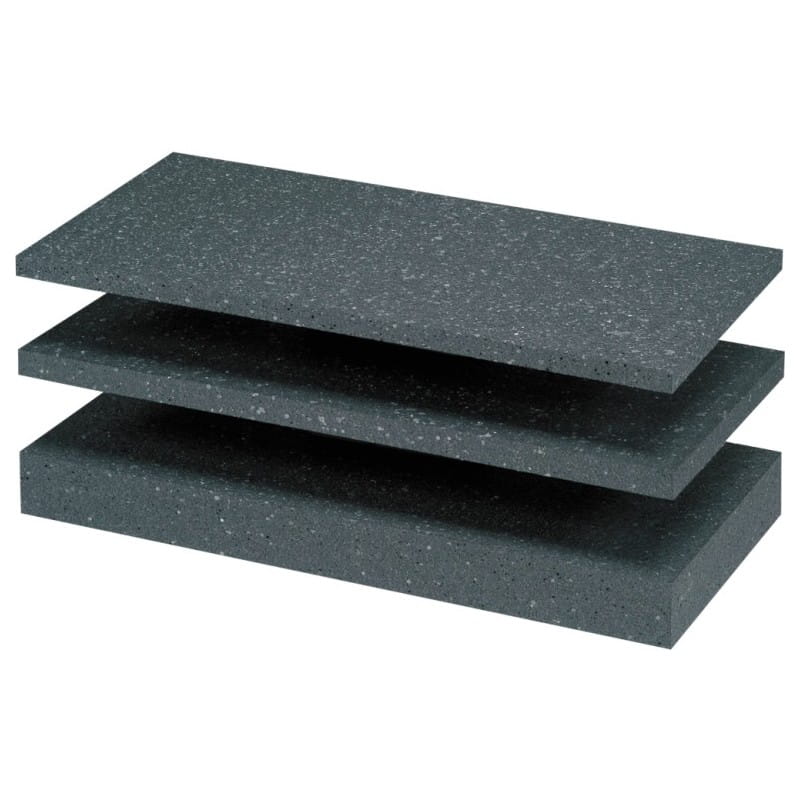
- Graphite EPS: Infused with high-purity graphite to reflect radiant heat, graphite EPS boards offer a superior thermal conductivity of $0.031\ W/mK$. This allows you to hit 2026 targets with an insulation thickness of approximately 150mm–160mm.
- Mineral Wool: Typically offering a thermal conductivity of $0.036\ W/mK$, mineral wool requires a slightly thicker application—usually 170mm–180mm—to achieve the same thermal resistance.
For low-rise residential projects where reveal depths and roof overhangs are limited, Graphite EPS remains the 2026 industry favorite for achieving a high-performance thermal jacket with minimal bulk.
Fire Safety: The 11-Metre Threshold in 2026
The Building Safety Act 2026 has brought absolute clarity to material selection based on building height. The fire classification of your insulation is now the most scrutinized detail by Building Control and the Building Safety Regulator (BSR).
- Class A1 (Non-Combustible): mineral wool insulation is manufactured from volcanic rock, providing a naturally non-combustible shield that can withstand temperatures over 1,000°C. It is the mandatory choice for buildings over 11 metres and is highly recommended for any multi-occupancy structure.
- Class E (Fire Retardant): While Graphite EPS is treated with fire-retardant additives, it remains a combustible material. In 2026, it is restricted to buildings under 11 metres (typically 3 storeys or fewer) and must be installed with certified fire breaks to comply with Approved Document B guidance.
If your project is a mid-to-high-rise development, or a high-risk building such as a school or hospital, mineral wool is the only pathway to 2026 compliance.
Moisture Management and Acoustic Comfort
Beyond heat and fire, 2026 facade engineering prioritizes occupant health (Healthy Homes). The vapour permeability of the system determines how well the building "breathes." Mineral wool is exceptionally vapour-open, allowing internal moisture to migrate out through the wall fabric, which is vital for the renovation of solid-wall Victorian and Edwardian properties. Conversely, while Graphite EPS is less breathable, its high resistance to water absorption makes it the ideal choice for modern masonry and areas prone to heavy driving rain. Furthermore, mineral wool provides a significant acoustic advantage, reducing airborne noise by up to 15–20dB more than foam-based alternatives—a critical consideration for 2026 urban developments near busy UK transport hubs.
2026 Technical Selection Matrix
| Feature | Graphite EPS | Mineral Wool (Stone Wool) |
|---|---|---|
| Lambda ($\lambda$) | $0.031\ W/mK$ (Superior) | $0.036\ W/mK$ (Good) |
| Fire Rating | Class E (Combustible) | Class A1 (Non-Combustible) |
| Vapour Flow | Vapour-Resistant | High Breathability (V1) |
| Installation | Lightweight / Fast-track | Heavy / Labour Intensive |
| 2026 Best Use | Low-rise residential (< 11m) | High-rise & Public Buildings |
Expert Verdict: Making the Right Call
Choosing between Graphite EPS vs Mineral Wool 2026 requires a holistic view of the building's lifecycle. For a standard domestic detached or semi-detached home, Graphite EPS offers the best return on investment, providing maximum thermal efficiency for the lowest material cost. However, if fire safety, noise reduction, or moisture breathability are the primary drivers—or if the building exceeds the 11-metre threshold—Mineral Wool is the professional recommendation. To ensure your choice meets current UK Building Regulations, always source BBA-certified systems and consult a qualified Retrofit Coordinator during the design phase.
Still unsure which material fits your 2026 project? Contact our technical support hub for bespoke U-value calculations, wind-load analysis, and fire safety compliance reports tailored to the UK market.