
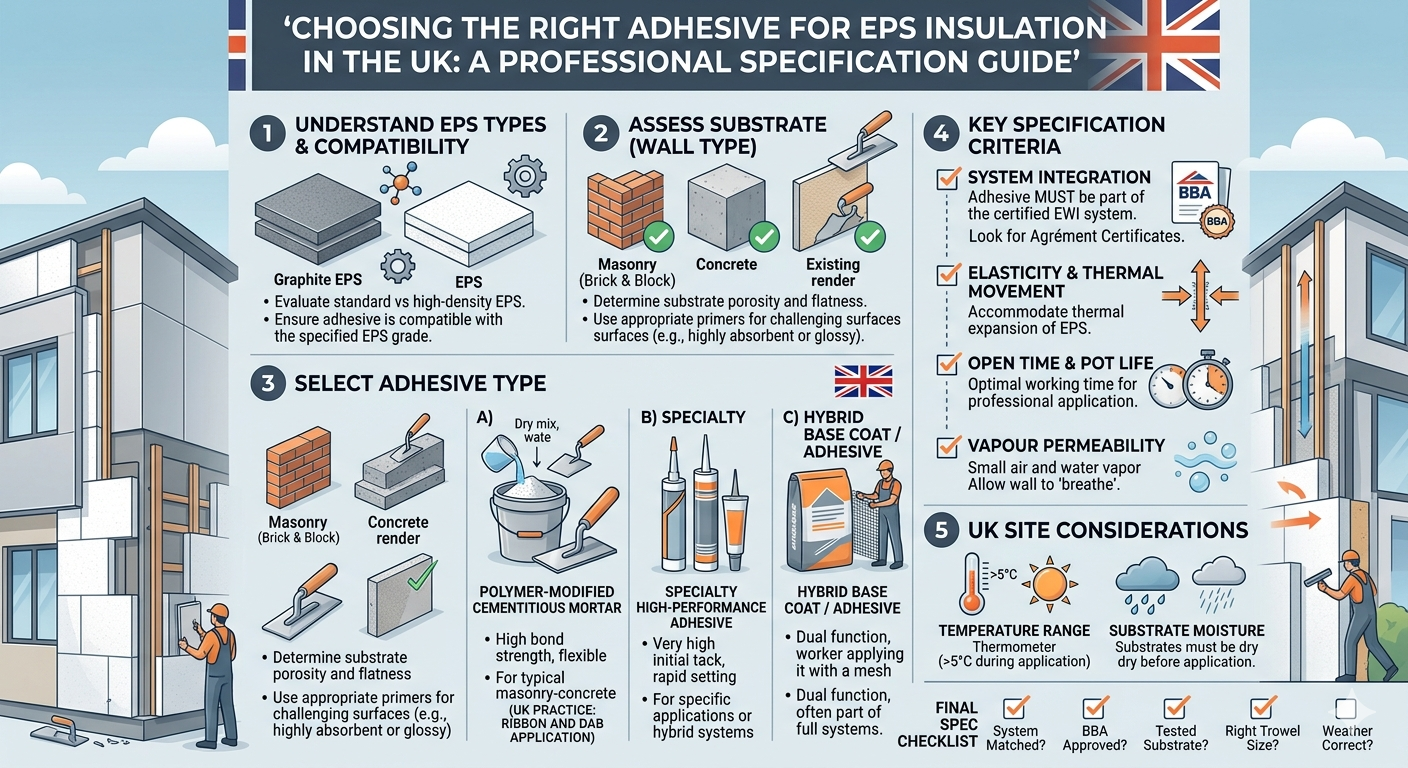
The adhesive holding EPS insulation boards to your wall is the single layer you never see once the render is finished — and the one most likely to cause expensive failures if it is specified incorrectly. Whether you are an installer comparing cementitious mortar with polyurethane foam, a developer writing a facade specification, or a homeowner planning your first external wall insulation project, this guide covers the technical and practical factors that matter on UK building sites in 2026. From product chemistry and substrate compatibility to coverage calculations and cold-weather application, every section is written to help you choose the right adhesive for EPS insulation with confidence.
With the Future Homes Standard now mandating wall U-values of 0.18 W/m²K, insulation thicknesses have increased significantly across residential and commercial sectors. Thicker boards demand higher adhesive performance — greater pull-off strength, better open time, and improved resistance to thermal cycling. Understanding the differences between cementitious mortars, polyurethane foams, and dual-purpose base coat adhesives is no longer optional; it is a core competency for any installer working within BBA-certified or ETA-approved systems on UK building sites.
Understanding EPS Adhesive Types for UK EWI Systems
The UK market offers three principal adhesive technologies for EPS-based External Thermal Insulation Composite Systems, each engineered for distinct project conditions. Cementitious mortars remain the most widely specified category, formulated from Portland cement blended with polymer dispersions, fine aggregates, and — in premium products — structural micro-fibres that inhibit crack propagation during the critical first curing phase. Products such as Atlas Hoter U and Ceresit ZU fall into this category, providing both board-bonding and mesh-embedding capability in a single 25 kg bag. Their mineral composition ensures high vapour permeability, allowing moisture to migrate outward through the wall build-up, and they deliver adhesion values typically between 0.08 and 0.25 MPa to EPS substrates when applied within the manufacturer's specified thickness range of 2–5 mm.
Polyurethane foam adhesives represent the second major category and have gained substantial traction on UK sites since 2024. Ceresit CT84, for example, bonds EPS boards at temperatures as low as 0 °C, cures to handling strength within approximately two hours, and yields around 10 m² per 850 ml canister — a coverage rate that is roughly double that of an equivalent weight of cementitious mortar. The lightweight nature of the cured foam (approximately 100 g per m² versus 5 kg per m² for cement-based products) also reduces dead load on the facade, which is a genuine advantage when insulating timber-frame structures or lightweight masonry above DPC level. The trade-off is that foam adhesives are generally supplemented with mechanical fixings in exposed locations, and they are not always accepted as the sole fixing method within certain BBA system certificates.
The third category — dedicated mesh-embedding base coats — serves a different function within the system stack. While many cementitious adhesives are marketed as "2-in-1" solutions, certain specifications call for a separate base coat optimised specifically for the reinforced render layer. These products are formulated with a finer aggregate grading and higher polymer content to achieve a smoother finish surface that accepts the topcoat render more uniformly. On large-scale projects where sprayed application is the norm, a dedicated base coat can improve productivity by reducing the number of passes required to achieve the specified 3–5 mm reinforced layer thickness.
The table below summarises the three adhesive types side by side — use it to match your project conditions to the right product category before reading further.
| Adhesive Type | Primary Function | Typical Coverage | Open Time | Min. Application Temperature |
|---|---|---|---|---|
| Cementitious Mortar (2-in-1) | Board bonding and mesh embedding | 4.0–5.0 kg/m² (bonding); 3.0–4.0 kg/m² (mesh) | 25–30 min | +5 °C |
| Polyurethane Foam | Board bonding only | ~10 m² per 850 ml canister | 5–10 min | 0 °C |
| Dedicated Base Coat | Mesh embedding and surface preparation | 3.0–4.5 kg/m² | 20–30 min | +5 °C |
Matching Adhesive to Substrate and Board Type
The single most common specification error on UK EWI projects is selecting an adhesive based solely on price or brand familiarity without assessing the substrate condition. A fibre-enhanced cementitious mortar like Atlas Hoter U — which permits EPS board thicknesses up to 500 mm and XPS up to 200 mm — is designed for stable, mineral-based backgrounds: blockwork, brick, concrete, and cement render in sound condition. On these substrates, the perimeter-and-dab or full-bed application method ensures at least 40 % surface contact (the BBA minimum), with best practice pushing that figure to 60 % or above to eliminate air pockets where interstitial condensation could form. Where the substrate is painted, the installer must carry out a cross-hatch adhesion test before specifying any adhesive; if the existing coating fails, mechanical preparation — scarification or high-pressure washing followed by a consolidating primer — is mandatory before the adhesive is applied.
For substrates that present particular challenges — chalky renders, old masonry paints with poor adhesion, or highly absorbent aerated concrete blocks — a specialist bonding primer applied 24 hours in advance significantly improves pull-off performance. In these situations, the adhesive alone cannot compensate for a weak boundary layer, and skipping the primer stage is a false economy that risks delamination within the first heating season. On timber-frame and SIP-panel structures, polyurethane foam adhesives are frequently the better choice because they bond directly to OSB and plywood sheathing boards without the moisture-related swelling risk that a wet cementitious mortar can introduce to a timber substrate.
Key Takeaway: BBA system certificates require a minimum of 40 % adhesive surface contact between the EPS board and the substrate, but achieving 60 % or above is recommended to prevent air looping and interstitial condensation — the leading cause of hidden mould growth behind insulation on solid-wall retrofits in the UK.
Board type also influences adhesive selection. Standard white EPS and graphite EPS boards are compatible with all three adhesive categories, but XPS boards — with their closed-cell, non-absorbent surface — require either a mechanical key (light sanding) or a polyurethane foam formulated specifically for XPS, such as Ceresit CT84 XPS. Applying a standard cementitious mortar to an unprepared XPS surface will produce initial adhesion that appears adequate during installation but degrades rapidly under thermal cycling, because the cement paste cannot penetrate the smooth, hydrophobic skin of the extruded polystyrene. This is a well-documented failure mode that comparative insulation guides consistently highlight when distinguishing between EPS and XPS system requirements.
Coverage Calculations and Material Planning
Accurate material estimation prevents both waste and the dangerous practice of "thinning out" the adhesive bed to stretch a short order across the remaining elevation. For cementitious 2-in-1 mortars, the board-bonding stage typically consumes 4.0–5.0 kg/m² when applied by the perimeter-and-dab method at the standard 10 mm bed thickness. On a 100 m² facade, that translates to 400–500 kg — or 16–20 bags of 25 kg mortar — for the bonding stage alone. Add the mesh-embedding stage at 3.0–4.0 kg/m² (a further 12–16 bags) and the total adhesive requirement for a fully reinforced system reaches approximately 7.0–9.0 kg/m², meaning 28–36 bags of 25 kg mortar per 100 m² of facade before accounting for substrate irregularities. For context, a typical three-bedroom semi-detached house has approximately 60–80 m² of insulated facade area, requiring roughly 17–29 bags of adhesive for the complete bonding and mesh-embedding stages — most three-bedroom semis fall in the 20–25 bag range on a reasonably flat substrate. As a practical ordering rule, allow 28–36 bags per 100 m² for a reasonably flat facade, then add a further 20–30 % if the wall needs dubbing out or local levelling.
Polyurethane foam adhesives simplify the calculation considerably. A single 850 ml canister of Ceresit CT84 covers approximately 10 m², so a 100 m² project requires around 10 canisters for the bonding stage alone. However, the installer must still account for the cementitious base coat and mesh-embedding stage, which foam does not replace. The net material saving therefore applies only to the bonding phase, though the labour saving — no mixing, no water supply, no bucket cleaning — can reduce overall installation time by up to a full day on a typical semi-detached house. For projects running tight winter schedules, this time advantage often justifies the higher per-unit cost of foam over traditional mortar.
Pot life and open time are the two parameters most frequently misunderstood on site. Pot life refers to how long the mixed mortar remains workable in the bucket — typically around four hours for Atlas Hoter U at +20 °C. Open time refers to how long the applied adhesive remains tacky enough to accept the board after it has been spread on the substrate — usually 25–30 minutes under the same conditions. In hot summer weather, both values shorten dramatically, and boards pressed onto adhesive that has skinned over will not achieve the specified pull-off strength. The practical rule is to mix only what the team can apply within 30 minutes and to work in the shade of the building wherever possible during July and August.
Temperature, Curing, and Seasonal Considerations
The British climate imposes constraints on adhesive application that continental European TDS documents rarely address in sufficient detail. Most cementitious EPS adhesives require an ambient and substrate temperature of at least +5 °C, with no frost forecast within 24–48 hours of application. On a north-facing elevation in February, the masonry surface temperature can sit at +2 °C even when the air temperature reads +7 °C on the thermometer, because the brickwork retains overnight cold well into mid-morning. Checking the substrate with an infrared thermometer — not just the ambient air — is a non-negotiable step that separates compliant installations from warranty claims. When working within these marginal conditions, Future Homes Standard compliance guidance emphasises the importance of documented temperature logs as part of the installation's "Golden Thread" quality record.
Polyurethane foam adhesives offer a genuine advantage during the extended UK winter season. Ceresit CT84 is rated for application at 0 °C, and its chemical curing mechanism — a moisture-activated polyurethane reaction — is not dependent on water evaporation in the same way that a cementitious mortar is. This means that high humidity, which would stall the drying of a traditional adhesive, actually accelerates the curing of a PU foam. For projects that must continue through November to March without protective heated enclosures, foam adhesives effectively extend the viable working season by two to three months. The trade-off is that the foam sets quickly and repositioning a board after initial contact is difficult, so accurate setting-out and board cutting must be completed before application begins.
Curing time also affects the scheduling of subsequent trades. After bonding with cementitious mortar, the adhesive typically requires 48–72 hours before mechanical fixings can be installed and the reinforced base coat applied. With PU foam, this wait drops to approximately two hours, meaning that on a well-organised site, one team can bond boards in the morning and the same team can begin mechanical fixing and mesh embedding in the afternoon. Over the course of a multi-elevation project, this compressed cycle can save three to five working days — a meaningful difference when scaffolding hire is charged by the week and weather windows in the UK are notoriously short.
Moisture management during curing deserves particular attention on solid-wall retrofits. If the adhesive bed traps moisture against a porous Victorian brick substrate, the subsequent insulation layer can seal that moisture into the wall fabric, creating exactly the interstitial condensation conditions that the system is designed to prevent. Allowing the adhesive to cure fully — and the substrate to reach equilibrium moisture content — before applying the insulation is a principle that experienced installers respect but tight project schedules often compress. When in doubt, a simple hand-held moisture meter reading of the substrate surface provides objective reassurance that conditions are within the adhesive manufacturer's specified limits — and a dated photograph of the reading adds a valuable record to the project's quality file should any warranty question arise later.
Summary and Specification Checklist
Choose cementitious 2-in-1 adhesive for most brick, block, and concrete facades; choose polyurethane foam where temperatures are low, the programme is tight, or the substrate is timber-based; and choose a dedicated base coat where the specification separates bonding from mesh embedding. Before ordering, confirm your substrate type, expected application temperature, total square metreage, and whether you also need primer, mesh, fixings, and topcoat render — if you are unsure about any of these, your adhesive supplier or EWI installer can advise based on a photograph of the existing wall surface. Whichever technology the project demands, the fundamentals remain constant: assess the substrate, verify the temperature, calculate the coverage, and allow full curing before proceeding to the next layer. For UK installers and specifiers sourcing fibre-enhanced cementitious adhesives, polyurethane foams, and mesh-embedding base coats with next-day delivery, the Renders World EPS adhesives and basecoats range covers every system configuration from single-dwelling retrofits to multi-block new builds, with coverage rates from 3.0 kg/m² to 10 m² per canister depending on the adhesive type selected.
Frequently Asked Questions
Can I use the same adhesive to bond EPS boards and embed fibreglass mesh?
Yes, most premium cementitious adhesives in the UK market are formulated as dual-purpose products. Atlas Hoter U and Ceresit ZU, for example, are both certified for board bonding and mesh embedding within their respective ETICS system approvals. The bonding stage uses a thicker application — typically 10 mm dabs or a full bed — while the mesh-embedding stage uses a thinner 3–5 mm skim. Using a single product for both stages simplifies site logistics and reduces the risk of compatibility issues between layers.
How do I know whether to use cementitious mortar or polyurethane foam on my project?
The decision hinges on three factors: substrate type, working temperature, and programme constraints. Cementitious mortar is the default for mineral substrates (brick, block, concrete) at temperatures above +5 °C. Polyurethane foam is the better choice when the substrate is timber-based, the temperature is between 0 °C and +5 °C, or the programme requires rapid curing to keep the project on schedule during winter months. Both technologies deliver compliant results when applied within their specified parameters.
Can I apply EPS adhesive myself as a DIY project?
Bonding EPS boards with cementitious mortar or polyurethane foam is technically straightforward, but achieving the 40 % minimum adhesive contact required by BBA system certificates — and ensuring the substrate is properly prepared — demands experience that most first-time applicators do not have. For a single-storey garden wall or outbuilding, a competent DIYer can achieve good results by following the manufacturer's TDS carefully. For a full house facade, hiring an experienced EWI installer is strongly recommended to protect both the warranty and the long-term performance of the system.
What else do I need besides the adhesive?
In most EPS-based EWI systems, the adhesive is only one component of the full material order. A typical installation also requires EPS insulation boards, fibreglass reinforcing mesh, mechanical fixings to supplement the adhesive bond, a primer where required by the substrate condition or topcoat system, and the final silicone or silicate render finish. If you are using polyurethane foam for the board-bonding stage, you will still need a separate cementitious base coat for the mesh-embedding layer. As a quick sense-check, a full cementitious bonding-and-mesh system typically needs 28–36 bags per 100 m² on a flat facade, while polyurethane foam still needs a separate cementitious base coat for mesh embedding. Ordering all components from a single supplier ensures system compatibility and simplifies delivery logistics.
What happens if the adhesive bed is too thin or coverage is insufficient?
Insufficient adhesive coverage is the most common cause of board detachment and facade failure in the UK. BBA system certificates mandate a minimum of 40 % surface contact between the adhesive and the board. If coverage falls below this threshold, thermal cycling causes differential movement between bonded and unbonded zones, leading to visible cracking in the render finish and, in severe cases, complete delamination of the insulation layer. The straightforward prevention is to use the correct quantity per square metre as specified in the product TDS and to visually inspect adhesive transfer on the back of each board immediately after pressing it into position.